



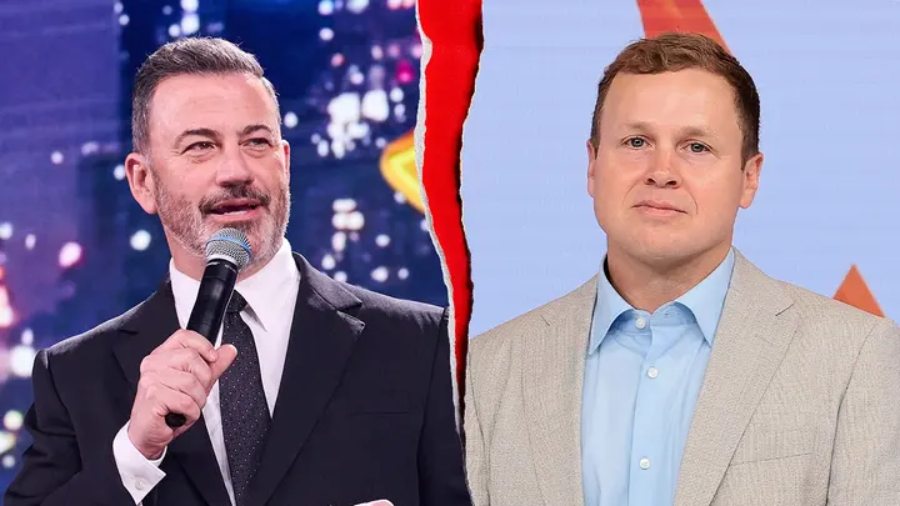
A late-night jab at Spencer Pratt’s Los Angeles mayoral campaign turned into a reminder of one of Jimmy Kimmel’s most damaging past controversies.
Kimmel mocked Pratt on Wednesday night’s show as the former reality television figure continued his bid to challenge incumbent Los Angeles Mayor Karen Bass. Pratt responded not with a campaign statement, but with a screenshot from Kimmel’s past: the host wearing blackface while impersonating former NBA star Karl Malone on “The Man Show” in the early 2000s.
The exchange pushed a local mayoral race into a broader media fight about celebrity politics, public memory and whether old scandals can be used as weapons when entertainers enter political commentary.
Kimmel framed Pratt’s candidacy as a punchline during a segment about the Los Angeles mayoral election.
He joked that it might take Democrats in Los Angeles time to figure out which of their friends had “secretly voted for Spencer Pratt,” a reference to California’s lengthy vote-counting process in recent elections.
Kimmel then described Pratt as a “former reality show villain” and suggested Los Angeles voters could face a choice between “a woman named Karen and a man who is one,” referring to Mayor Karen Bass and using the “Karen” insult aimed at demanding or entitled behavior.
He went further, saying Pratt should not be a top-two finalist for mayor and should instead be “DJing the worst New Year’s Eve party in Reno.”
Pratt’s Response
Pratt answered by resurfacing a photo from Kimmel’s earlier career.
The image showed Kimmel in blackface during his impersonation of Karl Malone on “The Man Show.” The old sketch has been widely criticized in recent years and remains one of the most controversial episodes in Kimmel’s entertainment history.
By posting the image, Pratt attempted to turn the scrutiny back on Kimmel. The response suggested that Kimmel’s own past should be part of the conversation if he is going to attack Pratt’s public image.
The move also reflected how quickly modern campaign fights can shift from policy arguments to cultural and personal counterattacks.
Kimmel has previously apologized for the blackface sketch.
In a past statement, he said the intent had been to imitate Karl Malone as closely as possible, and that he did not consider at the time that the performance would be viewed as anything other than an impression of another person.
He said the impersonation was not meant to be about Malone’s skin color any more than it was about Malone’s muscles or bald head.
Kimmel also acknowledged that many of those sketches were embarrassing in retrospect. He said it frustrated him that the moments had become a weapon used by critics to diminish his commentary on social and other injustices.
He apologized to those he had disappointed, while also saying he would not be bullied into silence by people he accused of using outrage for political purposes.
Pratt’s Mayoral Campaign
Pratt’s run for mayor has drawn attention because of his unusual path from reality television to local politics.
The former “Hills” personality launched his campaign after losing his home in the 2025 Palisades wildfire, a disaster that became a major point of criticism against Bass’s administration. AP reported that Bass advanced to the November runoff after a first term marked by the destructive wildfire and continuing homelessness challenges, while early returns showed Pratt in second place as votes continued to be counted.
Pratt has built his campaign around frustration with city leadership, especially over wildfire response, homelessness and infrastructure. The Guardian reported that Bass advanced after failing to clear the 50% threshold needed to avoid a runoff, while Pratt and City Council member Nithya Raman remained in the fight for the second runoff spot as ballots were still being tallied.
That uncertainty has made every media moment around Pratt more politically charged.
The Bass Factor
Bass remains the central figure in the race.
She is seeking another term as Los Angeles mayor after a difficult period that included the Palisades wildfire and persistent pressure over homelessness. AP reported that Bass has defended her record, pointing to reductions in homelessness and a historically low homicide rate, while retaining support from major Democratic figures including Vice President Kamala Harris and Gov. Gavin Newsom.
Pratt’s campaign has tried to frame Bass as disconnected from the city’s most urgent problems. Kimmel’s comments, in turn, treated Pratt’s candidacy as unserious and celebrity-driven.
The result is a race where entertainment, anger and local policy have become difficult to separate.
Why the Exchange Matters
The fight matters because it shows how Los Angeles politics is being filtered through celebrity culture.
Pratt is not a traditional candidate, and Kimmel is not a traditional political opponent. But both men have large public platforms, and their exchange immediately widened the audience for a city election.
Kimmel’s joke was aimed at Pratt’s credibility. Pratt’s response was aimed at Kimmel’s moral authority.
That dynamic captures a larger feature of modern politics: personal histories, old clips and viral images can become campaign ammunition within minutes.
Spencer Pratt’s response to Jimmy Kimmel was not a policy rebuttal. It was a cultural counterpunch.
Kimmel mocked Pratt’s mayoral campaign as absurd and unfit for Los Angeles. Pratt answered by resurfacing Kimmel’s blackface controversy, forcing the conversation away from late-night comedy and back toward the host’s own record.
As the Los Angeles mayoral race moves toward a runoff fight, the exchange shows how unpredictable the contest has become. What began as a joke about a reality TV star running for mayor quickly turned into a reminder that in celebrity-driven politics, no one’s past stays buried for long.