



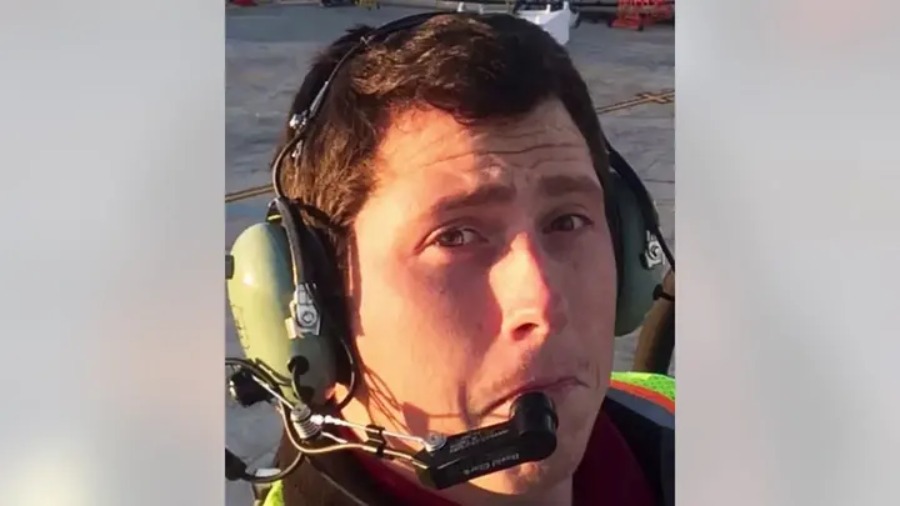
Patricia Gillespie is an Emmy Award-winning documentary director. She has told difficult stories before. But when she first heard the air traffic control recordings from August 2018 — the voice of a 29-year-old ground service agent flying a stolen commercial turboprop over the waters of Puget Sound, cracking jokes, apologizing to the people he loved, and waiting to die — she found herself unable to move on.
“When I heard these recordings, they really struck a chord with me,” Gillespie told Fox News Digital. “He just sounded like guys I knew back home, especially when he was talking about his work life, minimum wage and some of the frustrations he felt surrounding employment — and the fact that he couldn’t talk about the tough feelings he was having. It bewitched me. I couldn’t stop thinking about it.”
The result of that compulsion is “#SKYKING” — a new documentary from ABC News Studios, now streaming on Hulu and Hulu on Disney+, that offers the most complete portrait yet of Richard “Beebo” Russell and the hour that ended his life.
What Happened on August 11, 2018
On a summer evening in 2018, Russell clocked in for his shift as a ground service agent at Seattle-Tacoma International Airport — a job he had held for roughly three and a half years with Horizon Air. Instead of performing his usual duties, he boarded an unattended Bombardier Q400 turboprop, figured out enough of the controls to taxi and take off, and became airborne without authorization.
For more than an hour, he communicated with air traffic controllers who attempted to talk him down. He told them he didn’t want to hurt anyone. He kept the aircraft away from populated areas. He joked with the controllers — at one point asking if Alaska Airlines would hire him as a pilot if he landed safely, and answering his own question with a wry racial remark that would later be stripped of its context and weaponized online by commentators on both sides of the political spectrum.
“People who are very far to the other end of the spectrum were saying he’s a domestic terrorist hell-bent on destruction, which turned out not to be accurate,” Gillespie said. “Really unsavory characters, like actual White supremacists, are saying he’s their poster boy, which was completely inaccurate. But when I heard those words, and I saw how they were being taken in context, I had a sense that there was information missing.”
That missing information is what the documentary set out to find.
Before the plane went down, Russell attempted a barrel roll — a maneuver that, remarkably, he partially executed. Then he pointed the nose toward the earth.
“I think I’m going to try to do a barrel roll, and if that goes good, I’ll go nose down and call it a night,” he said from the cockpit.
The Q400 struck the woods of Ketron Island, sparking a two-acre fire. The FBI determined Russell died of “multiple traumatic injuries.” No one else was killed. Authorities later noted that Russell had flown near Safeco Field, where tens of thousands of people were gathering for a sold-out Pearl Jam concert — and that he had chosen not to fly toward it.
The Man Nobody Fully Saw Coming
The documentary draws on interviews with Russell’s family and friends — many speaking publicly for the first time — to construct a portrait of a man who concealed his suffering behind a personality that everyone around him found warm, funny, and grounded.
Russell was born in the Florida Keys and raised in Wasilla, Alaska. He was a beloved high school football player. He met his wife Hannah through a Christian youth program, married her in 2012, and the two eventually moved to Washington, where they opened a bakery together.
On his personal blog, Russell posted videos of his travels and spoke cheerfully about his airport work.
“I lift a lot of bags,” he said in one video. “Like a lot of bags. So many bags.”
His employer reported no significant personnel issues. Coworkers described him as quiet and reliable. His social media presence offered nothing that would have predicted what came next.
But FBI records, cited by The Associated Press, told a more complicated story beneath the surface. A week before the theft, Russell had missed work and expressed to people close to him that he felt he was “not living up to what others expected of him.” Loved ones attempted an intervention. He seemed to recover. And then, four days later, he walked onto the tarmac and changed everything.
Records indicated he had searched flight simulator resources in the days preceding the incident.
What the Recordings Reveal
Flying over the Olympic Mountains, Russell made an admission into the radio that Gillespie said continues to stay with her.
“I got a lot of people that care about me, and it’s going to disappoint them to hear that I did this,” Russell said. “I would like to apologize to each and every one of them. Just a broken guy. Got a few screws loose, I guess. Never really knew it till now.”
His final transmission suggested he was aware his fuel was nearly gone.
“Not for long. I feel like one of my engines is going out or something,” he said.
Among the other lines Gillespie found most revealing was Russell’s comment about his wages.
“If you ask me why I did it, blame it on not making minimum wage. We’ll chalk it up to that. Maybe that’ll grease the gears for the higher-ups,” he said.
“I have heard that at dinner. Not just from my male friends,” Gillespie told Fox News Digital.
She was careful to contextualize what Russell was expressing — not as ideology, but as accumulated personal pressure.
“He was not making a statement about feeling oppressed as a White guy. It sounds like a statement about things that had been said to him at work. And it’s scary to me that that story rarely got uncovered because the internet machine was so quick to politicize it instead of acting with curiosity and asking how these words ended up coming out of this person.”
A Generation’s Weight
Gillespie returned repeatedly in her interviews to a theme she believes the Russell story illuminates about a generation of working Americans — men in particular — who are quietly carrying a weight they feel they cannot put down or talk about.
Russell’s aunt articulated it in the documentary in terms Gillespie found particularly precise.
“This idea of an American dream — you can provide for your wife, you can have two cars in the driveway, a house, a white picket fence — you can do this on one income. And that’s just not the reality we’re living in anymore,” the aunt said.
Russell’s brother Phil offered the line that Gillespie said broke her heart in the editing room.
“He could have been anything he wanted to be,” Phil said — including, perhaps, a pilot.
“This idea that if he’d just believed in himself, if he just believed he was living in an America where guys like him could win,” Gillespie reflected. “The reality is they’re not failing. The economy is failing in this way, and they have to figure it out. And we don’t talk about these things, frankly.”
Eight years after that August evening, the people who loved Richard Russell are still living with what happened. Gillespie was direct about the documentary’s intended purpose.
“Suicide doesn’t end pain. It passes on to your loved ones,” she said. “But I also think the family wants his story to be a force for good in helping people like him get the help they need so that other families don’t have to go through what they’ve been through.”
In a statement, Russell’s family said they were “stunned and heartbroken” by what happened — and that it was clear he hadn’t intended to harm anyone else. They echoed what he himself said from the cockpit: that there were so many people who loved him.
He just couldn’t hold onto that truth when it mattered most.