



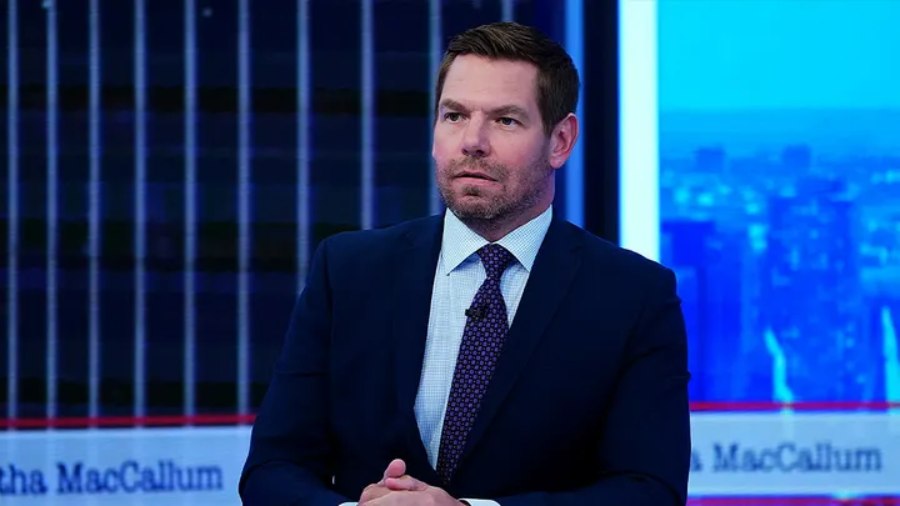
Forty-eight hours after a San Francisco Chronicle report detailed graphic sexual misconduct allegations against him, Rep. Eric Swalwell made it official: he is out of the race for California governor.
In a statement posted to X on Sunday, the California Democrat apologized to those closest to him while maintaining that the allegations against him are false — and framing his exit as a protective measure for the campaign rather than an admission of wrongdoing.
“I am suspending my campaign for Governor,” Swalwell wrote. “To my family, staff, friends, and supporters, I am deeply sorry for mistakes in judgment I’ve made in my past.”
“I will fight the serious, false allegations that have been made — but that’s my fight, not a campaign’s,” he added.
The pressure that built over the 48 hours preceding Swalwell’s announcement was swift, broad, and came from within his own party.
The San Francisco Chronicle’s Friday report — the first firsthand public account from a former female staffer — described allegations including Swalwell pursuing intoxicated women, pressuring employees into intimate situations, and soliciting explicit photographs from female contacts. CNN separately reported it had spoken to three additional women who alleged various forms of sexual misconduct, including receiving unsolicited explicit messages and nude images from the congressman.
Former House Speaker Nancy Pelosi, D-Calif., stopped short of explicitly demanding his withdrawal but made her position clear in a statement to NBC.
“The young woman who has made serious allegations against Congressman Swalwell must be respected and heard. This extremely sensitive matter must be appropriately investigated with full transparency and accountability. As I discussed with Congressman Swalwell, it is clear that this is best done outside of a gubernatorial campaign,” Pelosi said.
The message was unmistakable even without the explicit demand.
Sen. Ruben Gallego, D-Ariz. — who had actively defended Swalwell on social media just days earlier — reversed course entirely.
“I’ve read the San Francisco Chronicle’s reporting, and I take it seriously. What is described is indefensible. Women who come forward with accounts like this deserve to be heard with respect, not questioned or dismissed,” Gallego wrote on X.
Rep. Ted Lieu, a member of the House Judiciary Committee, also formally withdrew his endorsement.
“In light of the recent allegations against Representative Eric Swalwell, I am withdrawing my endorsement of his campaign for Governor,” Lieu said.
A House Republican also announced plans to file a motion to remove Swalwell from Congress — adding a potential institutional dimension to his legal and political problems that extended well beyond the governor’s race.
How It Started
The allegations against Swalwell did not originate with the Chronicle report. They had been circulating in Democratic political circles for weeks before mainstream publication.
Cheyenne Hunt, a former Capitol Hill staffer and political media personality, first began publicly amplifying accounts from women who alleged sexual misconduct by Swalwell earlier this month.
“The Democratic candidate currently leading in the California governor’s race has a known history of being predatory towards women,” Hunt wrote in a social media post.
Swalwell’s campaign initially stayed silent. When his office finally responded — in comments to the New York Post earlier this week — his spokesperson Micah Beasley was dismissive.
“This false, outrageous rumor is being spread 27 days before an election begins by flailing opponents who have sadly teamed up with MAGA conspiracy theorists because they know Eric Swalwell is the frontrunner in this race,” Beasley said.
Two days later, that frontrunner had suspended his campaign.
A Race Turned Upside Down
Swalwell’s exit leaves a significant hole in the Democratic field — and a reshuffled competitive landscape heading into the June 2 primary, with early voting beginning May 4.
He had been the top-polling Democrat in the race, ahead of former Rep. Katie Porter and billionaire Tom Steyer, who has spent heavily on advertising since entering the race in November. Both Porter and Steyer had called on Swalwell to drop out and resign from Congress before his Sunday announcement.
The remaining Democratic field is substantial. Former Health and Human Services Secretary Xavier Becerra and former Los Angeles Mayor Antonio Villaraigosa are also competing, creating a crowded contest for the party’s top-two primary finish.
On the Republican side, conservative commentator and former Fox News host Steve Hilton — endorsed by President Trump last weekend — and Riverside County Sheriff Chad Bianco are the two major candidates. Despite Trump’s backing, Hilton was unable to clear the 60% delegate threshold needed to secure the California GOP’s official endorsement at the party’s annual convention this weekend. Neither Hilton nor Bianco crossed that threshold.
Under California’s jungle primary system, Democrats and Republicans appear on the same ballot in June, with the top two finishers — regardless of party — advancing to the November general election.
What Comes Next for Swalwell
Swalwell remains a sitting member of Congress — though calls for his resignation from that seat, including from within his own party, are growing. His statement made clear he intends to contest the allegations legally, describing them as “serious, false” claims he will “fight.”
What that fight looks like — legally, institutionally, and politically — will unfold in the weeks ahead. The motion to remove him from Congress, if pursued, would add a formal congressional dimension to an already serious situation.
For now, the California governor’s race moves forward without its one-time frontrunner. The question of who benefits most from Swalwell’s exit — and whether his departure reshuffles the top-two calculus enough to alter the November matchup — will be answered by California voters beginning May 4.
Eric Swalwell entered the California governor’s race as the frontrunner. He exits it under a cloud of sexual misconduct allegations, with prominent members of his own party having publicly abandoned him, and with legal and congressional challenges still ahead. His apology for “mistakes in judgment” — offered alongside a continued denial of the core allegations — leaves the full truth of what occurred unsettled. For California’s Democratic Party, the task now is to consolidate behind a candidate capable of advancing through a June 2 primary that just got considerably more unpredictable.