



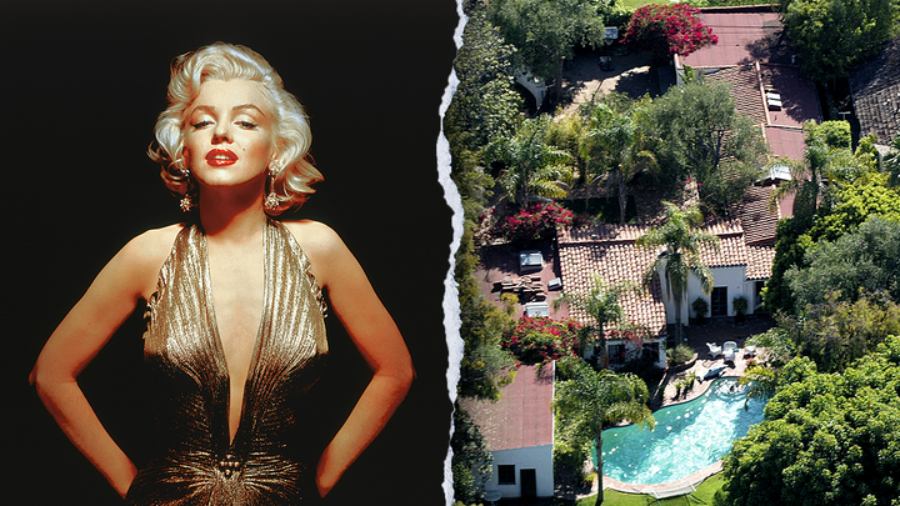
When Brinah Milstein and Roy Bank paid $8 million for a 2,300-square-foot Spanish bungalow in Brentwood, California in 2023, they had a straightforward plan: demolish the deteriorating structures on the property and redevelop the site. The permits came through. The timeline looked clear.
Then, in a sequence of events that began the day after their demolition permits were issued, the city of Los Angeles changed everything.
The couple is now in federal court, arguing that the city’s decision to declare the property — the former home of Marilyn Monroe — a historic-cultural monument constitutes an unconstitutional seizure of private property without the compensation the Fifth Amendment requires.
The Property’s History — and Its Condition
Monroe purchased the Brentwood bungalow in the final months of her life, owning it for approximately six months before her death in 1962. It was the only home she ever owned.
By the time Milstein and Bank acquired the property, however, the bungalow had passed through the hands of 14 previous owners and undergone significant alterations. The couple’s federal complaint describes the property as being in declining condition — changed enough over the decades that its connection to Monroe, they argue, is primarily historical association rather than preserved authenticity.
The demolition and grading permits were issued on September 7, 2023. The following day — September 8, 2023 — the Los Angeles City Council initiated proceedings to designate the property a historic-cultural monument, responding to pressure from Monroe fans and historians who wanted the demolition stopped.
The formal designation came in June 2024, when the council voted to confer historic-cultural monument status on the site.
What the Designation Has Cost Them
The legal and financial consequences for Milstein and Bank have been substantial.
Their property sits unusable — they cannot demolish it, cannot meaningfully repair it, cannot build on it, and, they say, cannot sell it to anyone who could do those things either. According to the complaint, the historic-cultural designation has rendered the home’s market value “zero or a negative amount.”
In the meantime, the financial bleeding continues. The lawsuit documents:
$30,000 in permit costs. Hundreds of thousands of dollars in security expenses — driven by what the owners describe as a steady stream of tourists and multiple break-ins since the designation transformed the property into an informal attraction. Millions of dollars in attorneys’ fees. And more than $100,000 per year in property taxes, insurance, and utility costs for a property they are legally barred from using as intended.
“They couldn’t demolish, couldn’t repair, couldn’t build and couldn’t sell to someone who could. The city had effectively turned their private property into a public monument without paying for it,” the Pacific Legal Foundation said in a statement announcing it had joined the homeowners’ legal effort.
The Offer the City Refused
Among the details that Milstein and Bank’s legal team have highlighted as particularly significant: the couple made a proactive effort to find a solution that served both their interests and the city’s stated preservation goals.
They offered to fund the relocation of the home themselves — paying to move the structure to another site where it could be converted into a public museum dedicated to Monroe’s legacy.
Los Angeles refused.
The complaint draws on this refusal as evidence that the city’s action was not genuinely oriented around public benefit, noting that the walled-off property is not visible from the street. The legal filing argues that because the site cannot be seen by passing members of the public, designating it a landmark “lacked a public purpose.”
“The City took no action regarding the house’s now-alleged ‘historic’ or ‘cultural’ status, essentially admitting it was neither and that no public good would be served by so designating the house or the Property,” the complaint states.
The federal lawsuit names Los Angeles Mayor Karen Bass and the City of Los Angeles as defendants. Its central legal claim is rooted in the Fifth Amendment’s Takings Clause, which prohibits the government from taking private property for public use without providing just compensation.
Pacific Legal Foundation attorney J. David Breemer framed the argument in terms designed to resonate beyond the specifics of the Monroe property.
“These homeowners have a straightforward request: either let them use their own property or compensate them fairly for turning it into a public monument,” Breemer said. “The Fifth Amendment doesn’t have caveats. If the City of Los Angeles wants a museum, it must pay for one — not force private homeowners to bear the cost and liability.”
The city has filed a motion to dismiss, advancing several counterarguments. Los Angeles contends that Milstein and Bank knew when they purchased the property that it had Monroe associations, attracted tourist attention, and was a candidate for landmark designation. The city further argues the owners have not yet demonstrated a valid constitutional taking claim and have not exhausted the administrative processes available to alter or develop the property.
The owners previously mounted a state court challenge to the designation and lost at the trial court level before bringing the case to federal court.
Mayor Bass’ office and the Los Angeles City Attorney’s Office did not respond to Fox News Digital’s request for comment.
The legal battle over Marilyn Monroe’s former Brentwood home has become something considerably larger than a dispute about one celebrity property. At its core, it raises a question that property rights advocates have been pressing for decades: when a government designates private property a public monument — blocking its use, reducing its value to near zero, and refusing offered compromises — does the Fifth Amendment require compensation? For Milstein and Bank, the answer is clearly yes. For the city of Los Angeles, the matter is still before a judge. The outcome could establish a precedent that matters far beyond the walls of a 2,300-square-foot Spanish bungalow in Brentwood.