



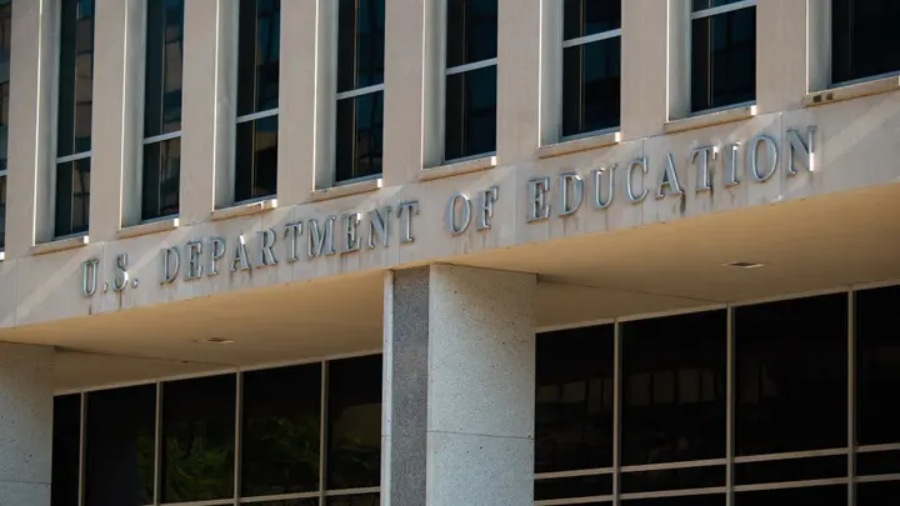
The Trump administration has taken what officials and outside analysts are calling its most consequential action yet in its campaign to eliminate a cabinet-level agency that has existed for nearly five decades.
A newly announced interagency agreement between the Department of Education (ED) and the Treasury Department will transfer responsibility for federal student loan operations to Treasury — a shift in both budget and workforce that experts say fundamentally changes the equation for whether the department can survive at all.
“Characterizing it as the next and largest step toward winding down the Department of Education is absolutely the right way to think about it,” said Nicholas Kent, Undersecretary of Education, in an interview with Fox News Digital.
Under the new arrangement, the Treasury Department will assume operational responsibility for collecting on defaulted federal student loan debt and will provide operational support for the Education Department’s efforts to return delinquent borrowers to active repayment.
The scope of what is being transferred makes this agreement categorically different from anything the administration has done before.
Andrew Gillen of the Cato Institute explained to Fox News Digital that prior interagency agreements have involved relatively modest transfers of function and staff.
“This student loan move — this is the biggest staffing and the biggest budgetary component of the Department of Education,” Gillen said. “If it’s sent over to Treasury, this really does indicate that this is moving a substantial portion of the Department of Education elsewhere.”
Kent agreed without reservation, calling Gillen’s framing accurate.
The scale of what is being handed to Treasury is striking.
According to the Department of Education, the total outstanding federal student loan balance stands at nearly $1.7 trillion. The department also disclosed that fewer than 40% of borrowers have entered into any formal repayment arrangement, while nearly 25% are currently in default.
The administration frames the transfer as a corrective measure, arguing that it will “mitigate the continuing fallout and cost to taxpayers from the Biden Administration’s mismanagement” of the federal student loan portfolio.
Gillen offered a more structural take on the long-term implications.
“This will benefit students by streamlining the aid application and student loan repayment processes and save taxpayers money by reducing losses on student loans,” he said. “Once the move is complete, Education’s biggest budgetary and staffing requirements will be handled elsewhere, which will make it much more feasible to shut down the Department of Education.”
A Campaign Promise Becoming Policy Reality
Eliminating the Department of Education was not a late-cycle talking point for Donald Trump — it was a defining pledge throughout his 2024 presidential campaign. Upon returning to office, Trump signed an executive order directing his administration to begin disbanding the agency.
What followed has been a methodical, phased deconstruction.
“I think we’ve been very clear about this last week that this is a multiphase process,” Kent told Fox News Digital.
The administration describes the interagency agreements as a “proof of concept” — a way of demonstrating to Congress, and to American families, that federal student aid and grant programs can continue functioning even without the Department of Education as their institutional home.
“The Secretary has been on the record saying that these interagency agreements are proof of concept, that we want to show Congress, that we want to show families, we want to show moms and dads and families that the Department of Education does not need to be here for federal grant aid and federal student loans to continue flowing to borrowers,” Kent said.
The numbers Kent cited suggest the administration has moved aggressively since taking office.
According to the Undersecretary, the Department of Education has already been reduced in size by more than 40%. The administration has completed 10 interagency agreements in total, and a number of department staff have been physically relocated to work within other federal agencies.
“We are showing Congress and others that this proof of concept works,” Kent said, “and we want to continue to work with Congress to memorialize these changes in legislation and with the ultimate goal of closing down the department and putting ourselves out of a job.”
Secretary of Education Linda McMahon framed the effort in equally direct terms, describing the reduction of bureaucratic complexity in Washington as “one essential piece of our final mission.”
McMahon said the department is simultaneously conducting a 50-state tour to gather best practices from local education leaders and working to restore what she called “excellence to higher education” — all while partnering with other agencies to transition its core functions outward.
What Happens to Students and Borrowers?
A key question hovering over the administration’s entire effort is whether the students and families who depend on federal financial aid will feel any disruption during — or after — the transition.
The administration’s consistent message has been that the answer is no — that the structural changes are happening at the institutional level and that aid will continue to flow regardless of which federal agency manages the backend.
McMahon has publicly offered reassurances on this front, including to parents of children with special needs who have expressed concern about the future of federal education funding.
Whether Congress ultimately acts to codify the changes into law — formally eliminating the Department of Education through legislation rather than executive action — remains the central uncertainty. The administration has been explicit that legislation is its end goal.
The Supreme Court recently cleared the way for the Trump administration to proceed with significant reductions at the department, removing one major legal obstacle from the path forward.
What is unfolding at the Department of Education is deliberately incremental — and, by the administration’s own account, nearing the point of no return.
With student loan operations moving to Treasury, the department’s largest financial and staffing function is now effectively housed elsewhere. What remains is a diminished institutional shell, reduced by nearly half and shedding responsibilities with each new interagency agreement.
Whether Congress acts to make the dissolution permanent, and how borrowers and states ultimately experience the transition, will define what comes next. For now, the administration’s message is unambiguous: the Department of Education’s days are numbered, and the countdown is accelerating.