



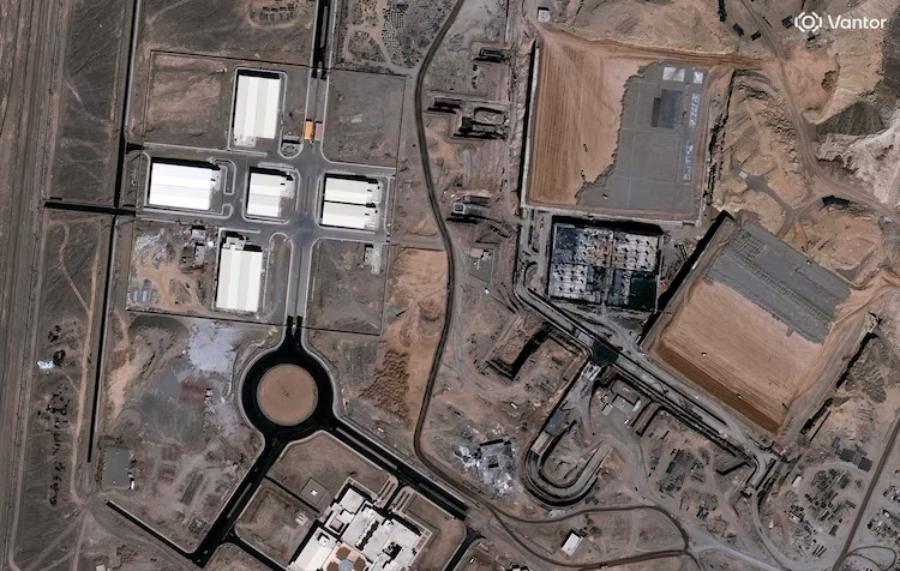
The uranium is buried. The sites have been bombed. And recovering what remains could demand one of the most complex and dangerous special operations missions in modern American military history.
That is the sobering assessment from former senior US defense officials, who say any attempt to physically seize Iran’s stockpile of enriched uranium — believed to be lying beneath nuclear facilities struck by the United States last year — would almost certainly require a substantial American ground force, not a small covert team.
President Donald Trump first raised the possibility publicly on Saturday, telling reporters aboard Air Force One that he was not ruling out the use of US ground troops inside Iran. He added, however, that such a deployment would only happen “for a very good reason.” By Monday, speaking to the New York Post, Trump appeared to dial back the urgency, saying his administration was “nowhere near” any decision on a potential ground operation. “We haven’t made any decision on that,” he said.
Yet the question is no longer purely hypothetical — and the details of what such a mission would entail are sobering.
At the center of this debate is a specific and deeply troubling arithmetic.
Iran currently holds approximately 970 pounds of uranium enriched to 60% purity — far beyond the 3–20% enrichment level considered appropriate for civilian energy use. US officials have stated that this material could be pushed to weapons-grade 90% purity within just one week.
Separately, Iran possesses a further 2,200 pounds of uranium enriched to 20% — material that US officials say could reach weapons-grade levels within three to four weeks.
A US official painted the stakes in stark terms: the combined stockpile, if fully weaponized, would not yield the roughly eleven nuclear devices initially feared — it could produce 40 to 50 bombs.
“They could, literally, within a short period of time — a week to 10 days on the 60%, and maybe a month on the 20% — have 1,500 kilograms of weapons-grade,” the official said, noting that would translate to 40 or 50 weapons.
For years, Tehran maintained that its 60%-enriched uranium was intended for civilian purposes. The United States consistently rejected that claim, arguing that no civilian nuclear program requires enrichment at that level.
‘Operation Midnight Hammer’ and What It Left Behind
Last June, the US military launched “Operation Midnight Hammer,” a strike campaign that President Trump declared had “obliterated” Iran’s nuclear capability. But obliterating the facilities did not eliminate the material inside them.
The enriched uranium is believed to be buried deep beneath the bombed sites — physically present but not easily accessible. It is this subterranean stockpile that now sits at the heart of the debate over whether US forces could — or should — go in to retrieve or destroy it.
Preventing Iran from acquiring a nuclear weapon is one of three core military objectives the Trump administration has outlined from its campaign against Iran. The other two are dismantling Iran’s ballistic missile program and destroying its naval capabilities.
Conventional special operations raids are deliberately lean. A compact assault element executes the objective while a broader perimeter force — supported by air cover — shields the team from counterattack. Speed and minimal footprint are the hallmarks of such missions.
Securing an Iranian nuclear site would break that mold entirely, according to two former US officials.
The scope of the mission — multiple sites, deeply buried materials, and a hostile environment — would demand something far larger. A reasonable initial approach, one former defense official suggested, would involve an airborne force dropping in first to establish a hard security cordon, followed by elite assault units drawn from Joint Special Operations Command (JSOC) to take control of the facilities themselves.
After that would come military engineers tasked with locating and extracting — or destroying — the uranium.
Going in with a larger special operations force is “a reasonable assumption,” the official said, emphasizing that various operational elements would not be mutually exclusive. The mission would begin, as all such operations do, by establishing a security perimeter — ensuring, in the official’s words, that “nothing can get out, and nothing can get in” — while airpower overhead prevents the perimeter from being overrun.
Former Defense Secretary Mark Esper, who held that role during Trump’s first term and appeared on News Nation on Monday, agreed with the assessment that a significant force would be required. He described any uranium-seizure mission in blunt terms: “very perilous, very dangerous.”
Destroy What You Can’t Take
Regardless of whether the administration ultimately opts to extract the uranium or simply deny it to Iran, one former official outlined the likely endgame in unambiguous language.
“You go in, take out what you can take out,” the official said. “If there’s anything left, you blow it up so nobody else can ever use it. Blow it up so completely — and you can do that — so that it’s unusable.”
The decision about the mission’s ultimate goal — full seizure, partial seizure, or destruction — would directly determine how long US forces would need to remain on Iranian soil. That calculation carries profound military and geopolitical consequences.
Mick Mulroy, a former assistant secretary of defense for the Middle East and an ABC News contributor, believes that even staging such an operation raises a fundamental unanswered question: does the US actually know where the material is?
“My question is do we even know where the material is or whether we can get to it since it might be buried,” Mulroy said, underlining that better intelligence would be essential before any boots hit the ground.
His concern points to the most basic challenge of the mission — the uranium isn’t simply sitting in a warehouse. It lies beneath bombed-out facilities, possibly at significant depth and in conditions that remain unclear.
What the IAEA Says
Some clarity came Monday from Rafael Grossi, Director General of the International Atomic Energy Agency, who addressed reporters in Paris. Grossi said the agency’s working assumption is that roughly half of Iran’s 60%-enriched uranium is stored in sealed barrels at Iran’s Isfahan nuclear site.
“That material was in barrels — barrels that were sealed by the IAEA,” Grossi said. “So it remains to be seen whether they are still there, but the widespread assumption is that they are still there.”
That assumption, if correct, offers a potential starting point. But it does not resolve the deeper questions of accessibility, security, or the political will required to act.
The Trump administration has not committed to any ground operation, and the president himself has been deliberately vague. But the combination of a live uranium stockpile, a compressed weaponization timeline, and a bombing campaign that damaged facilities without neutralizing their contents has made the question unavoidable.
Whether the US ultimately moves to seize, destroy, or negotiate the fate of Iran’s enriched uranium, one thing is clear: the window for decision-making is narrow, the risks are severe, and the margin for error — with material capable of producing dozens of nuclear weapons — is essentially zero.