



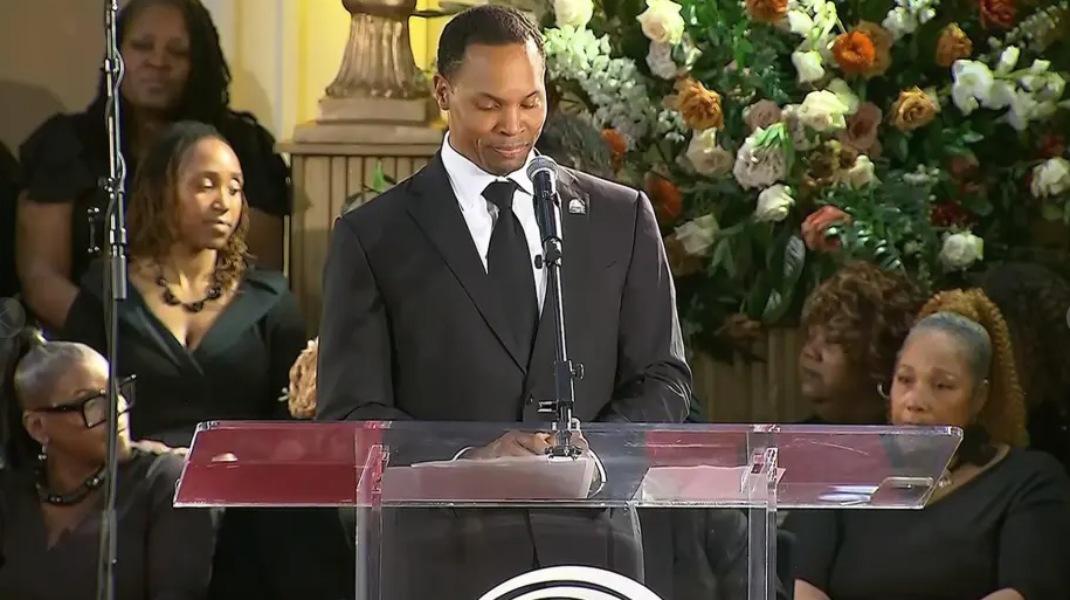
CHICAGO — One day after a nationally televised celebration drew former presidents, sitting governors, and thousands of Chicago residents to honor Rev. Jesse Jackson Sr., his inner circle came together Saturday for something far more personal.
A few hundred family members, longtime allies, and trusted confidants filled the Rainbow PUSH Coalition headquarters on Chicago’s South Side for a homegoing service that served as both a final goodbye and a rallying cry.
The tone was unmistakable from the opening speeches: grief and action were not mutually exclusive.
Yusef Jackson, one of the reverend’s sons and president of the Rainbow PUSH Coalition, told attendees that honoring his father means doing more than mourning him.
“It is appropriate that we respect this season of grief,” he said. “However, it is also appropriate to honor him by stepping up, to step out, and continue his work by answering his call to serve.”
Yusef also noted that the Coalition had recently expanded partnerships with activists in Minnesota, following what he described as the largest-ever Homeland Security operation in that state — a move he framed as a direct extension of his father’s organizing legacy.
U.S. Rep. Jonathan Jackson (D-IL), another of the reverend’s sons, invoked one of his father’s most enduring convictions: “He taught me that any society that will not support the many who are poor will never be able to save the few who are rich.”
The congressman was direct about the hostility his father faced. “My father was attacked for speaking about diversity,” Rep. Jackson said. “He was vilified for his stand on equality.”
A Message to 2028 Presidential Hopefuls
Marc Morial, president of the National Urban League, used the occasion to deliver a pointed message to future political candidates.
Referencing Jackson’s two landmark presidential campaigns, Morial argued that the coalition-building model Jackson pioneered remains essential. “Let the word go out that anyone who would like to be president of the United States in 2028, you’d better study this concept of the rainbow coalition,” he said.
CHICAGO — One day after a nationally televised celebration drew former presidents, sitting governors, and thousands of Chicago residents to honor Rev. Jesse Jackson Sr., his inner circle came together Saturday for something far more personal.
A few hundred family members, longtime allies, and trusted confidants filled the Rainbow PUSH Coalition headquarters on Chicago’s South Side for a homegoing service that served as both a final goodbye and a rallying cry.
The tone was unmistakable from the opening speeches: grief and action were not mutually exclusive.
Yusef Jackson, one of the reverend’s sons and president of the Rainbow PUSH Coalition, told attendees that honoring his father means doing more than mourning him.
“It is appropriate that we respect this season of grief,” he said. “However, it is also appropriate to honor him by stepping up, to step out, and continue his work by answering his call to serve.”
Yusef also noted that the Coalition had recently expanded partnerships with activists in Minnesota, following what he described as the largest-ever Homeland Security operation in that state — a move he framed as a direct extension of his father’s organizing legacy.
U.S. Rep. Jonathan Jackson (D-IL), another of the reverend’s sons, invoked one of his father’s most enduring convictions: “He taught me that any society that will not support the many who are poor will never be able to save the few who are rich.”
The congressman was direct about the hostility his father faced. “My father was attacked for speaking about diversity,” Rep. Jackson said. “He was vilified for his stand on equality.”
A Message to 2028 Presidential Hopefuls
Marc Morial, president of the National Urban League, used the occasion to deliver a pointed message to future political candidates.
Referencing Jackson’s two landmark presidential campaigns, Morial argued that the coalition-building model Jackson pioneered remains essential. “Let the word go out that anyone who would like to be president of the United States in 2028, you’d better study this concept of the rainbow coalition,” he said.
CHICAGO — One day after a nationally televised celebration drew former presidents, sitting governors, and thousands of Chicago residents to honor Rev. Jesse Jackson Sr., his inner circle came together Saturday for something far more personal.
A few hundred family members, longtime allies, and trusted confidants filled the Rainbow PUSH Coalition headquarters on Chicago’s South Side for a homegoing service that served as both a final goodbye and a rallying cry.
The tone was unmistakable from the opening speeches: grief and action were not mutually exclusive.
Yusef Jackson, one of the reverend’s sons and president of the Rainbow PUSH Coalition, told attendees that honoring his father means doing more than mourning him.
“It is appropriate that we respect this season of grief,” he said. “However, it is also appropriate to honor him by stepping up, to step out, and continue his work by answering his call to serve.”
Yusef also noted that the Coalition had recently expanded partnerships with activists in Minnesota, following what he described as the largest-ever Homeland Security operation in that state — a move he framed as a direct extension of his father’s organizing legacy.
U.S. Rep. Jonathan Jackson (D-IL), another of the reverend’s sons, invoked one of his father’s most enduring convictions: “He taught me that any society that will not support the many who are poor will never be able to save the few who are rich.”
The congressman was direct about the hostility his father faced. “My father was attacked for speaking about diversity,” Rep. Jackson said. “He was vilified for his stand on equality.”
A Message to 2028 Presidential Hopefuls
Marc Morial, president of the National Urban League, used the occasion to deliver a pointed message to future political candidates.
Referencing Jackson’s two landmark presidential campaigns, Morial argued that the coalition-building model Jackson pioneered remains essential. “Let the word go out that anyone who would like to be president of the United States in 2028, you’d better study this concept of the rainbow coalition,” he said.
In a gesture that organizers said reflected the reverend’s own beliefs, members of the public who had gathered outside the PUSH headquarters were invited inside to join the service.
Ashley Jackson, the reverend’s youngest daughter, explained what drove that decision. “Dad’s theology was rooted in the belief that every human being carries inherent worth,” she said. “He fought for that truth in places that most people never saw, people whose names never made the news across decades and continents and causes.”
Stevie Wonder, African Heads of State Among Those Paying Tribute
The service was as wide-ranging as Jackson’s life. Stevie Wonder, Opal Staples, Terisa Griffin, Kim Burrell, and other artists performed. Comedian Chris Tucker offered a stand-up set, bringing moments of laughter to an otherwise solemn occasion.
Two sitting African presidents traveled to Chicago to pay their respects — a measure of Jackson’s international reach.
South African President Cyril Ramaphosa, himself a key negotiator in the dismantling of apartheid, credited Jackson with linking the American civil rights movement to the global struggle against racial injustice. “He told the world that the struggle for dignity in the United States was inseparable from the fight against apartheid and injustice in South Africa,” Ramaphosa said, noting that his nation considered Jackson one of their own. Jackson had been a close friend of Nelson Mandela, South Africa’s first Black president.
Felix Tshisekedi, president of the Democratic Republic of the Congo, mourned Jackson as a bridge-builder whose loss extended well beyond America’s borders. “Your mourning is also ours,” Tshisekedi said. “The world has lost a pastor, a champion, a mender of bridges. Africa has lost a faithful, loving son.”
Saturday’s homegoing capped a week of commemorations. Mourners first gathered in Chicago last month as Jackson lay in repose. He then lay in state at the South Carolina State Capitol — a nod to his roots in segregated Greenville, South Carolina, where as a teenager he led a student protest that desegregated a local library.
Planned events in Washington, D.C., were scaled back after House Republican leadership denied a request for Jackson to lie in honor at the U.S. Capitol, citing precedent that restricts the privilege to former presidents and senior military generals.
Jesse Jackson Jr., the reverend’s eldest son and a former congressman now running to reclaim his congressional seat, addressed what he saw as the defining quality of his father’s career: an unwavering commitment to the powerless, regardless of political party.
“He maintained an intense relationship with the political order, not because presidents were white or Black,” he said, “but the demands of speaking to the least of these — those who were disinherited, the dispossessed, the disrespected — demanded a consistent, prophetic voice.”
Fraternity Brothers, Alumni, and Activists Convene at PUSH
The week’s events weren’t limited to Sunday services. On Thursday, the headquarters hosted a memorial gathering for members of Omega Psi Phi Fraternity Inc., of which Jackson was a member, drawing several hundred fraternity brothers. That same evening, a Rainbow PUSH alumni reunion brought together former staffers and collaborators to share memories of the reverend’s presidential campaigns, his work as a hostage negotiator, and his global anti-apartheid activism.
The Rev. Janette Wilson, a senior adviser to Jackson and executive director at Rainbow PUSH, connected the reverend’s legacy to present-day battles. “We’re in a global moment where peace in the world is in jeopardy,” she said, citing proposed cuts to SNAP benefits as one immediate front where Jackson’s spirit of advocacy must carry on.
The commemorations will continue Sunday, when members of the Jackson family and the reverend’s mentees travel to Selma, Alabama, to participate in the annual march marking the 1965 “Bloody Sunday” — the day civil rights marchers were beaten by police on the Edmund Pettus Bridge.
Jackson himself regularly attended the annual march.
Jimmy Coleman, a longtime Jackson aide and Selma native, said the march captures the essence of what Jackson stood for. “Selma has always stood for the basics of what civil rights is, what we are debating in policy,” Coleman said. “He was always focused on what we needed in terms of policy in any given political moment, and that’s what the march represents.” From the South Side of Chicago to the halls of power in Pretoria and Kinshasa, the message delivered at Saturday’s homegoing was consistent: Jesse Jackson Sr.’s work is unfinished, and those who loved him are expected to finish it.
His children are running for office. His organization is deepening alliances. His mentees are organizing marches. And his message — that the struggles of the poor, the marginalized, and the forgotten are inseparable from the health of any democracy — lives on in each of them.