



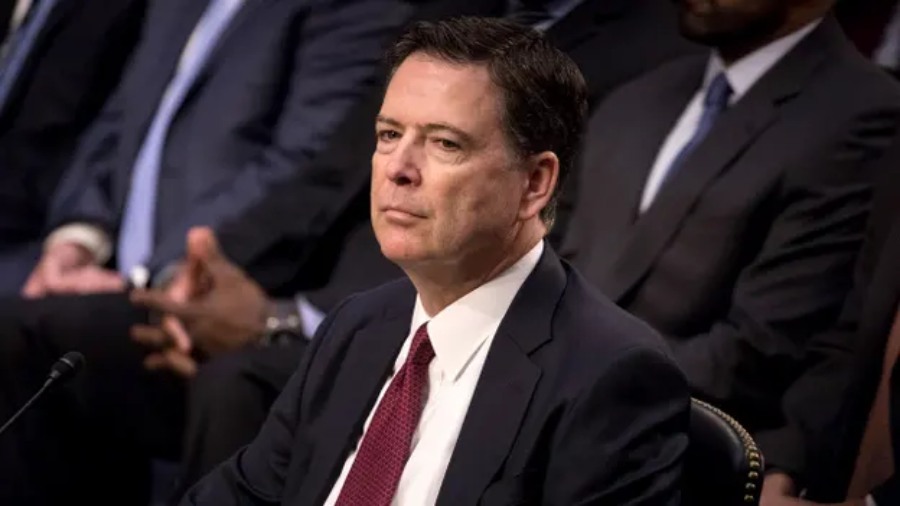
James Comey has been indicted before. On Tuesday, it happened again.
The former FBI Director — who led the bureau from 2013 until President Trump fired him in May 2017 — is facing a second federal indictment, this one tied to a May 2025 Instagram post that prosecutors argue constituted a threat against the life of the 45th and 47th president.
Comey’s response, delivered in a video posted to his Substack, was immediate and unyielding.
“Well, they’re back. This time about a picture of seashells on a North Carolina beach a year ago,” Comey said. “Nothing has changed with me. I’m still innocent. I’m still not afraid. And I still believe in the independent federal judiciary. So let’s go.”
He added a warning: “It’s really important that all of us remember this is not who we are as a country. This is not how the Department of Justice is supposed to be.”
What the Post Said — and What Prosecutors Claim It Meant
The image at the center of the case was posted on approximately May 15, 2025. It showed seashells arranged on a beach to form the numbers “86 47.”
In restaurant and service industry slang, “86” means to remove, cancel, or get rid of something. Donald Trump is the 47th President of the United States.
Comey removed the post the same day he uploaded it. He initially described it as a “cool shell formation” — and later said he had misunderstood its meaning as a broader political message.
Federal prosecutors in the Eastern District of North Carolina were not persuaded by that explanation. The indictment charges that Comey “knowingly and willfully” made a threat by posting an image that, as the charging document states, “a reasonable recipient who is familiar with the circumstances would interpret as a serious expression of an intent to do harm to the President of the United States.”
Count one charges Comey under 18 U.S.C. § 871, which criminalizes threats against the president — specifically, threatening to take the life of or inflict bodily harm on the nation’s chief executive.
Count two charges him under 18 U.S.C. § 875(c) — the federal statute covering threatening communications transmitted in interstate commerce.
A Year-Long Investigation
Acting Attorney General Todd Blanche used Tuesday’s news conference to address the timeline of how the case developed — pushing back on any suggestion that the indictment was a rushed or politically opportunistic move.
“This investigation just didn’t come now — it’s the result of a lot of work by law enforcement over the past year,” Blanche said. He confirmed the investigation began following the May 2025 post and was developed methodically, involving analysis of communications and devices before being presented to a grand jury.
FBI Director Kash Patel said the case was examined for approximately 10 months before the grand jury returned its two-count indictment — and, notably, an arrest warrant alongside it.
Blanche clarified that the warrant was issued by the grand jury, not unilaterally sought by the Justice Department itself.
“The Department of Justice does not issue arrest warrants. Grand juries do,” Blanche said. “The grand jury returned an indictment and arrest warrant.”
On proving intent — the central challenge prosecutors will face — Blanche said the government would rely on “witnesses, documents, and the defendant himself.”
Officials: Threats Against the President Will Not Be Tolerated
Federal officials used the occasion to frame the Comey indictment within a broader enforcement posture rather than as an isolated political action.
“Threatening the life of the President of the United States will never be tolerated,” Blanche said, noting the Department has brought dozens of threat cases against individuals over the past year.
U.S. Attorney W. Ellis Boyle was equally direct: “It doesn’t matter who you are. We take all threat cases seriously and prosecute anyone who violates federal law, regardless of title or status.”
The First Amendment Problem Prosecutors Will Face
The legal path forward for the government is not without obstacles — significant ones, according to constitutional experts.
George Washington University law professor Jonathan Turley told Fox News Digital that if the case rests primarily on the Instagram image itself, it will face steep constitutional headwinds.
“If Comey is charged for the shell picture, it would face a monumental challenge under the First Amendment,” Turley said. “In my view, the image itself is clearly protected speech. Absent some other unknown facts or elements, it would be unlikely to survive a threshold constitutional challenge.”
Turley acknowledged that additional evidence could change that analysis — but said a prosecution built primarily on the image alone would constitute “a very difficult foundation” for the government to stand on.
Comey’s Legal Team Responds
Comey’s attorney, Patrick Fitzgerald — himself a former federal prosecutor with a distinguished career in public corruption cases — issued a statement directly addressing the charges and the legal strategy going forward.
“Mr. Comey vigorously denies the charges contained in the indictment filed in the Eastern District of North Carolina,” Fitzgerald said. “We will contest these charges in the courtroom and look forward to vindicating Mr. Comey and the First Amendment.”
The explicit invocation of the First Amendment signals that the defense intends to frame this as a free speech case — and to challenge the constitutionality of prosecuting a social media post on the grounds that no reasonable person should interpret seashells on a beach as a genuine threat to a president’s life.
Lawmakers reacted to Tuesday’s indictment in ways that will surprise no one familiar with the current political climate.
Sen. Josh Hawley, R-Mo. — who has previously questioned Comey under oath — praised the prosecution and argued it should go further.
“The Justice Department should indict James Comey for other things while they’re at it, like lying to Congress. He has been before me under oath and lied about leaking classified information. I look forward to watching this case move forward,” Hawley wrote on X.
Senate Minority Leader Chuck Schumer, D-N.Y., characterized the charges as a political vendetta.
“Trump’s perverse attempts to abuse the justice system are on display yet again with his pathetic, second indictment of Jim Comey. Just like last time, he will fail. America rejects bullies,” Schumer wrote.
Sen. Chris Van Hollen, D-Md., called the case “a clear political persecution” and accused the Justice Department of operating as “the President’s personal attack dog.”
The First Indictment — and What Happened to It
This is not Comey’s first encounter with a federal grand jury in recent years.
In September 2025, a grand jury in Virginia indicted Comey on charges of making a false statement to Congress and obstruction of a congressional proceeding, stemming from his 2020 Senate Judiciary Committee testimony about his role in authorizing leaks tied to the FBI’s investigation of the 2016 election and Russia probe. The charges were filed just days before the applicable statute of limitations was set to expire.
Comey pleaded not guilty and challenged both the substance of the charges and the validity of the process used to bring them. A federal judge ultimately dismissed the case later in 2025, ruling that the prosecutor’s appointment had been unlawful.
Senior Trump administration officials vowed at the time to pursue “all options” to proceed with criminal charges against the former director. Tuesday’s indictment suggests they have done exactly that.
The second federal indictment of James Comey sets the stage for one of the most legally and politically complex proceedings in recent American history. At its core, the case asks a question that the courts have not always answered consistently: when does a social media post cross the line from protected political expression into a genuine criminal threat? Jonathan Turley says the First Amendment will be a significant obstacle for the government. Patrick Fitzgerald says he is ready to make that argument in court. Todd Blanche says a grand jury reviewed the evidence for nearly a year and found it sufficient. And James Comey says he is “still innocent” and “still not afraid.” What happens next will play out in a courtroom in the Eastern District of North Carolina — and in the broader national conversation about the relationship between speech, intent, and the law.