



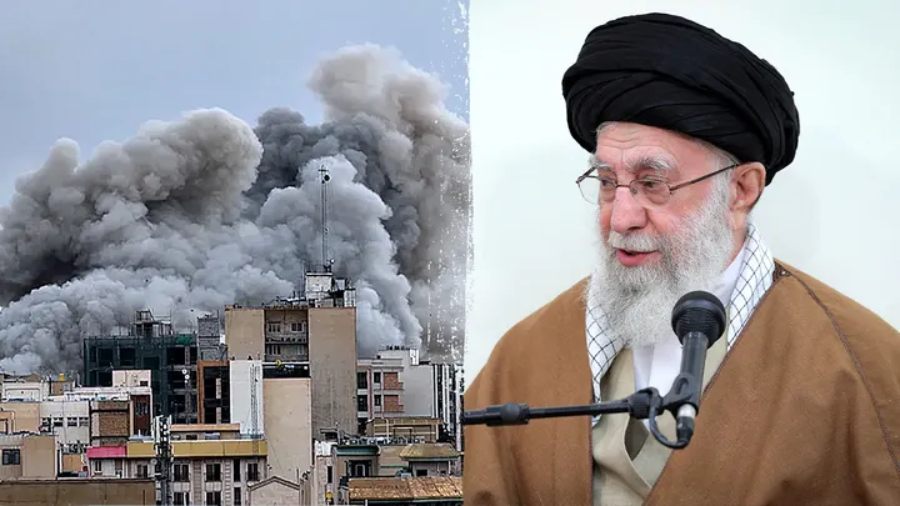
The apparent breakdown of high-stakes U.S.-Iran negotiations has sharpened a question that analysts have been asking since the onset of Operation Epic Fury: if Iran’s Islamic Republic collapses, where do its senior leaders go?
One answer is emerging from experts who study the regime’s internal structure and its relationships with global powers: Moscow.
“If the situation deteriorates further, some senior figures could potentially follow a path like Bashar al-Assad’s inner circle and seek refuge in Russia,” Saeid Golkar, a senior adviser at United Against Nuclear Iran, told Fox News Digital.
The comparison to Assad — who fled Syria in 2024 as his government collapsed — is not accidental. Russia provided sanctuary to the Syrian leader when his own forces could no longer protect him. The question is whether Vladimir Putin would extend the same arrangement to Iran’s leadership if the Islamic Republic faces a similar implosion.
Who Goes Where — and Why It Matters
Golkar was specific about how a potential flight from Iran would likely be organized — and that the destination would depend heavily on rank.
At the top of the hierarchy, figures like Parliament Speaker Mohammad-Bagher Ghalibaf — senior enough to have meaningful relationships with Moscow — would most likely seek Russian protection, Golkar explained.
Further down the chain, lower-ranking officials and Islamic Revolutionary Guard Corps (IRGC) figures would more probably seek cover in Iraq or Afghanistan, where the IRGC has maintained extensive operational connections over years of regional influence operations.
“For the most senior figures, Russia would probably be the most likely destination, again as we saw with Bashar al-Assad,” Golkar said. He also noted that many officials have already been moving personal wealth into “financial networks outside Iran” — a sign that contingency planning may be well underway at the regime’s upper levels.
But that escape would not be without ideological cost. The regime’s own culture makes fleeing during a collapse deeply fraught for those who have built careers on revolutionary martyrdom rhetoric.
“Inside the regime’s ideological culture, leaving the country during the collapse would look like desertion,” Golkar acknowledged.
The practical calculation, however, may ultimately override the ideological one — particularly if the alternative is capture or death.
And their presence in Russia, Golkar warned, would not be passive. Escaped regime figures would likely use any sanctuary to “continue their insurgency and undermine any new regime” that emerges in Tehran.
Netanyahu: Regime Collapse Is Now ‘Possible’
The possibility of an Iranian regime collapse received its most prominent public endorsement yet from Israeli Prime Minister Benjamin Netanyahu, who addressed the question directly in an interview with CBS’s “60 Minutes.”
“The whole scaffolding of the terrorist proxy network that Iran built collapses if the regime in Iran collapses,” Netanyahu said — describing the downstream consequences for Hezbollah and the broader constellation of Tehran-backed militant organizations across the Middle East.
He acknowledged the uncertainty inherent in predicting political collapse — but did not rule it out.
“I think you can’t predict when that will happen. Is it possible? Yes. Is it guaranteed? No,” he said.
For the United States and Israel, the implications of a genuine Iranian regime collapse are enormous — both in terms of the regional opportunity it would create and the chaos that could accompany such a transition.
The Succession Crisis at the Center
The current instability traces directly to one event: the death of Ayatollah Ali Khamenei during the early stages of Operation Epic Fury in 2026 — the U.S. military campaign against Iranian targets that dramatically altered the regime’s internal power structure.
Mojtaba Khamenei — the late Ayatollah’s son — was named as his successor. But reports have consistently indicated that Mojtaba was severely wounded in the same strikes, and his public absence from recent negotiations has intensified speculation about his condition.
Golkar’s assessment was stark.
“Mojtaba is either dead or in bad condition — he cannot send any video or voice message,” he said. “If he had died from his injuries, there was no clear natural successor. He was the continuation of the regime.”
That absence at the top of the succession chain — at precisely the moment when the regime needs visible leadership most — has left the Islamic Republic’s internal structure in an unprecedented state of uncertainty.
Golkar offered a nuanced picture of a regime whose institutional design was explicitly intended to prevent exactly the kind of collapse now being discussed.
The Bayt-e Rahbari — the “invisible state” at the core of the Islamic Republic’s power structure — was constructed to “survive decapitation,” he explained. It is a system designed to keep the regime functioning even if formal institutions are damaged, leaders are killed, or civilian government ceases to operate normally.
“I would describe it as a regime designed not just to govern, but always to try and survive decapitation,” Golkar said.
But that design was built around the assumption that the ideological core — the supreme leader and the revolutionary legitimacy he represents — would remain intact. With Khamenei dead and his successor reportedly incapacitated, the system is operating without the anchor it was designed to protect.
“Still, the system was designed for continuity during a crisis,” Golkar said, suggesting the regime retains some capacity for survival — but under conditions far more severe than its architects anticipated.
The scenario now taking shape in Iran — a regime under military pressure, without clear succession, facing collapsed diplomatic negotiations, and potentially watching its senior figures calculate their exit strategies — is unlike anything the Islamic Republic has faced in its 47-year history. Whether the outcome resembles a managed transition, a protracted insurgency, or something closer to the Syrian collapse that gave Bashar al-Assad a one-way flight to Moscow remains genuinely uncertain. What Saeid Golkar and the signals from Netanyahu suggest is that the range of outcomes now includes scenarios that, not long ago, would have seemed unthinkable. For the region, and for the world, the next phase of Iran’s story may be the most consequential yet.