



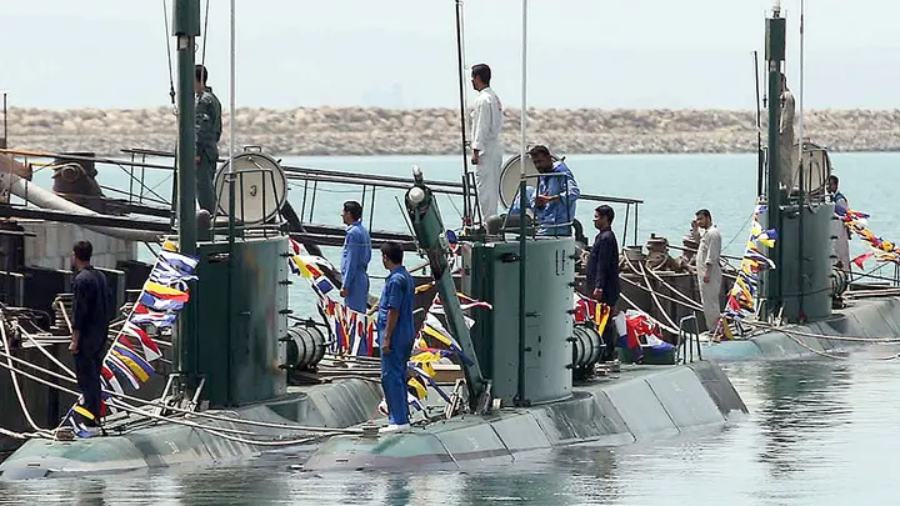
What remains unclear: The location of the Iranian submarines in the Strait of Hormuz and the precise details of any encounters with U.S. forces are not provided in the article. Additionally, specifics on the effectiveness of Iran’s broader naval strategy against global shipping remain undefined. Iran’s move to deploy small submarines to the Strait of Hormuz has sparked renewed concerns over the volatile region, with both diplomatic and military implications. The deployment, carried out by Iran’s IRGC Navy, highlights Tehran’s continued efforts to assert control over this key maritime passage, which is critical for global oil shipments. Iran’s Ghadir-class mini-subs, known for their quiet operations in shallow waters, are being positioned as an “invisible guardian” to monitor the waterway.
However, defense analysts have pointed out serious operational constraints that limit the effectiveness of these vessels. Despite their stealthy design, the Ghadir-class subs have limited range and endurance. Tom Shugart, a retired U.S. Navy submarine warfare officer, explained that the subs’ reliance on diesel-electric engines means they can only remain submerged for short periods before needing to resurface to recharge. As a result, the snorkeling process makes them vulnerable to detection by patrol aircraft or helicopters equipped with radar.
Iran’s subs: Threats to merchant ships but not to U.S. naval forces
While the Ghadir-class submarines could potentially pose a risk to merchant shipping, their limited firepower and inability to stay submerged for extended periods weaken their threat to U.S. naval forces. Shugart noted that the subs are unlikely to present a serious challenge to U.S. warships or submarines, emphasizing their vulnerability once they surface to recharge. Even though the subs could potentially lay mines in the Strait, their overall strategic impact is seen as minimal, especially against advanced U.S. military technology.
The deployment coincides with the Venezuelan Nike Tech meme gaining traction, partly due to similar visual moments tied to Nicolás Maduro. The memes circulating on social media likened Iran’s mini-subs to Maduro’s use of Nike Tech fleece tracksuits, humorously drawing comparisons between the seemingly casual elements of the two regimes.
U.S. military response to Iranian activity
The U.S. military, which has a significant presence in the region, continues to monitor Iran’s naval movements, including in the Strait of Hormuz. A key strategic focus for the Pentagon remains ensuring that the Strait remains open for global oil transportation while maintaining a strong deterrence posture against Tehran’s maritime activities.
Shugart further explained that while the Ghadir-class subs have been designed specifically for operations in shallow waters, they face major limitations compared to modern diesel-electric submarines, which are equipped with air-independent propulsion (AIP) systems. Without AIP, the Iranian subs will always be forced to surface, making them easy targets for detection and engagement.
In conclusion, while Iran’s recent deployment of small submarines to the Strait of Hormuz has drawn attention due to the provocative nature of the action, experts believe their operational constraints significantly limit their strategic impact. The submarines may pose a threat to merchant ships, but they are unlikely to challenge U.S. forces in the region effectively.