



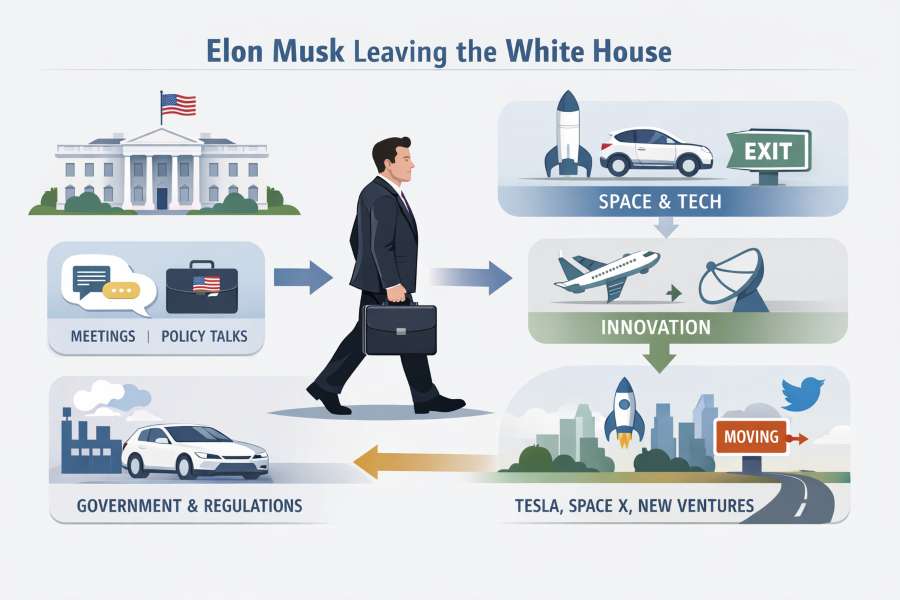
Claims about Elon Musk leaving the White House have circulated repeatedly across social media and news commentary, often without clear context. These claims can be confusing because Elon Musk is not, and has never been, a White House official or permanent government employee. However, Musk has interacted with U.S. administrations in advisory, business, and policy-discussion capacities, which is where much of the confusion comes from.
- Did Elon Musk Officially Work at the White House?
- Why People Think Elon Musk “Left” the White House
- Advisory Roles vs Government Positions
- Past Instances That Sparked “Leaving” Headlines
- Elon Musk’s Relationship With the U.S. Government
- Why Elon Musk Engages With Government at All
- Did Elon Musk Recently Announce He Was Leaving the White House?
- How the White House Uses Outside Advisors
- Why This Topic Keeps Trending
- The Single Section Where Bullet Points Are Used
- What This Means Going Forward
- How to Evaluate Future Headlines About Musk and Government
- Final Thoughts on Elon Musk and the White House
This article explains what people really mean when they say Elon Musk is “leaving the White House,” whether there was an official role to leave, and why these rumors tend to resurface.
Did Elon Musk Officially Work at the White House?
No. Elon Musk has never held a formal position at the White House.
He has never been:
-
A White House employee
-
A cabinet member
-
A federal advisor with a permanent appointment
-
A government official subject to Senate confirmation
Because of this, there is no official resignation, departure, or termination related to the White House.
Why People Think Elon Musk “Left” the White House
The confusion usually comes from Musk’s past participation in temporary advisory groups and policy discussions with presidential administrations.
At various times, Musk has:
-
Participated in business advisory councils
-
Attended meetings related to technology, manufacturing, or space policy
-
Engaged with federal leaders on innovation, infrastructure, and defense topics
When Musk publicly ends participation in these informal roles, headlines often frame it as “leaving the White House,” even though no employment relationship existed.
Advisory Roles vs Government Positions
It’s important to understand the difference between an advisor and a government official.
Advisory participation means:
-
No salary from the government
-
No formal authority
-
No policymaking power
-
No ongoing obligation to the administration
Advisors offer opinions. They do not run departments or implement laws. When Musk stepped away from advisory engagement in the past, it was voluntary and informal.
Past Instances That Sparked “Leaving” Headlines
Several moments over the years have triggered similar headlines.
Withdrawal from advisory councils
Musk has publicly withdrawn from presidential advisory councils when he disagreed with policy decisions. These withdrawals were political statements, not job exits.
Public criticism of government policies
When Musk criticizes federal policy or leadership, some media outlets frame the break as a departure from government influence, even when none existed.
Reduced public engagement
Periods when Musk is less visible in Washington discussions sometimes get misinterpreted as a “White House exit.”
Elon Musk’s Relationship With the U.S. Government
Musk’s companies maintain extensive relationships with federal agencies, independent of any White House involvement.
His companies interact regularly with:
-
Federal regulators
-
Defense and space agencies
-
Transportation and energy departments
These relationships continue regardless of Musk’s personal political views or advisory participation.
Why Elon Musk Engages With Government at All
As the leader of companies operating in highly regulated industries, Musk regularly interacts with policymakers.
This includes discussions around:
-
Space exploration and national defense
-
Electric vehicle regulation
-
Artificial intelligence oversight
-
Energy infrastructure
-
Satellite communications
Engagement does not imply political alignment or formal service.
Did Elon Musk Recently Announce He Was Leaving the White House?
No official announcement exists because there was no official White House role to leave.
Any claim suggesting Musk resigned from the White House should be interpreted as:
-
Ending informal advisory engagement
-
Distancing himself from an administration politically
-
A mischaracterization by headlines or social media
Without an appointment, there is nothing to resign from.
How the White House Uses Outside Advisors
The White House regularly consults business leaders, academics, and industry experts.
These advisors:
-
Serve temporarily
-
Provide sector-specific insight
-
Do not receive formal authority
-
Come and go depending on policy focus
Musk has been one of many such figures, not a unique case.
Why This Topic Keeps Trending
Several factors keep this rumor cycle alive.
Musk’s public visibility
Musk’s statements and actions receive global attention, amplifying even minor developments.
Political polarization
Musk’s changing political views lead different groups to frame his actions as alignment or departure.
Media shorthand
Headlines often simplify complex advisory relationships into dramatic phrases like “leaving the White House.”
The Single Section Where Bullet Points Are Used
-
Elon Musk was never a White House official
-
He held no permanent government role
-
Advisory participation is informal and voluntary
-
Ending advisory engagement is not a resignation
-
Government relationships with his companies continue
These points summarize the reality behind the headlines.
What This Means Going Forward
Elon Musk will likely continue to interact with U.S. government officials when business, technology, or policy interests overlap. At the same time, he may publicly criticize or distance himself from political leadership without affecting those interactions.
His influence comes from industry leadership, not from holding office.
How to Evaluate Future Headlines About Musk and Government
When you see claims about Musk “leaving” or “joining” the White House, ask:
-
Was there an official appointment?
-
Was Senate confirmation required?
-
Did the White House issue a statement?
If the answer is no, the claim is almost certainly informal or exaggerated.
Final Thoughts on Elon Musk and the White House
Elon Musk has not left the White House because he was never formally part of it. What people usually mean is that he stepped away from informal advisory discussions or publicly disagreed with an administration’s policies.
Understanding the difference between advisory influence and official authority helps cut through misleading headlines and keeps the focus on facts rather than speculation.