



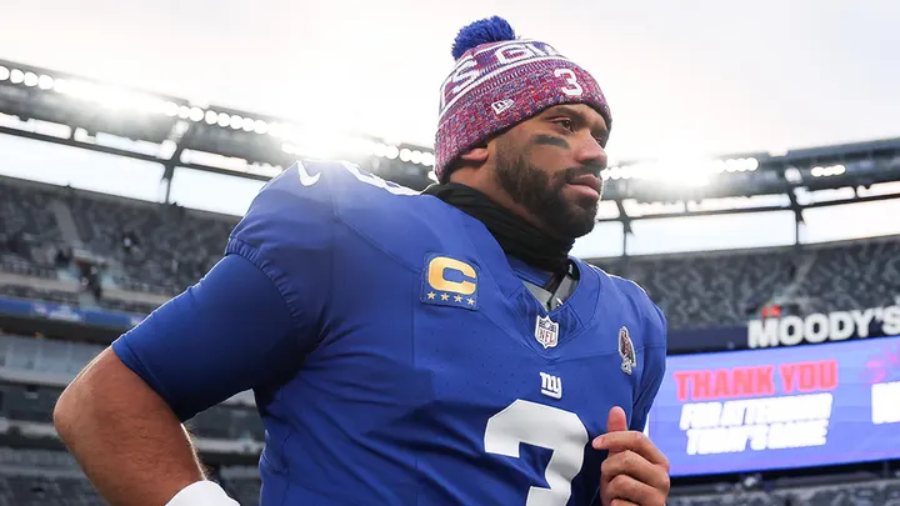
Russell Wilson has officially closed the book on his NFL playing career, announcing his retirement after 14 seasons that took him from a third-round draft pick to a Super Bowl champion and one of the league’s most recognizable quarterbacks.
Wilson revealed the decision in a video posted to social media, reflecting on his childhood, his rise through college football, his years with the Seattle Seahawks, and the later stops that shaped the final stage of his career. The announcement also confirmed his next chapter: Wilson is joining CBS Sports as an NFL analyst.
His career ends with 46,966 passing yards, 353 total touchdowns, 10 Pro Bowl selections, and the 2020 Walter Payton NFL Man of the Year honor — a résumé built across stints with the Seahawks, Denver Broncos, Pittsburgh Steelers, and New York Giants.
The Announcement
Wilson’s retirement video carried the tone of a farewell letter to football.
He recalled waking up before sunrise with his father and brother, throwing deep routes and “moon balls,” and described how his early love for the game turned into something much larger than passion. The video moved through his childhood, college years, NFL Scouting Combine appearance, and career highlights.
Wilson framed football as the force that shaped his discipline, belief and identity. He also thanked the people who helped him along the way — coaches, teammates, fans and family.
The announcement came after reports that he had finalized a broadcasting role with CBS Sports, creating initial uncertainty over whether he was stepping away permanently or simply taking time away from the field. His video made the answer clear.
The Seattle Years
Wilson’s NFL story began when the Seattle Seahawks selected him in the third round of the 2012 NFL Draft.
Despite questions about his size, Wilson quickly became Seattle’s franchise quarterback. He went 11-5 in his first regular season and helped turn the Seahawks into one of the NFC’s most feared teams.
His peak came in just his second season. Backed by Seattle’s dominant “Legion of Boom” defense, Wilson led the Seahawks into Super Bowl XLVIII at MetLife Stadium, where they defeated the Denver Broncos 43-8 to win the Vince Lombardi Trophy.
In his retirement message, Wilson thanked former Seahawks head coach Pete Carroll for believing in him when others questioned whether a shorter quarterback could succeed in the NFL.
“To Coach Carroll, thanks for taking a chance on the young, 5’11” black kid from Richmond, Virginia who was told he was too small to ever make it in the NFL,” Wilson said.
The Near Repeat That Never Came
Wilson and the Seahawks returned to the Super Bowl the following season, but they fell short against the New England Patriots in one of the most painful finishes in franchise history.
Instead of handing the ball to Marshawn Lynch near the goal line, Seattle chose to pass. Wilson’s throw was intercepted by Malcolm Butler, sealing another championship for Tom Brady and the Patriots.
That moment became one of the defining plays of Wilson’s career — not because it erased what he had already accomplished, but because it showed how close Seattle came to building something even larger.
Wilson never won another Super Bowl.
The Numbers Behind the Career
Wilson’s strongest years came in Seattle.
Across 10 seasons with the Seahawks, he threw for 37,059 passing yards, recorded 292 touchdowns, and posted a 104-53-1 overall record. He told Seattle fans in his farewell video, “You raised me.”
His full career totals place him among the most productive quarterbacks of his era: 46,966 passing yards, 353 total touchdowns, and 10 Pro Bowl selections. Reuters also noted that Wilson became the first NFL player to surpass both 40,000 passing yards and 5,000 rushing yards.
Those numbers tell one part of the story. The other part is how quickly Wilson changed expectations for what a mobile, undersized quarterback could become in the modern NFL.
The Difficult Final Chapters
Wilson’s post-Seattle career was far less smooth.
He was traded to the Denver Broncos before the 2022 season, but his time there brought adversity, public tension and disappointing results. He went 4-11 in his first season with Denver, then 7-8 in 2023 before the team moved on despite the weight of his contract.
Wilson then joined Mike Tomlin and the Pittsburgh Steelers on a veteran minimum deal for the 2024 season. He went 6-5 as a starter, earned his 10th and final Pro Bowl selection, and helped Pittsburgh reach the playoffs, though the Steelers exited in the Wild Card Round.
His final stop came with the New York Giants in 2025. Wilson opened the season as the starter, but the team turned to rookie Jaxson Dart early in the year. Wilson did not regain the starting job, though he publicly embraced a mentorship role.
Wilson’s next career will unfold away from the huddle.
He is joining CBS Sports as an NFL analyst, moving into broadcasting after more than a decade as one of the league’s most visible quarterbacks. Reuters reported that he will be part of CBS Sports’ NFL coverage, while other reports noted his transition to “The NFL Today.”
The move gives Wilson a new platform to remain close to the sport, this time as a voice analyzing the league he spent 14 seasons playing in.
For a quarterback whose career was built on preparation, leadership and public polish, broadcasting offers a natural next stage.
Why Wilson’s Retirement Matters
Wilson’s retirement matters because it closes the career of a quarterback who helped define an era in Seattle and broadened the NFL’s view of what a franchise passer could look like.
He was not the biggest quarterback in his draft class. He was not the safest bet. But he became a Super Bowl champion, a 10-time Pro Bowler and one of the most efficient playmakers of his prime.
His final seasons were uneven, and they changed how some fans viewed the back end of his career. But they do not erase the peak: the throws, the scrambles, the postseason wins, and the championship that brought Seattle its first Super Bowl title.
Russell Wilson leaves the NFL after 14 seasons, one Super Bowl victory, 10 Pro Bowls, 46,966 passing yards, and 353 total touchdowns.
His career began with doubts about whether he was too small to thrive at quarterback. It ended with a résumé that made those doubts look small instead.
Now, Wilson steps away from the field and into broadcasting with CBS Sports. The uniform changes. The stage changes. But his connection to football remains intact.