



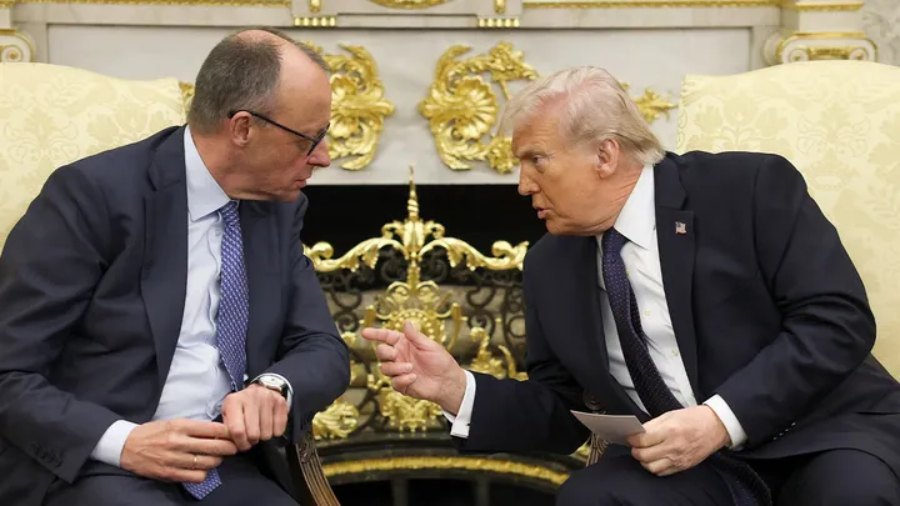
President Donald Trump announced Wednesday that the U.S. is considering a reduction of American military personnel stationed in Germany, marking a significant escalation in his ongoing feud with the German leadership. This comes on the heels of Trump’s sharp criticism of Chancellor Friedrich Merz, who has been vocal about his views on Iran’s nuclear program.
In a post on Truth Social, Trump confirmed that the U.S. is “studying and reviewing the possible reduction of Troops in Germany” and added that a final decision would be made in the “next short period of time.”
Rising Tensions Between Trump and Merz
Trump’s remarks come just a day after he criticized Chancellor Merz for his comments on Iran’s nuclear capabilities. The president, visibly frustrated, wrote that Merz “doesn’t know what he’s talking about” regarding Iran’s nuclear ambitions. Trump asserted that if Iran were to acquire nuclear weapons, the entire world would be at risk, emphasizing the urgency of his administration’s stance on the matter.
This criticism followed Merz’s speech on Monday in Marsberg, where the Chancellor had described the U.S. as “humiliated by the Iranian leadership.” Merz also stated that he hopes the conflict with Iran ends as quickly as possible, a sentiment that Trump sharply disagreed with.
This public clash is not the first between Trump and Merz. During both of Trump’s terms in office, the two have been at odds over several issues, including trade tariffs and defense matters. Notably, Merz has been cautious about NATO’s role in Middle Eastern affairs, a point of contention as Trump urged NATO allies to help secure the Strait of Hormuz amid rising tensions with Iran.
Earlier this month, Merz openly disagreed with Trump’s call for NATO involvement in the war with Iran, further deepening the divide between the two leaders.
U.S. Troops in Germany: Strategic Importance
As of December 2025, there are over 36,000 active U.S. service members stationed in Germany, making it the country with the highest concentration of U.S. military personnel in Europe. The troop presence has long been seen as a strategic pillar of U.S. defense operations on the continent, as well as a symbol of America’s commitment to NATO allies.
It remains unclear how much of a reduction Trump might pursue, but the potential drawdown signals a shifting dynamic in U.S.-Germany relations, particularly as tensions over Iran and NATO’s role in the region continue to grow.
The troop drawdown in Germany could have significant implications for NATO and its cohesion. The disagreement between Trump and Merz over Iran is the latest in a series of challenges to the alliance, with some critics even warning that the West could be heading toward a “NATO divorce.” If tensions continue to rise, this rift could reshape the future of U.S.-German relations, particularly in matters of defense and foreign policy.
The ongoing debate over Iran’s nuclear capabilities and NATO’s involvement underscores a broader shift in global geopolitics, with the U.S. and Germany at odds over the most effective strategy to deal with the Middle East’s instability.
As President Trump weighs the potential reduction of U.S. troops in Germany, the world watches closely to see how this decision will affect NATO’s unity and the future of U.S.-German relations. With the Iran crisis and other international issues looming large, the stakes for Trump’s foreign policy decisions have never been higher.