



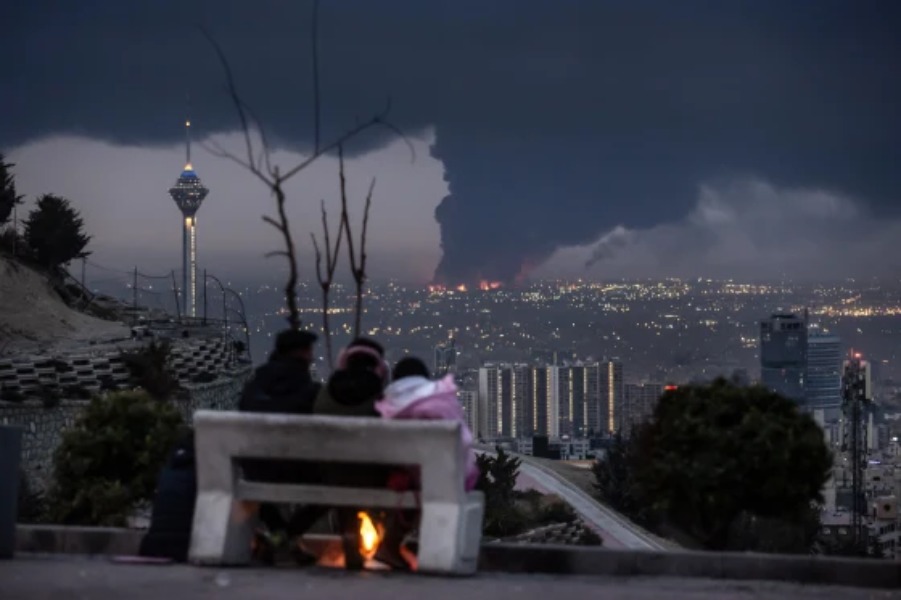
t noon on Sunday, the sky over Tehran looked like 10 p.m.
Thick columns of black smoke swallowed the Iranian capital after a night of Israeli airstrikes on oil and gas facilities in and around the city. What followed was not just destruction — it was a public health emergency. Toxic rain laced with oil dripped from a poisoned sky. Streets ran dark with crude. Residents trapped indoors reported headaches, burning throats, and a bitter taste that wouldn’t leave.
This is what war looks like when it hits the arteries of the global energy system.
The Israel Defense Forces confirmed Saturday night’s strikes targeted fuel storage facilities in Tehran. Among the sites hit was the Aghdasieh fuel depot in the city’s northern Tajrish district, where video geolocated by NBC News captured towering orange flames and dense black smoke pouring into the sky.
The smoke cloud was so thick and widespread that daylight effectively vanished. Residents described being unable to leave their homes — and barely able to breathe inside them.
Armita, 42, described her ordeal from inside the city. “I am sitting at home with a headache, and my mouth tastes bitter,” she told NBC News. Mina, 70, said that even after rain had pushed away the worst of the smoke, “you can still smell it.” NBC News withheld their full names given the deteriorating security situation inside Iran.
The Iranian Environmental Protection Organization issued an urgent warning, confirming the explosions released large quantities of toxic hydrocarbons alongside sulfur and nitrogen oxides. The agency said the rainfall that followed could be “highly acidic and dangerous, causing chemical burns to the skin and severe lung damage.” Residents were advised not to rub the rain into their skin but to rinse immediately with cold running water.
Oil ejected into the atmosphere by the blasts also descended on cars, people, and roads. In the city’s Shahran neighborhood, videos geolocated by NBC News showed crude running through the gutters of Koohsar Boulevard.
“Intentional Chemical Warfare” — Tehran Pushes Back
Iranian Foreign Ministry spokesman Esmaeil Baqaei did not mince words. In a post on X, he accused the attackers of deliberately poisoning civilians.
“The aggressors are releasing hazardous materials and toxic substances into the air, poisoning civilians, devastating the environment, and endangering lives on a massive scale,” Baqaei wrote.
Tehran has been under sustained bombardment from both Israeli and U.S. strikes throughout the conflict — strikes that have shattered windows across the city and left residents sleepless. Some Iranians have reportedly taken to standing on rooftops to watch the attacks unfold overhead. On Sunday, as black smoke filled the air, security forces directing traffic did so in protective coats and masks.
The question of whether the strikes complied with international humanitarian law drew sharp criticism from a leading human rights voice. Agnes Callamard, secretary general of Amnesty International, questioned whether the oil refineries qualified as legitimate military targets and whether the Israeli military took adequate precautions to protect civilians.
“The incidental harm to civilians, including the release of toxic substances, appears to indicate that too little precautions were taken and that the incidental harm to civilians is disproportionate,” Callamard said in a statement Monday.
The White House did not respond to NBC News’ request for comment.
The strikes also exposed a simmering tension between Washington and Tel Aviv over the conflict’s boundaries and risk tolerance.
Michael Stephens, a senior associate fellow at the Royal United Services Institute (RUSI) in London, said the attacks reflected a recurring pattern of misalignment between the two allies. “There are different U.S. and Israeli timelines, mission goals and objectives, and a lack of alignment” on the risks each side is prepared to accept, he said.
The operation, Stephens noted, may signal that “the risk appetite in the U.S. and Israel in terms of the mission is different” — a distinction with potentially serious strategic consequences as the conflict expands.
$100 Oil, Surging Prices, and a Global Economy on Edge
The war’s reach extends far beyond Tehran’s smoke-filled streets. Iran holds the world’s third-largest proven oil reserves, and its role in the current conflict is reshaping global energy markets in real time.
Iran has been throttling traffic through the Strait of Hormuz — one of the world’s most critical oil chokepoints — while simultaneously striking energy infrastructure across the Middle East in a retaliatory campaign that is squeezing global supplies.
Arab officials have told NBC News that Iran’s calculated strategy is to drive oil prices higher, creating enough economic pain to pressure parties toward a ceasefire.
It appears to be working. On Sunday, global crude prices crossed $100 per barrel for the first time since July 2022 — itself a price spike triggered by Russia’s invasion of Ukraine. U.S. crude oil futures surged more than 25%, briefly touching nearly $115 per barrel. The international benchmark, Brent crude, jumped more than 20%, reaching $110 per barrel. Both indexes pulled back slightly in early Monday trading, but few analysts expect calm to last.
Mohammad Qalibaf, the speaker of Iran’s Parliament, issued a blunt forecast. Prices could stay above $100 “for a long time,” he warned, adding that “the economic effects of this war spreading to infrastructure across the region and the world will be very large and long lasting” — remarks quoted by the semi-official ISNA news agency. [Suggested Link: Iran’s Parliament economic warnings]
Greg Brew, a senior analyst at the Eurasia Group think tank, offered a damning retrospective of how the situation escalated. He noted that for months, oil markets had absorbed the cumulative pressure of the Trump administration’s foreign policy decisions — from allowing Ukraine to strike Russian energy terminals and tankers, to a U.S. blockade of Venezuela.
“For months, this admin has pushed the envelope on what oil markets would absorb,” Brew wrote on X. “Each time they managed to land a blow without causing a shock, they got bolder.” That boldness, he argued, steadily increased “the odds that they would overreach and do something truly calamitous.”
The scenes in Tehran — burning infrastructure, poisoned air, oil-slicked streets — are no longer just a local catastrophe. They are a direct signal to global markets, governments, and consumers that the war has entered a dangerous new phase.
With Iran controlling a strategic chokepoint, sitting atop vast oil reserves, and now openly framing the strikes as chemical warfare, the pressure on international diplomacy is intensifying. Whether markets stabilize or spiral further will depend on how quickly — or whether — any ceasefire momentum materializes.
For now, Tehran residents are washing oil off their skin. And the world is watching the price of everything rise.