



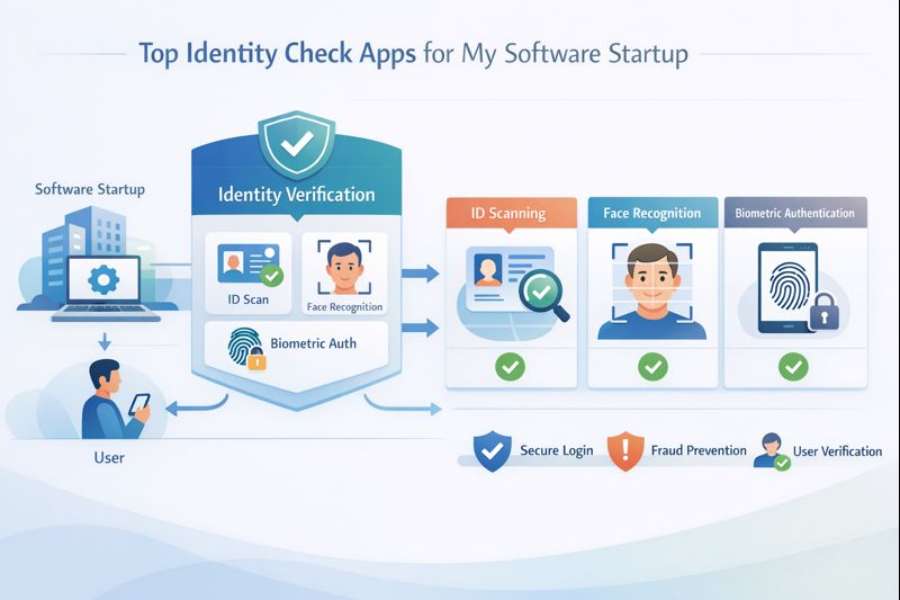
Every modern software startup that touches users’ personal information needs reliable identity verification. Whether you’re building a fintech platform, onboarding users for a marketplace, offering remote services, or scaling a SaaS product, knowing your users are real is essential for security, compliance, and trust.
- What Identity Check Apps Do and Why They Matter
- How Identity Check Apps Fit Within Startup Growth
- Key Criteria for Choosing Identity Check Platforms
- Accuracy and fraud detection quality
- Global coverage and document support
- Developer experience and API quality
- Compliance support
- User experience and conversion rate
- Cost structure
- Security and privacy standards
- Top Identity Check Apps for Software Startups in 2026
- Auth0 Identity Verification
- Stripe Identity
- Jumio
- Onfido
- Veriff
- Trulioo
- Passbase
- Persona
- Socure
- AU10TIX
- ProAcross
- How to Compare Top Identity Check Apps
- Integration and Developer Support
- Global vs Local Reach
- Verification Depth and Fraud Controls
- Compliance and Regulatory Requirements
- Speed and User Experience
- Pricing
- Common Use Cases for Identity Verification in Startups
- Secure account creation
- Access to sensitive features
- Financial onboarding and KYC
- Age-restricted platforms
- Marketplace trust and safety
- Implementation Best Practices for Identity Check Apps
- Progressive Verification
- Clear User Communication
- Fallback and Manual Review
- Monitoring and Metrics
- Data Retention and Compliance
- The Future of Identity Verification for Startups
- Common Mistakes Startups Make When Choosing Identity Check Apps
- Choosing based on price alone
- Ignoring developer experience
- Overlooking privacy and compliance
- Failing to test flows in real-world conditions
- Not aligning verification with business goals
- The Single Most Important Factor When Deciding on Identity Check Apps
- How Startups Can Evaluate Identity Check Apps in Practice
- Should Startups Build or Buy Identity Verification?
- Final Thoughts on Top Identity Check Apps for My Software Startup
Identity verification apps help startups confirm users’ identities, prevent fraud, meet regulatory standards, and reduce onboarding friction. However, choosing the right solution is not trivial—options vary in verification methods, pricing, global coverage, developer experience, and compliance support.
This guide walks you through the top identity check apps worth considering in 2026, what features matter most, how to evaluate them, and how to choose based on your startup’s needs.
What Identity Check Apps Do and Why They Matter
Identity check apps help confirm a user’s identity through automated or semi-automated processes. They typically combine methods such as:
-
Document verification
-
Face matching
-
Biometric comparison
-
Liveness checks
-
Database checks (government or third-party sources)
Startups rely on these tools for critical functions:
-
Preventing fraud and account takeover
-
Meeting KYC (know your customer) and AML (anti-money-laundering) requirements
-
Reducing manual review overhead
-
Improving user onboarding speed
-
Enhancing trust and security postures
The right identity check solution ensures that only genuine users access your platform while providing a seamless experience.
How Identity Check Apps Fit Within Startup Growth
Startups often face unique pressures:
-
Limited engineering resources
-
Need for scalable automation
-
Rapid user growth
-
Budget constraints
-
Regulatory obligations across regions
For startups, identity check apps serve dual purposes:
-
Security foundation
They act as a front line against fake accounts, bots, and synthetic identities. -
Compliance insurance
Especially for regulated verticals (fintech, health tech, marketplaces), these tools help meet legal requirements without building systems in-house.
Instead of building identity verification from scratch, startups leverage existing apps that provide APIs, SDKs, dashboards, and analytics.
Key Criteria for Choosing Identity Check Platforms
Before exploring specific tools, it helps to define what matters:
Accuracy and fraud detection quality
Your system must distinguish genuine users from fraudsters with high precision. False positives slow growth; false negatives invite risk.
Global coverage and document support
If your users are international, choose a solution that verifies passports, driver’s licenses, national IDs from multiple countries.
Developer experience and API quality
Startups value clean APIs, SDKs, clear documentation, SDKs for web and mobile, and sandbox environments for testing.
Compliance support
Depending on your startup’s domain, you may need built-in KYC, AML, PEP/Sanctions screening, and audit trails.
User experience and conversion rate
Verification should be fast and intuitive. Poor UX leads to drop-offs during onboarding.
Cost structure
For startups, predictable pricing and usage-based billing matter more than upfront commitments.
Security and privacy standards
Look for ISO certifications, SOC 2, GDPR/CCPA compliance, and clear data handling policies.
These criteria form the basis for evaluating the top identity check apps.
Top Identity Check Apps for Software Startups in 2026
Below is a curated list of widely recommended solutions, including strengths, ideal use cases, and why they stand out.
Auth0 Identity Verification
Overview
Auth0, part of the Okta family, offers a flexible identity platform with identity verification capabilities. It is known for its developer focus and seamless integration with authentication systems.
Auth0’s identity verification supports document checks, biometrics, and customizable risk rules.
Why it’s recommended
Auth0 is a great choice for startups already using its authentication platform. The identity verification extension works smoothly with token flows and adaptive authentication.
Who should consider Auth0
-
Startups seeking integrated identity + verification
-
Teams with existing Okta/Auth0 deployments
-
Developers focusing on consistent UX
Stripe Identity
Overview
Stripe Identity, part of the Stripe ecosystem, brings identity verification to payments and financial onboarding. It focuses on document verification, selfie matching, and risk scoring.
Stripe’s product is API-first and designed for fast integration.
Why it’s recommended
Stripe Identity excels when user verification is tightly tied to payments, financial accounts, or transaction risk.
Stripe’s documentation, SDKs, and developer community are strong advantages.
Who should consider Stripe Identity
-
Fintech startups
-
Marketplaces with payment flows
-
Platforms prioritizing seamless onboarding
Jumio
Overview
Jumio has been a long-standing player in identity verification with advanced document verification, biometric matching, liveness detection, and fraud scoring.
Jumio supports a broad set of international IDs and compliance frameworks.
Why it’s recommended
Jumio’s global coverage and mature verification workflows make it ideal for startups with international user bases and strict compliance requirements.
Who should consider Jumio
-
Global startups
-
Regulated industries (finance, healthcare, crypto)
-
Teams needing robust fraud detection
Onfido
Overview
Onfido specializes in identity verification with strong document capture, facial recognition, and AI-powered checks. It also offers clear reporting and monitoring tools.
Onfido emphasizes UX with mobile-optimized flows and real-time feedback.
Why it’s recommended
Its combination of high accuracy, clear developer tools, and mobile focus make Onfido appealing for consumer-facing startups.
Who should consider Onfido
-
Consumer app startups
-
Companies needing mobile-first verification
-
Teams prioritizing speed and usability
Veriff
Overview
Veriff offers identity verification with a strong focus on fraud detection and wide document support. It emphasizes transparency with verification explanations for users.
Veriff also provides risk insights and workflow customization.
Why it’s recommended
Veriff stands out for its fraud resistance and ability to explain decisions to end users, reducing confusion during verification.
Who should consider Veriff
-
Startups with fraud risk concerns
-
Platforms operating in diverse markets
-
Teams valuing explainable outcomes
Trulioo
Overview
Trulioo’s GlobalGateway offers identity verification in over 100 countries with AML/KYC compliance, watchlist checks, and broad dataset coverage.
It is frequently recommended for regulated onboarding and cross-border verification.
Why it’s recommended
Its strength lies in global identity and compliance coverage, particularly for financial and lending startups.
Who should consider Trulioo
-
Regulated fintech startups
-
Platforms requiring PEP/Sanctions screening
-
Businesses with cross-border compliance needs
Passbase
Overview
Passbase provides an API-first identity verification platform with document checks, liveness, and customizable workflows. It focuses on flexibility and developer experience.
Passbase also supports white-label verification flows.
Why it’s recommended
Passbase balances ease of integration with strong verification capabilities, making it ideal for early-stage startups needing custom workflows.
Who should consider Passbase
-
Early-stage startups
-
Developers needing flexible verification APIs
-
Projects with design-centric onboarding
Persona
Overview
Persona emphasizes customizable verification workflows, no-code builders, and detailed compliance controls. It supports identity verification, KYC, and risk assessments.
Persona also integrates with analytics dashboards to track verification performance.
Why it’s recommended
Persona’s workflow configurability is excellent for startups that need varied verification paths for different user types.
Who should consider Persona?
-
Startups needing flexible verification logic
-
Teams balancing security and conversion rates
-
Companies building niche user experiences
Socure
Overview
Socure offers identity verification, fraud prediction, and digital identity scoring. Its systems use machine learning, global data signals, and cross-source correlation.
Socure focuses heavily on accuracy and reducing false positives.
Why it’s recommended
Socure’s predictive risk scoring helps startups avoid friction while maintaining security, especially where fraud is a concern.
Who should consider Socure
-
Fintech and lending startups
-
Platforms dealing with high-risk accounts
-
Organizations focused on identity risk scoring
AU10TIX
Overview
AU10TIX provides automated identity verification, document authentication, facial matching, and anti-spoofing. It includes preprocessing features to enhance capture quality.
Its identity verification pipeline emphasizes precision and fraud control.
Why it’s recommended
AU10TIX’s capture enhancement and anti-spoofing controls strengthen verification mirrors in high-fraud environments.
Who should consider AU10TIX
-
High-security platforms
-
Startups integrating AI-based document capture
-
Teams needing premium fraud controls
ProAcross
Overview
ProAcross focuses on identity verification and fraud prevention for global markets. It supports broad document support and risk analytics.
Its modular platform lets teams choose verification tasks independently.
Why it’s recommended
Modularity provides flexibility for startups that want to adopt verification capabilities incrementally.
Who should consider ProAcross
-
Early stage or bootstrapped startups
-
Teams wanting granular control over verification components
-
Projects needing flexible pricing
How to Compare Top Identity Check Apps
Selecting the most recommended identity check app depends on your priorities. Consider evaluating these dimensions:
Integration and Developer Support
Look for clear API docs, SDKs for web and mobile, sandbox testing, and support channels. Startups benefit when integration requires minimal engineering effort.
Global vs Local Reach
If your users are global, choose solutions with broad document coverage and support for local IDs. For region-specific products, prioritize tools optimized for those regions.
Verification Depth and Fraud Controls
Some apps focus primarily on document verification. Others combine document checks with biometrics, liveness tests, and risk scoring. Choose based on threat exposure.
Compliance and Regulatory Requirements
Regulated industries need built-in compliance pathways, strong audit logs, and reporting. If your startup deals with financial or sensitive data, prioritize compliance support.
Speed and User Experience
Verification that blocks users due to poor UX hurts conversion. Mobile-optimized, real-time feedback and asynchronous verification improve onboarding success.
Pricing
Startups must balance cost with capabilities. Some apps charge per verification while others bundle advanced checks in premium tiers. Understand pricing to avoid surprises.
Common Use Cases for Identity Verification in Startups
Identity check technology applies to many scenarios:
Secure account creation
Verifying users at signup prevents the creation of fake accounts and bots.
Access to sensitive features
For premium services, verification adds a layer of trust.
Financial onboarding and KYC
Banking, lending, investment, and payments require identity checks for compliance.
Age-restricted platforms
Gaming, alcohol delivery, and restricted content platforms verify age reliably.
Marketplace trust and safety
Platforms that connect buyers and sellers verify identity to reduce fraud and disputes.
Each use case has a different tolerance for friction, making tailored verification flows necessary.
Implementation Best Practices for Identity Check Apps
Even the best tool requires thoughtful implementation. Consider these approaches:
Progressive Verification
Verify minimally at first to reduce friction and escalate checks only when needed.
Clear User Communication
Explain why verification is needed and what data will be used. Transparency improves trust and completion rates.
Fallback and Manual Review
Not all users verify cleanly. Offer manual review or support channels rather than outright rejection.
Monitoring and Metrics
Track verification success rates, drop-offs, and fraud patterns. Use dashboards and logs to refine flows over time.
Data Retention and Compliance
Store data securely, comply with privacy policies, and purge unnecessary data in accordance with the law and best practices.
The Future of Identity Verification for Startups
Identity verification continues to evolve rapidly. Trends include:
-
Biometric advances that reduce friction and improve accuracy
-
Behavioral analysis that detects fraud through patterns rather than explicit checks
-
Decentralized identity where users control their identity data
-
Zero-trust verification flows tightly integrated with access and authorization
Startups will increasingly expect identity check apps that integrate with broader risk and access platforms, making identity a core organizational capability rather than a point function.
Common Mistakes Startups Make When Choosing Identity Check Apps
Even well-intentioned startups can misstep when adopting identity verification.
Choosing based on price alone
Lowest cost does not equate to best identity verification. Poor accuracy leads to fraud losses or user churn.
Ignoring developer experience
A product with great marketing but weak documentation creates engineering debt and delays.
Overlooking privacy and compliance
Failing to align with GDPR, CCPA, or local laws leads to regulatory risk.
Failing to test flows in real-world conditions
Sandbox success is not the same as live user behavior. Test early, iterate fast.
Not aligning verification with business goals
Identity checks must match your risk tolerance, industry requirements, and user expectations.
The Single Most Important Factor When Deciding on Identity Check Apps
This is the only section that uses a bullet list.
-
Accuracy and fraud detection quality
-
Developer experience and API clarity
-
Global coverage and document support
-
Compliance support for your industry
-
User experience and onboarding conversion
-
Pricing predictability and scalability
Focusing on these fundamentals ensures you choose a solution that protects users while supporting growth.
How Startups Can Evaluate Identity Check Apps in Practice
A practical evaluation approach includes:
-
Building a prototype with the shortlisted APIs
-
Testing with real user flows under simulated conditions
-
Measuring verification speed, accuracy, and drop-off rates
-
Evaluating dashboard usability for monitoring and admin tasks
-
Getting internal feedback from engineers, product, and legal teams
This hands-on process reveals strengths and limitations that documentation alone may not surface.
Should Startups Build or Buy Identity Verification?
For most startups, building in-house identity verification is not a practical choice. It requires:
-
Deep expertise in security and fraud
-
Continuous updates for global document formats
-
Compliance infrastructure
-
Monitoring and false-positive handling
Identity check apps provide these capabilities out of the box with ongoing maintenance and updates, letting startups focus on core product differentiation.
Final Thoughts on Top Identity Check Apps for My Software Startup
Identity verification is no longer a luxury for startups — it’s a strategic necessity. The right identity check app protects your product, builds user trust, and supports regulatory compliance, all while minimizing friction.
The platforms highlighted here represent the most recommended choices in 2026, each with strengths tailored to different startup needs. The key to success lies in thoughtful evaluation, real user testing, and continuous refinement.
As your startup grows, identity verification will become part of your security fabric, not just a checklist item.