



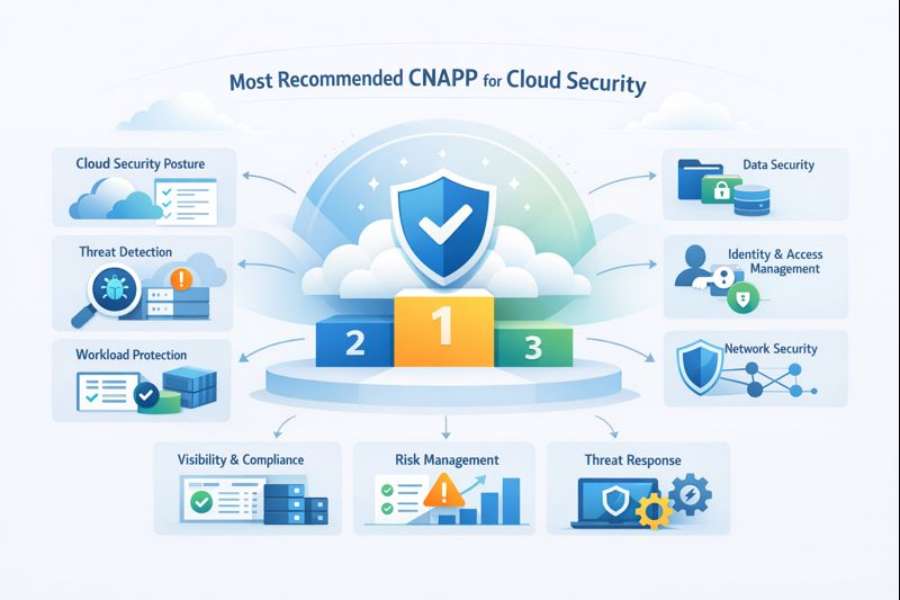
Cloud adoption continues to grow as organizations modernize their infrastructure and migrate workloads from data centers to cloud platforms. But with this evolution comes a surge in security challenges. Misconfigurations, sprawling attack surfaces, evolving threats, and shared responsibility models make cloud security complex.
- What is a CNAPP and Why It Matters for Cloud Security
- The Evolution of Cloud Security Tools
- Core Capabilities Required in a Best-In-Class CNAPP
- Why Organizations Are Choosing CNAPP Solutions
- 1. Unifying security data and context
- 2. Reducing tool sprawl
- 3. Supporting DevSecOps workflows
- 4. Enabling detection and response
- 5. Aligning cloud security with compliance
- How to Choose the Most Recommended CNAPP
- Cloud platform compatibility
- Integration with DevOps toolchains
- Real-time detection and automated response
- Contextual risk scoring
- Ease of deployment and scalability
- Compliance and reporting support
- Top Recommended CNAPP Solutions for Cloud Security in 2026
- Palo Alto Networks Prisma Cloud
- Microsoft Defender for Cloud
- Wiz Security Platform
- Lacework Cloud Security Platform
- Trend Micro Cloud One
- Check Point CloudGuard
- Orca Security
- Why These CNAPP Solutions Stand Out in 2026
- Real-World Use Cases for CNAPP Adoption
- Detecting misconfigurations before exploitation
- Prioritizing vulnerabilities across thousands of assets
- Protecting identities and permissions
- Responding to runtime threats
- Challenges in CNAPP Adoption
- How to Evaluate CNAPP ROI
- The Future of CNAPP and Cloud Security
- Final Thoughts on the Most Recommended CNAPP for Cloud Security
Cloud-native application protection platforms, commonly known as CNAPPs, are increasingly recommended as a unified approach to cloud security. CNAPPs combine multiple security disciplines into a single platform that secures workloads, data, identities, and infrastructure across cloud environments.
In this comprehensive guide, you will learn what CNAPP is, why it matters, key features to evaluate, and the most recommended CNAPP solutions for enterprise and mid-market cloud security.
What is a CNAPP and Why It Matters for Cloud Security
Cloud-native application protection platforms are built to secure modern cloud environments from development through runtime. Unlike point tools that focus on one layer—such as vulnerability scanning or cloud workload protection—CNAPP is designed to cover security broadly and cohesively.
Organizations adopting CNAPP aim to reduce blind spots, improve risk visibility, and consistently enforce security controls across cloud services, containers, serverless functions, and infrastructure.
At its core, a CNAPP converges multiple capabilities to align security with the speed and complexity of the cloud.
The Evolution of Cloud Security Tools
To understand why CNAPP is recommended, it helps to look at what came before.
Legacy approaches relied on discrete tools for:
-
Vulnerability scanning
-
Cloud security posture management
-
Runtime protection
-
Identity and access control
-
Network segmentation
Each tool generated data in isolation, creating point solutions that were difficult to correlate. This fragmentation made it hard for security teams to understand risk holistically or prioritize threats effectively.
CNAPP emerged to overcome these limitations by integrating these functions into a unified platform.
Core Capabilities Required in a Best-In-Class CNAPP
A recommended CNAPP should cover both proactive and reactive controls to secure cloud environments throughout the software lifecycle.
These capabilities include:
-
Cloud Security Posture Management (CSPM)
-
Cloud Workload Protection Platform (CWPP)
-
Vulnerability management
-
Identity and Access Management (IAM) analytics
-
Runtime threat detection and response
-
Network and data security insights
-
Infrastructure as Code (IaC) scanning
Together, these capabilities help organizations identify risk early in development and protect workloads in production.
Why Organizations Are Choosing CNAPP Solutions
Cloud security challenges are accelerating faster than legacy tools can respond. There are several strategic reasons why CNAPP has become a recommended choice:
1. Unifying security data and context
CNAPP brings disparate signals from multiple sources into a single pane of glass, improving team visibility and prioritization.
2. Reducing tool sprawl
Managing five, ten, or more disjointed tools increases cost and complexity. CNAPP replaces many of them while maintaining depth.
3. Supporting DevSecOps workflows
Security must shift left into the development pipeline. CNAPP integrates with CI/CD systems, scanning IaC templates and container images before deployment.
4. Enabling detection and response
Once workloads run in production, CNAPP solutions detect threats in real time and support automated or manual response actions.
5. Aligning cloud security with compliance
CNAPP typically includes mapping to cloud security frameworks and compliance standards, helping organizations meet audit requirements.
How to Choose the Most Recommended CNAPP
Selecting a CNAPP requires careful evaluation, as cloud environments vary widely in architecture, scale, and risk profile. Consider these factors:
Cloud platform compatibility
Ensure support for the cloud providers you use, whether it’s AWS, Azure, Google Cloud, or multi-cloud.
Integration with DevOps toolchains
A CNAPP must work with CI/CD, IaC, and developer workflows to enforce security early.
Real-time detection and automated response
Look for behavior-based detection, not just signature-based alerts.
Contextual risk scoring
Effective CNAPP platforms prioritize findings with business impact in mind.
Ease of deployment and scalability
Deployment should be straightforward and scalable to your workloads.
Compliance and reporting support
Prebuilt frameworks can expedite audit readiness and governance.
This thoughtful selection process ensures the recommended CNAPP aligns with organizational priorities rather than simply replacing existing tools.
Top Recommended CNAPP Solutions for Cloud Security in 2026
The following CNAPP solutions consistently rank among the top recommendations from security analysts, industry leaders, and cloud security teams seeking comprehensive protection.
Each is described in depth, including strengths and target use cases.
Palo Alto Networks Prisma Cloud
Overview
Palo Alto Networks Prisma Cloud is widely recommended for organizations seeking an enterprise-grade CNAPP with advanced workload and platform threat detection.
Prisma Cloud integrates CSPM, CWPP, vulnerability scanning, compliance automation, and runtime defense in a unified platform. Its AI-driven insights and broad cloud platform coverage make it a go-to choice for large, complex environments.
Key strengths
Prisma Cloud’s strengths include deep integration with AWS, Azure, and Google Cloud Platform, robust visibility into infrastructure drift, and strong compliance automation. It is particularly effective in environments with diverse workloads and heavy regulatory requirements.
Target users
-
Large enterprises
-
Multi-cloud deployments
-
Regulated industries with compliance needs
Microsoft Defender for Cloud
Overview
Microsoft Defender for Cloud is recommended for organizations with a strong Azure footprint. While it also supports AWS and GCP, its integration with Azure native tools makes it an attractive choice for enterprises primarily running on Azure.
It offers CSPM, workload protection, compliance assessment, and security alerts within the Azure portal.
Key strengths
Native integration with Azure services provides seamless workflows for teams invested in Microsoft ecosystems. Microsoft Defender also integrates with Microsoft Sentinel for unified SIEM correlation.
Target users
-
Azure-centric enterprises
-
Organizations needing integrated cloud and identity security
-
Teams already using Microsoft security products
Wiz Security Platform
Overview
Wiz has emerged as one of the most recommended CNAPPs due to its agentless architecture, rapid deployment, and deep cloud inventory insights. It focuses on risk prioritization and contextualized alerts to reduce noise and accelerate response.
Wiz ingests data across infrastructure, workloads, network configurations, identities, and IAM policies to present a unified risk picture.
Key strengths
Wiz’s agentless approach reduces overhead, allowing faster onboarding and immediate visibility. It excels at correlating signals across security domains for actionable insights.
Target users
-
Mid-market to large enterprises
-
Organizations needing rapid deployment
-
Teams requiring high-quality risk prioritization
Lacework Cloud Security Platform
Overview
Lacework is recommended when behavior-based threat detection and machine learning-driven analytics are priorities. It uses comprehensive event data and baseline learning to detect anomalies and potential threats in real time.
Lacework’s model focuses less on traditional signatures and more on patterns of behavior that deviate from expected norms.
Key strengths
Strong anomaly detection, ease of deployment, and comprehensive workload visibility make Lacework suitable for teams focused on runtime security and threat hunting.
Target users
-
Organizations with active threat hunting needs
-
Security teams emphasize runtime detection
-
Cloud operators with dynamic workloads
Trend Micro Cloud One
Overview
Trend Micro Cloud One is a recommended CNAPP for organizations balancing cloud security with broader workload protection needs. It offers vulnerability scanning, runtime defense, CSPM, and container security.
Trend Micro’s integration with automation frameworks and DevOps pipelines supports security earlier in the build process.
Key strengths
Ease of use, strong container security, and integration with scanning and CI/CD tools position Cloud One as a comprehensive option for mid-market to enterprise environments.
Target users
-
DevSecOps teams
-
Organizations with heavy container usage
-
Mid-market deployments
Check Point CloudGuard
Overview
Check Point CloudGuard combines security posture management, threat intelligence, micro-segmentation, and runtime protection. Its strength lies in extending network security principles to cloud-native environments.
CloudGuard emphasizes policy enforcement across cloud infrastructure and workloads, helping maintain consistent security guardrails.
Key strengths
Integration with existing network security controls and robust micro-segmentation capabilities make CloudGuard effective for organizations with hybrid environments.
Target users
-
Hybrid cloud operators
-
Teams needing strong segmentation
-
Organizations with existing Check Point investment
Orca Security
Overview
Orca Security is recommended for organizations that want rapid visibility without deploying agents. Its side-scanning technique retrieves deep insights into cloud assets, vulnerabilities, misconfigurations, and identity risks.
Orca’s prioritization and contextual risk scoring help security teams focus on what truly matters.
Key strengths
Agentless scanning and strong risk prioritization set Orca apart for teams seeking simplicity and depth without installation overhead.
Target users
-
Organizations prioritizing fast onboarding
-
Security teams with limited personnel
-
Teams seeking contextualized risk scoring
Why These CNAPP Solutions Stand Out in 2026
These platforms are repeatedly recommended due to their ability to:
-
Provide integrated visibility across cloud environments
-
Reduce noise with contextual risk prioritization
-
Support DevSecOps workflows and shift-left security
-
Combine preventative controls with runtime protection
-
Scale with dynamic, multi-cloud infrastructures
They represent a shift from fragmented tools to unified platforms designed for modern cloud risks.
Real-World Use Cases for CNAPP Adoption
To understand the value of a recommended CNAPP, consider real scenarios.
Detecting misconfigurations before exploitation
Misconfigurations are one of the leading causes of cloud breaches. A CNAPP ingests configuration data and compares it against best practices, alerting teams before attackers can exploit weaknesses.
Prioritizing vulnerabilities across thousands of assets
Not all vulnerabilities matter equally. CNAPP platforms correlate asset criticality, exposure, and threat intelligence to highlight what needs attention first.
Protecting identities and permissions
Cloud identity risk is a top threat vector. CNAPP tools analyze IAM policies, detect excessive permissions, and reduce attack surface.
Responding to runtime threats
Threats that bypass preventative controls must be detected during execution. CNAPP runtime modules monitor behavior and alert teams to deviations from normal patterns.
Challenges in CNAPP Adoption
Even though CNAPP is recommended, adoption is not without challenges.
Integration with legacy systems remains a common barrier. Organizations often struggle to align security workflows across both cloud and on-premise environments. Data privacy and regulatory compliance add complexity, particularly for global organizations with varied jurisdictions.
Security teams also grapple with balancing automated responses with human oversight. Too much automation can alarm teams, while too little can slow response times.
Training and process alignment are essential to mitigate these issues.
How to Evaluate CNAPP ROI
Measuring the value of a CNAPP requires focusing on outcomes rather than features. Organizations should assess:
-
Reduction in security incidents
-
Time to detect and respond to threats
-
Reduction in false positives and alert noise
-
Cost savings from tool consolidation
-
Improvement in compliance posture
These metrics help justify investment and refine security strategy over time.
The Future of CNAPP and Cloud Security
CNAPP adoption is expected to accelerate as organizations pursue greater automation, deeper insight, and stronger governance. Advances in machine learning, threat intelligence, and cloud telemetry will make future CNAPP platforms even more capable.
Integration with secure development workflows, real-time adaptive controls, and risk scoring aligned with business objectives is likely to become a baseline expectation.
Final Thoughts on the Most Recommended CNAPP for Cloud Security
In 2026, CNAPP has emerged as the recommended architectural approach for organizations seeking both breadth and depth of protection. The platforms highlighted here represent leaders in visibility, risk prioritization, scalability, and operational impact.
Selecting a CNAPP requires careful alignment with organizational goals, cloud strategy, and security maturity. When chosen wisely and implemented effectively, a CNAPP can dramatically improve an organization’s cloud risk management.