



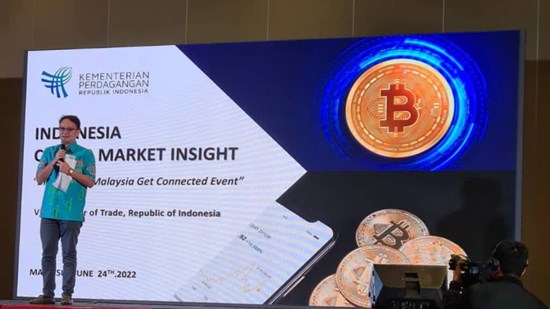
Kuala Lumpur — Indonesia’s deputy minister of trade, Jerry Sambuaga, used a regional blockchain forum in Malaysia to outline Jakarta’s regulatory approach to cryptocurrency and invite foreign investors to participate in one of Southeast Asia’s fastest-growing digital asset markets.
Sambuaga was a featured speaker at Malaysia International Blockchain Connected 2022, a two-day seminar held June 24–25 that brought together blockchain and crypto stakeholders from across Asia, North America, Europe, and the Middle East. He delivered the main address on the opening day, focusing on Indonesia’s rapidly expanding crypto trading sector and the government’s plans to manage its growth.
During his remarks, Sambuaga emphasized that cryptocurrency trading in Indonesia is regulated by Bappebti, which operates under the Ministry of Trade. He reiterated that digital assets are classified as commodities, not legal tender, under Indonesian law.
“Crypto trading is regulated because crypto in Indonesia is categorized as a commodity and not as a currency,” Sambuaga said, stressing that the rupiah remains the country’s sole legal means of payment.
The hybrid event drew participants from Indonesia, Malaysia, Singapore, New Zealand, Canada, India, Vietnam, the United Arab Emirates, Venezuela, the United States, and several European countries. In addition to policy discussions, the forum focused on innovation, education, and cross-border collaboration within the Asian blockchain ecosystem.
Sambuaga encouraged Indonesian crypto companies to continue educating the public on the use of digital assets as investment instruments. He also extended an invitation to international players to invest and operate in Indonesia’s crypto market, describing the country as a high-potential growth hub supported by a large and youthful population.
Indonesia is also preparing to launch a national crypto exchange, he said, aimed at protecting consumers, traders, and token developers alike. According to Sambuaga, regulatory clarity and consumer protection are essential if the industry is to mature sustainably.
“We cannot stop technological progress,” he said. “But we can guide it by providing proper education and clear protections for all stakeholders.”
In a panel discussion, Sambuaga cited rapid growth in Indonesia’s crypto sector. As of December 31, 2021, total transaction value had reached 859 trillion rupiah, or about $58 billion, with the number of registered crypto investors climbing to 12.5 million. The discussion also featured industry representatives including figures associated with the Monetary Authority of Singapore and the Malaysian blockchain community.
The forum concluded with a networking session and a call for closer regional cooperation. Organizers and participants expressed hope that Indonesia, Malaysia, and Singapore could align their visions to support the long-term development of Asia’s blockchain and crypto industries.
