



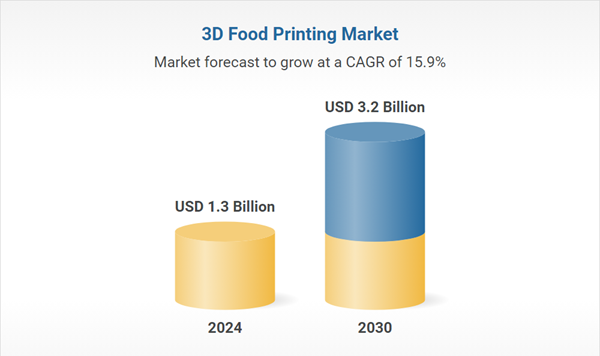
Chicago — The global 3D food printing market is poised for explosive growth over the next five years, with revenues expected to surge from about $201 million in 2022 to nearly $1.94 billion by 2027, according to a new industry report released this week.
The study, published by MarketsandMarkets, forecasts the sector will grow at a compound annual growth rate of more than 57 percent, driven by rising concern over food waste, advances in food manufacturing technology, and demand for customized nutrition.
Researchers point to large scale food production as a key contributor to global food waste, noting that 3D food printing offers a way to reuse by products such as meat off cuts, leftover fruits and vegetables, and seafood remnants. As consumer awareness of sustainability and environmental impact increases, adoption of 3D food printers by food suppliers and households is expected to accelerate.
By ingredient type, carbohydrate based materials are projected to hold the largest share of the market in 2022. Analysts say carbohydrates are well suited for 3D printing due to their gelatinization properties and widespread use in bakery and confectionery products, which remain the most common applications for printed food.
From an end use perspective, the commercial segment is expected to record the fastest growth through 2027. Many manufacturers are focusing on professional kitchens, bakeries, and food service operations, where 3D food printers are already being used to produce chocolates, candies, and breads. Major food companies including Nestlé and Barilla are also exploring printed alternatives for more complex foods, including meat products.
In terms of technology, extrusion based printing is projected to dominate the market. The technique, which builds food layer by layer using heat and pressure, is compatible with soft ingredients such as purees, cheese, frosting, and mashed potatoes. Its relatively low cost has made it the most widely adopted method, particularly among small businesses and residential users.
Regionally, North America is expected to lead the global market in 2022 and throughout the forecast period. The report attributes this dominance to the presence of early technology adopters, a strong base of 3D printing companies, and growing interest in personalized nutrition. In the United States, demand is also being fueled by healthcare applications, including printed foods designed for elderly patients with specific dietary needs or difficulty chewing and swallowing.
The report profiles several key players in the emerging industry, including companies based in the United States, Europe, and Asia, and notes that continued innovation in ingredients and printing techniques will be critical to sustaining growth.
Analysts conclude that while 3D food printing remains a niche market today, its rapid expansion signals a broader shift in how food is produced, customized, and consumed in the coming decade.
