



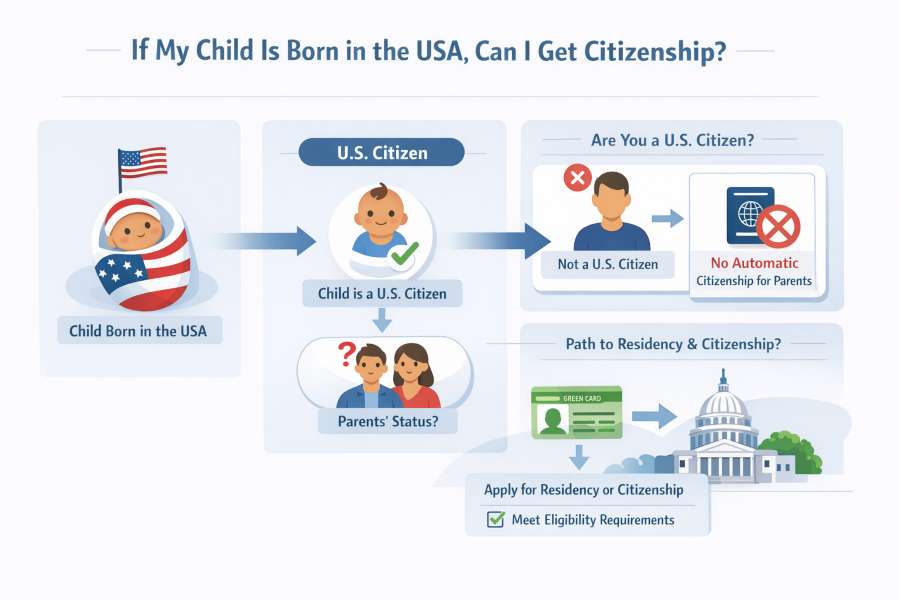
This is one of the most common immigration questions parents ask. Many people assume that having a child born in the United States automatically leads to citizenship for the parents. The reality is more nuanced. While U.S. birthright citizenship is real and powerful, it does not directly grant citizenship or legal status to the parents.
- Birthright Citizenship in the United States
- Does a U.S.-Born Child Give Parents Citizenship?
- Why This Misunderstanding Is So Common
- When Can a U.S.-Citizen Child Help a Parent Immigrate?
- What Immigration Status Do Parents Have After Birth?
- Can Parents Get a Green Card Because of a U.S.-Born Child?
- Common Legal Pathways for Parents
- Employment-based immigration
- Marriage to a U.S. citizen or green card holder
- Asylum or humanitarian protection
- Temporary visas
- Does a U.S.-Born Child Protect Parents from Deportation?
- Special Cases and Rare Exceptions
- What About Birth Tourism?
- Rights of a U.S.-Born Child
- What Happens If Parents Leave the United States?
- Can Parents Apply Later When the Child Is an Adult?
- The Single Most Important Point to Remember
- Common Myths About U.S.-Born Children and Citizenship
- When to Speak With an Immigration Attorney
- Final Thoughts on U.S. Birth and Parental Citizenship
This guide explains exactly what happens when a child is born in the U.S., what rights the child has, and what options parents may or may not have under U.S. immigration law.
Birthright Citizenship in the United States
The United States follows a legal principle known as jus soli, meaning “right of the soil.” This means citizenship is based on place of birth rather than the nationality of the parents.
Under the U.S. Constitution, specifically the 14th Amendment, any child born on U.S. soil is automatically a U.S. citizen, with very limited exceptions.
This applies regardless of:
-
The parents’ immigration status
-
Whether the parents are citizens, visa holders, or undocumented
-
How long the parents have been in the U.S.
Once born, the child has full U.S. citizenship from day one.
Does a U.S.-Born Child Give Parents Citizenship?
No. Having a child born in the United States does not give the parents U.S. citizenship or permanent residency.
Parents do not gain:
-
Automatic citizenship
-
Automatic green cards
-
Protection from deportation
-
Legal status
The child’s citizenship is separate and independent from the parents’ immigration status.
Why This Misunderstanding Is So Common
Many people confuse a child’s future rights with immediate immigration benefits for parents. While a U.S.-born child can help parents later in life, there is no immediate legal benefit at birth.
The law intentionally separates birthright citizenship from family-based immigration to prevent abuse of the system.
When Can a U.S.-Citizen Child Help a Parent Immigrate?
A U.S.-born child can sponsor a parent only after turning 21 years old.
At that point, the child may file a petition for their parent through family-based immigration.
However, approval is not guaranteed and depends on multiple factors, including:
-
The parent’s immigration history
-
Prior visa overstays or unlawful presence
-
Criminal records
-
Immigration violations
Even sponsorship by a U.S.-citizen child does not override serious immigration issues.
What Immigration Status Do Parents Have After Birth?
The parents’ immigration status remains exactly the same after the child is born.
For example:
-
Visa holders must still follow visa rules
-
Undocumented parents remain undocumented
-
Expired visas do not become valid
-
Deportation risks do not disappear
The birth of a U.S.-citizen child does not stop removal proceedings.
Can Parents Get a Green Card Because of a U.S.-Born Child?
Not immediately.
A green card through a child is only possible when:
-
The child is at least 21 years old
-
The child is financially able to sponsor the parent
-
The parent qualifies under U.S. immigration law
Until then, parents must qualify for immigration benefits through other legal pathways.
Common Legal Pathways for Parents
Parents must qualify independently through existing immigration options, such as:
Employment-based immigration
Some parents qualify through employer sponsorship if they have specialized skills.
Marriage to a U.S. citizen or green card holder
Marriage-based immigration is one of the most common legal paths, provided the marriage is genuine and meets legal requirements.
Asylum or humanitarian protection
Parents fleeing persecution may qualify for asylum or other forms of protection if they meet strict criteria.
Temporary visas
Parents may remain legally through student visas, work visas, or other temporary programs, if eligible.
Each pathway has its own requirements and limitations.
Does a U.S.-Born Child Protect Parents from Deportation?
No.
U.S. immigration authorities do not grant legal protection simply because someone has a U.S.-citizen child.
While immigration judges may consider family hardship in some cases, citizenship of a child alone does not prevent deportation.
Special Cases and Rare Exceptions
There are extremely limited situations where the child’s citizenship may factor into legal relief, such as:
-
Certain forms of cancellation of removal
-
Exceptional hardship claims
-
Humanitarian discretion
These cases are complex and require legal review. They are not automatic and do not apply to most situations.
What About Birth Tourism?
The U.S. government has increased scrutiny of individuals who travel to the U.S. primarily to give birth for citizenship purposes.
While the child remains a U.S. citizen, parents may face visa denial, revocation, or future entry bans if authorities determine the visit was misrepresented.
Birth tourism does not create a legal immigration advantage for parents.
Rights of a U.S.-Born Child
A child born in the U.S. receives full citizenship rights, including:
-
A U.S. birth certificate
-
Eligibility for a U.S. passport
-
The right to live and work in the U.S.
-
Constitutional protections
These rights belong to the child alone.
What Happens If Parents Leave the United States?
Parents may leave the U.S. with their child at any time.
The child:
-
Remains a U.S. citizen permanently
-
Can return to the U.S. in the future
-
May live abroad without losing citizenship
Citizenship does not expire, even if the child grows up outside the U.S.
Can Parents Apply Later When the Child Is an Adult?
Yes. Once the child turns 21, they may sponsor their parents.
However, parents should understand:
-
The process can take years
-
Prior unlawful presence can cause long bans
-
Waivers may be required
-
Legal assistance is often necessary
Early planning can help avoid future problems.
The Single Most Important Point to Remember
This is the only section where bullet points are used.
-
A child born in the U.S. is automatically a U.S. citizen
-
Parents do not gain citizenship or legal status at birth
-
Parents can only be sponsored after the child turns 21
-
Immigration history still matters
Understanding this distinction prevents costly mistakes.
Common Myths About U.S.-Born Children and Citizenship
Many myths circulate online and within communities.
Some of the most common myths include:
-
“The parents become legal immediately”
-
“The child can stop deportation”
-
“The child can sponsor parents right away”
-
“Citizenship passes automatically to parents”
None of these are true under U.S. law.
When to Speak With an Immigration Attorney
Parents should consider legal advice if:
-
They are undocumented
-
They have prior immigration violations
-
They are in removal proceedings
-
They plan to adjust status in the future
Early guidance can protect both parents and children.
Final Thoughts on U.S. Birth and Parental Citizenship
If your child is born in the United States, your child becomes a U.S. citizen immediately. However, you do not receive citizenship, a green card, or legal status simply because of the birth.
Parents must qualify for immigration benefits on their own and may only be sponsored by their child once the child turns 21 and meets all legal requirements.
Understanding how birthright citizenship works helps families plan realistically and avoid dangerous assumptions.