



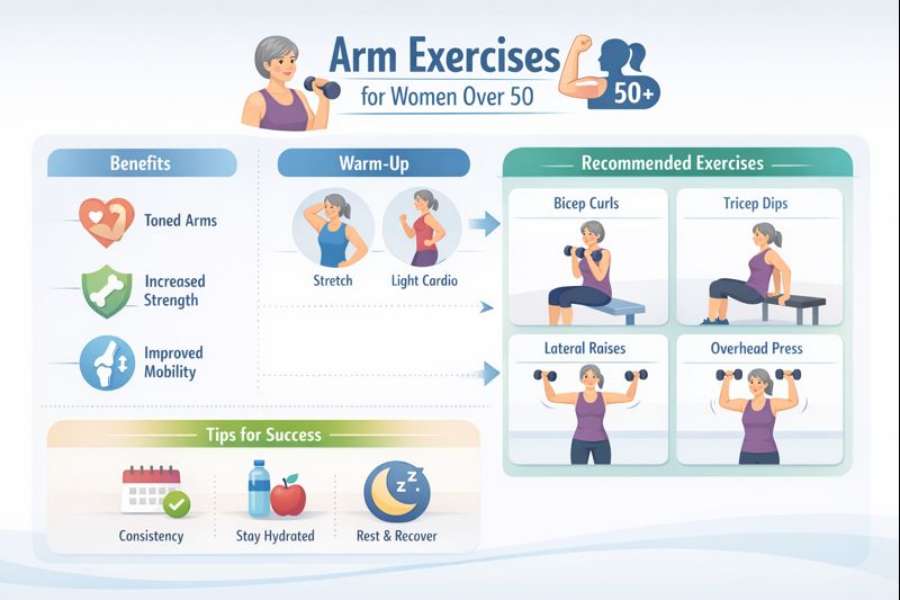
As women move past 50, their bodies begin to change in noticeable ways. Muscle mass naturally declines, joints may feel stiffer, and everyday tasks such as lifting groceries, opening jars, or reaching overhead can require more effort. Arms often show these changes first, leading many women to seek exercises that improve strength, tone, and function without risking injury.
- Why Arm Strength Matters More After 50
- Understanding Body Changes in Women Over 50
- Principles for Safe Arm Training After 50
- Warm-Up Importance for Arm Exercises
- Key Muscle Groups in the Arms
- Arm Exercises That Are Ideal for Women Over 50
- Bicep curls
- Tricep kickbacks
- Overhead tricep extensions
- Shoulder presses
- Lateral arm raises
- Front arm raises
- Chest presses
- Using Resistance Bands for Arm Training
- The Single Most Important Arm Exercises to Focus On
- How Often Women Over 50 Should Train Arms
- Repetitions and Sets for Best Results
- Breathing and Technique During Arm Exercises
- Preventing Common Arm Exercise Injuries
- Arm Exercises for Women Over 50 With Arthritis
- Arm Training and Bone Health
- Posture Improvement Through Arm Exercises
- Combining Arm Exercises With Full-Body Fitness
- Equipment Options for Home Workouts
- Tracking Progress Without the Scale
- Nutrition Support for Arm Strength
- Mental Benefits of Arm Exercises
- Adapting Arm Exercises Over Time
- When to Seek Professional Guidance
- Final Thoughts on Arm Exercises for Women Over 50
Arm exercises for women over 50 are not about chasing youthful extremes. They are about maintaining independence, protecting joints, supporting bone health, and feeling strong in daily life. This guide explains how to train the arms safely, effectively, and sustainably at this stage of life.
Why Arm Strength Matters More After 50
Arm strength plays a larger role in overall health than many people realize.
Daily function and independence
Strong arms make everyday activities easier. Carrying items, pushing doors, lifting objects, and maintaining balance all rely on upper-body strength.
Muscle loss and aging
After age 50, women experience a gradual loss of muscle mass known as sarcopenia. Without resistance training, this process accelerates and can affect mobility and posture.
Bone density and joint protection
Resistance exercises stimulate bone remodeling, which is especially important after menopause. Strong muscles also help stabilize joints, reducing strain and discomfort.
Understanding Body Changes in Women Over 50
Exercise selection should reflect physiological changes that occur with age.
Hormonal shifts
Lower estrogen levels affect muscle recovery, bone density, and connective tissue elasticity. This means recovery may take longer, and joint care becomes more important.
Joint sensitivity
Shoulders, elbows, and wrists may be more sensitive to repetitive strain. Exercises should emphasize control and alignment rather than speed.
Recovery capacity
Rest between sessions becomes more important. Progress comes from consistency, not intensity.
Principles for Safe Arm Training After 50
Before discussing specific exercises, it’s important to understand guiding principles.
Focus on control
Slow, controlled movements protect joints and improve muscle activation.
Prioritize posture
Good posture during exercises reduces shoulder and neck strain.
Start light and progress gradually
Light weights or resistance bands are often more effective than heavy loads when used consistently.
Warm-Up Importance for Arm Exercises
Warming up is essential, not optional.
Why warm-ups matter more with age
Warm muscles and joints move more freely and are less prone to injury.
Effective warm-up approach
Gentle arm circles, shoulder rolls, and light movements prepare the upper body without fatigue.
Key Muscle Groups in the Arms
Understanding which muscles you are training helps improve results.
Biceps
Located on the front of the upper arm, biceps assist with lifting and pulling.
Triceps
Located on the back of the upper arm, triceps are responsible for pushing movements and arm extension.
Shoulders
The shoulder muscles stabilize the arms and allow overhead movement.
Forearms
Forearm strength supports grip and wrist stability.
Arm Exercises That Are Ideal for Women Over 50
These exercises emphasize safety, effectiveness, and functional strength.
Bicep curls
Bicep curls strengthen the front of the arms and support daily lifting tasks. They can be done with dumbbells, resistance bands, or even household items.
Proper form involves keeping elbows close to the body and lifting slowly without swinging.
Tricep kickbacks
Tricep kickbacks target the back of the arms. They help improve arm definition and pushing strength.
Maintaining a stable torso and controlled extension is key to avoiding shoulder strain.
Overhead tricep extensions
This movement strengthens the triceps and supports overhead activities. It should be performed carefully, with attention to shoulder comfort.
Shoulder presses
Shoulder presses build strength for reaching and lifting. Using light weights and controlled motion protects the shoulder joints.
Lateral arm raises
Lateral raises improve shoulder stability and posture. They should be done with very light resistance and slow movement.
Front arm raises
Front raises strengthen the shoulders and support daily reaching motions.
Chest presses
Although often considered a chest exercise, chest presses strengthen the arms and shoulders and improve upper-body pushing strength.
Using Resistance Bands for Arm Training
Resistance bands are especially useful for women over 50.
Joint-friendly resistance
Bands provide smooth resistance that reduces joint impact.
Adjustable difficulty
Resistance can be increased by changing band length rather than weight.
Versatility
Bands allow arm exercises from seated, standing, or supported positions.
The Single Most Important Arm Exercises to Focus On
This is the only section where bullet points are used.
-
Bicep curls for lifting strength
-
Tricep extensions for pushing movements
-
Shoulder presses for overhead reach
-
Lateral raises for shoulder stability
-
Resistance band rows for arm and shoulder support
-
Wall push-ups for functional arm strength
These exercises cover the essential movement patterns needed for daily life.
How Often Women Over 50 Should Train Arms
Frequency matters more than intensity.
Recommended training schedule
Two to three arm-focused sessions per week allow enough stimulus while supporting recovery.
Rest and recovery
At least one rest day between sessions helps muscles repair and grow stronger.
Repetitions and Sets for Best Results
Volume should match individual comfort and goals.
Ideal repetition range
Higher repetitions with lighter resistance often work best for joint comfort and endurance.
Progression over time
Progress can come from better control, increased repetitions, or slightly higher resistance.
Breathing and Technique During Arm Exercises
Proper breathing supports strength and reduces strain.
Breathing pattern
Exhale during effort and inhale during relaxation phases.
Avoid holding breath
Holding breath increases blood pressure and unnecessary tension.
Preventing Common Arm Exercise Injuries
Awareness reduces injury risk.
Shoulder strain prevention
Avoid lifting weights too high or locking joints.
Elbow and wrist care
Neutral wrist alignment protects joints during curls and presses.
Arm Exercises for Women Over 50 With Arthritis
Exercise remains beneficial with joint conditions.
Low-impact modifications
Seated exercises, resistance bands, and water-based training reduce joint stress.
Range of motion focus
Gentle movement maintains joint mobility without pain.
Arm Training and Bone Health
Resistance training supports skeletal strength.
Postmenopausal bone support
Arm exercises load the bones in a safe way, helping slow bone density loss.
Consistency over intensity
Regular training is more beneficial than occasional heavy sessions.
Posture Improvement Through Arm Exercises
Arm strength contributes to better posture.
Upper-back engagement
Balanced arm training prevents rounded shoulders and neck strain.
Everyday posture awareness
Stronger arms and shoulders support upright posture during daily activities.
Combining Arm Exercises With Full-Body Fitness
Arm training works best as part of a broader routine.
Cardiovascular activity
Walking, swimming, or cycling supports circulation and overall health.
Core and lower-body training
Strong arms work best when supported by a stable core and legs.
Equipment Options for Home Workouts
Many women prefer exercising at home.
Dumbbells
Light dumbbells provide simple and effective resistance.
Resistance bands
Compact and affordable, bands are ideal for home use.
Bodyweight exercises
Wall push-ups and modified planks build arm strength without equipment.
Tracking Progress Without the Scale
Progress shows up in many forms.
Functional improvements
Lifting objects becomes easier, and endurance improves.
Visual changes
Arms may appear firmer and more defined over time.
Confidence and comfort
Feeling capable and strong is a major benefit.
Nutrition Support for Arm Strength
Exercise works best with proper nutrition.
Protein intake
Adequate protein supports muscle maintenance and repair.
Hydration
Hydration helps joint lubrication and muscle performance.
Mental Benefits of Arm Exercises
Physical strength supports emotional well-being.
Confidence boost
Feeling physically capable improves self-image.
Stress reduction
Exercise releases tension and supports mental clarity.
Adapting Arm Exercises Over Time
Needs change with age.
Listening to the body
Adjust resistance or volume based on comfort.
Long-term sustainability
Exercises should feel supportive, not punishing.
When to Seek Professional Guidance
Some situations benefit from expert input.
Physical therapists
Helpful for injury recovery or chronic pain.
Certified trainers
Useful for learning proper technique and progression.
Final Thoughts on Arm Exercises for Women Over 50
Arm exercises for women over 50 are about strength, function, and confidence, not chasing unrealistic ideals. With thoughtful movement, proper technique, and consistency, women can maintain strong, capable arms that support daily life and long-term health.
It is never too late to build strength. The key is to move with intention, respect the body, and make exercise a regular, supportive part of life.