



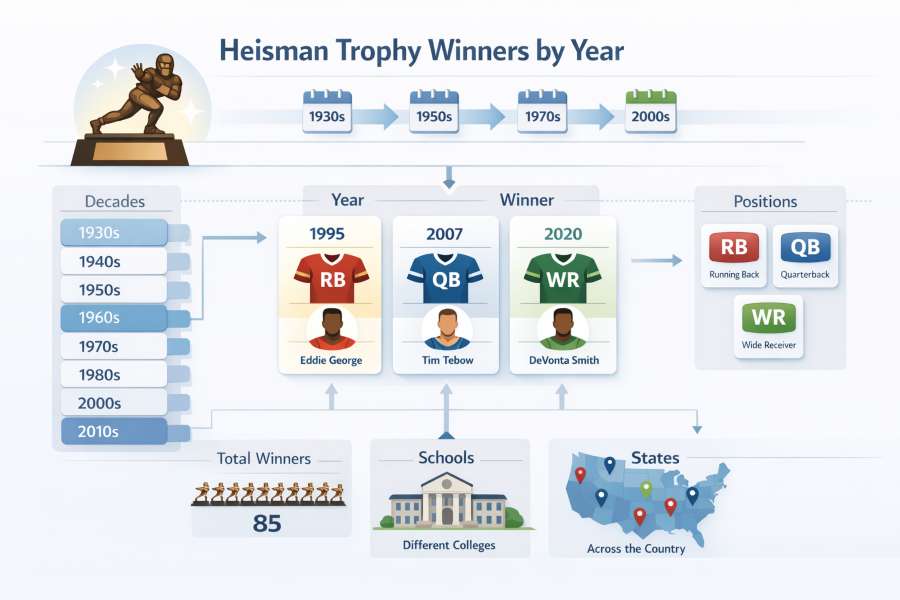
The Heisman Trophy is the most prestigious individual award in college football. Awarded annually to the most outstanding player in NCAA football, it has become a defining symbol of excellence, performance, and impact on the game. Since its first presentation in 1935, the Heisman Trophy has recognized players who shaped college football history.
This guide provides a year-by-year list of Heisman Trophy winners, along with context on how the award evolved and what the trends reveal about the sport.
What Is the Heisman Trophy?
The Heisman Trophy is awarded each year by the Heisman Trophy Trust. Voters include sports journalists, former winners, and select college football officials.
The award honors the player judged to be the most outstanding in college football, considering performance, leadership, and influence on team success.
Heisman Trophy Winners by Year
1930s–1940s
1935 – Jay Berwanger, Chicago
1936 – Larry Kelley, Yale
1937 – Clint Frank, Yale
1938 – Davey O’Brien, TCU
1939 – Nile Kinnick, Iowa
1940 – Tom Harmon, Michigan
1941 – Bruce Smith, Minnesota
1942 – Frank Sinkwich, Georgia
1943 – Angelo Bertelli, Notre Dame
1944 – Les Horvath, Ohio State
1945 – Doc Blanchard, Army
1946 – Glenn Davis, Army
1947 – Johnny Lujack, Notre Dame
1948 – Doak Walker, SMU
1949 – Leon Hart, Notre Dame
1950s
1950 – Vic Janowicz, Ohio State
1951 – Dick Kazmaier, Princeton
1952 – Billy Vessels, Oklahoma
1953 – Johnny Lattner, Notre Dame
1954 – Alan Ameche, Wisconsin
1955 – Howard Cassady, Ohio State
1956 – Paul Hornung, Notre Dame
1957 – John David Crow, Texas A&M
1958 – Pete Dawkins, Army
1959 – Billy Cannon, LSU
1960s
1960 – Joe Bellino, Navy
1961 – Ernie Davis, Syracuse
1962 – Terry Baker, Oregon State
1963 – Roger Staubach, Navy
1964 – John Huarte, Notre Dame
1965 – Mike Garrett, USC
1966 – Steve Spurrier, Florida
1967 – Gary Beban, UCLA
1968 – O.J. Simpson, USC
1969 – Steve Owens, Oklahoma
1970s
1970 – Jim Plunkett, Stanford
1971 – Pat Sullivan, Auburn
1972 – Johnny Rodgers, Nebraska
1973 – John Cappelletti, Penn State
1974 – Archie Griffin, Ohio State
1975 – Archie Griffin, Ohio State
1976 – Tony Dorsett, Pittsburgh
1977 – Earl Campbell, Texas
1978 – Billy Sims, Oklahoma
1979 – Charles White, USC
1980s
1980 – George Rogers, South Carolina
1981 – Marcus Allen, USC
1982 – Herschel Walker, Georgia
1983 – Mike Rozier, Nebraska
1984 – Doug Flutie, Boston College
1985 – Bo Jackson, Auburn
1986 – Vinny Testaverde, Miami
1987 – Tim Brown, Notre Dame
1988 – Barry Sanders, Oklahoma State
1989 – Andre Ware, Houston
1990s
1990 – Ty Detmer, BYU
1991 – Desmond Howard, Michigan
1992 – Gino Torretta, Miami
1993 – Charlie Ward, Florida State
1994 – Rashaan Salaam, Colorado
1995 – Eddie George, Ohio State
1996 – Danny Wuerffel, Florida
1997 – Charles Woodson, Michigan
1998 – Ricky Williams, Texas
1999 – Ron Dayne, Wisconsin
2000s
2000 – Chris Weinke, Florida State
2001 – Eric Crouch, Nebraska
2002 – Carson Palmer, USC
2003 – Jason White, Oklahoma
2004 – Matt Leinart, USC
2005 – Reggie Bush, USC
2006 – Troy Smith, Ohio State
2007 – Tim Tebow, Florida
2008 – Sam Bradford, Oklahoma
2009 – Mark Ingram, Alabama
2010s
2010 – Cam Newton, Auburn
2011 – Robert Griffin III, Baylor
2012 – Johnny Manziel, Texas A&M
2013 – Jameis Winston, Florida State
2014 – Marcus Mariota, Oregon
2015 – Derrick Henry, Alabama
2016 – Lamar Jackson, Louisville
2017 – Baker Mayfield, Oklahoma
2018 – Kyler Murray, Oklahoma
2019 – Joe Burrow, LSU
2020s
2020 – DeVonta Smith, Alabama
2021 – Bryce Young, Alabama
2022 – Caleb Williams, USC
2023 – Jayden Daniels, LSU
2024 – Quinn Ewers, Texas
Trends in Heisman Trophy Winners
Position trends
Quarterbacks dominate modern Heisman voting, especially since the 2000s. Earlier decades saw more running backs, linemen, and even defensive players receive the award.
Repeat winners
Only one player has won the Heisman Trophy twice: Archie Griffin of Ohio State.
Schools with the most winners
Programs like USC, Ohio State, Notre Dame, and Oklahoma have produced multiple winners, reflecting sustained elite football success.
Why the Heisman Trophy Still Matters
Winning the Heisman Trophy often leads to:
-
National recognition
-
Higher NFL draft positioning
-
Long-term legacy in college football history
Even finalists who do not win often see career benefits.
The Only Section Where Bullet Points Are Used
-
The Heisman Trophy has been awarded since 1935
-
Quarterbacks dominate modern winners
-
Archie Griffin is the only two-time winner
-
USC, Ohio State, and Oklahoma lead in total winners
-
The award reflects performance, impact, and leadership
These points summarize the award’s historical significance.
Final Thoughts on Heisman Trophy Winners by Year
The Heisman Trophy tells the story of college football through its most dominant and influential players. From early Ivy League stars to modern dual-threat quarterbacks, each winner reflects the era they played in.