



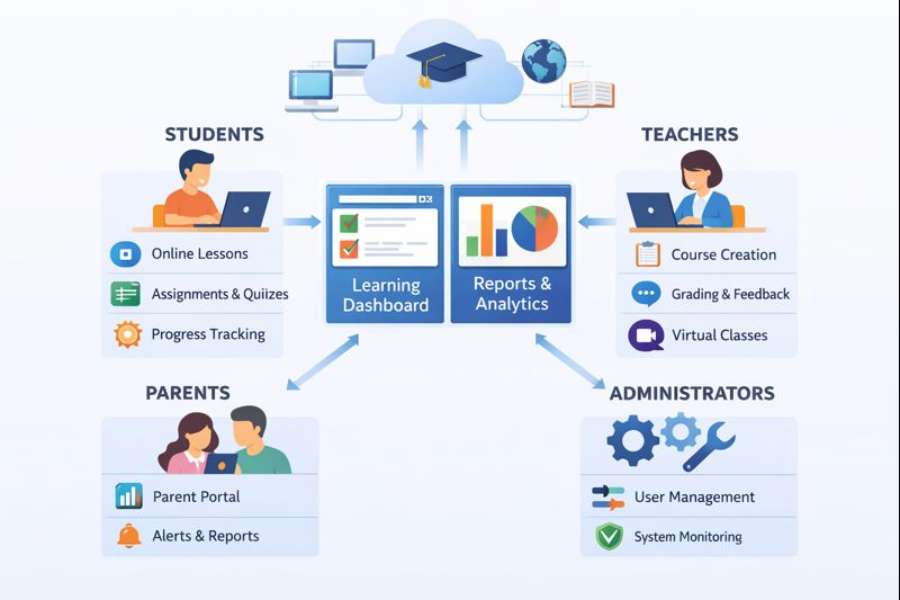
In today’s digital classroom environment, the K12 learning management system (LMS) plays a central role in organizing instruction, tracking student progress, and connecting teachers, students, and families. Whether learning takes place in person, remotely, or in a hybrid model, an LMS supports communication, assessment, and engagement across grades K–12.
- What Is a K12 Learning Management System?
- Core Features of a K12 LMS
- Course and Content Management
- Assignment Distribution and Submission
- Gradebook and Reporting
- Communication Tools
- Assessments and Quizzes
- Parent Access and Dashboards
- Why K12 LMS Platforms Have Become Essential
- How Schools Implement K12 LMS Platforms
- Popular K12 Learning Management Systems
- How an LMS Supports Teachers
- How It Benefits Students
- Parent and Family Engagement Through LMS
- Common Challenges With K12 LMS Adoption
- The One Section Where Bullet Points Are Used
- Trends in K12 LMS Use
- How to Evaluate an LMS for Your School
- The Future of LMS in K12 Education
- Final Thoughts on K12 Learning Management Systems
This comprehensive guide explains what a K12 LMS is, key features, how schools implement it, benefits and challenges, and how it shapes modern education.
What Is a K12 Learning Management System?
A K12 learning management system is a software platform designed specifically for primary and secondary education. It provides a centralized environment where teachers can:
-
Distribute lessons and assignments
-
Share resources and content
-
Track student participation
-
Communicate with students and parents
-
Assess learning and record grades
Unlike corporate LMS platforms, a K12 LMS is tailored to the developmental and administrative needs of K–12 education.
Core Features of a K12 LMS
A well-designed K12 LMS includes functionality that supports instruction, assessment, and collaboration. Common features include:
Course and Content Management
Teachers can organize lessons, modules, and multimedia resources into structured units that align with curriculum standards.
Assignment Distribution and Submission
Students access assignments online and submit responses, while teachers can view, comment, and grade digitally.
Gradebook and Reporting
Integrated gradebooks automate scoring, track progress, and generate reports for students, parents, and administrators.
Communication Tools
Messaging, announcements, discussion boards, and alerts keep teachers, students, and families connected.
Assessments and Quizzes
Built-in tools allow for formative and summative assessments, with automatic scoring and analytics in some cases.
Parent Access and Dashboards
Family portals provide visibility into assignments, grades, and upcoming deadlines, improving home-school collaboration.
Why K12 LMS Platforms Have Become Essential
Several educational trends accelerated LMS adoption long before remote learning became widespread:
Personalized Learning
LMS tools help differentiate instruction by enabling teachers to tailor content and pacing to individual student needs.
Data-Driven Instruction
Centralized data allows teachers to identify learning gaps and adjust strategies based on performance analytics.
Continuity of Learning
An LMS ensures that learning materials and progress remain accessible across classrooms, schedules, and instructional models.
Parent Engagement
Family portals and real-time updates strengthen communication and help parents support student learning at home.
How Schools Implement K12 LMS Platforms
Implementing an LMS requires coordination across teachers, students, IT staff, and administrators.
Successful implementation includes:
Professional Development
Training teachers and support staff on platform functionality, instructional design within the LMS, and best practices for digital engagement.
Infrastructure Readiness
Ensuring reliable devices and internet access for students and teachers, whether in school or at home.
Content Integration
Organizing curriculum materials, digital textbooks, and learning resources into the LMS for seamless access.
Policy and Privacy Compliance
Adhering to student data privacy laws, such as COPPA and FERPA, to protect student information.
Popular K12 Learning Management Systems
Schools choose among a range of LMS options based on needs, budget, and compatibility.
Some widely adopted K12 LMS platforms include:
-
Systems designed for district-wide rollout
-
Tools with built-in assessment and analytics
-
Platforms that integrate seamlessly with student information systems
The choice often depends on instructional goals, technological maturity, and community needs.
How an LMS Supports Teachers
A K12 LMS helps teachers save time, stay organized, and enhance instruction:
-
Distributes lessons to large groups without printing
-
Automates grading and tracking of routine assignments
-
Provides analytics to inform lesson planning
-
Offers communication channels for announcements and feedback
-
Enables asynchronous learning and differentiated pacing
These functions help teachers focus more on instruction and less on coordinating logistics.
How It Benefits Students
Students using a K12 LMS experience several advantages:
-
Clear access to assignments and calendars
-
Centralized learning materials
-
Immediate feedback on quizzes and lessons
-
Multiple interaction channels with teachers and peers
-
Ability to review past lessons and resources
For students who struggle or need enrichment, LMS resources provide flexibility and additional learning pathways.
Parent and Family Engagement Through LMS
Family engagement is a key advantage of a K12 LMS. Parent portals allow families to:
-
Monitor student progress
-
See upcoming assignments
-
Communicate with teachers
-
Support learning at home
This transparency builds trust and encourages active participation in the learning process.
Common Challenges With K12 LMS Adoption
While LMS platforms offer many benefits, implementation is not without obstacles:
Digital Divide
Not all students have equal access to devices or stable internet at home, creating equity concerns.
Training Gaps
Teachers need ongoing professional development to use LMS tools effectively.
Platform Overload
Using too many disconnected tools can overwhelm students and teachers if an LMS is not well-integrated.
Change Management
Shifting instructional practices requires time, support, and leadership commitment.
The One Section Where Bullet Points Are Used
-
A K12 LMS centralizes lesson delivery and tracking
-
Parent portals improve family engagement
-
Analytics support data-informed teaching
-
Assessment tools streamline grading workflows
-
Integration with administrative systems enhances coordination
These points highlight key benefits of a K12 LMS in practice.
Trends in K12 LMS Use
K12 LMS platforms continue to evolve with trends such as:
Adaptive Learning Technology
Systems that adjust content based on student performance.
Mobile Optimization
Platforms compatible with phones and tablets for anytime access.
Collaboration Tools
Built-in video conferencing, group workspaces, and discussion boards.
Data Dashboards
Advanced analytics that help educators visualize performance patterns.
These innovations expand how teachers engage students and personalize learning.
How to Evaluate an LMS for Your School
When choosing a K12 LMS, consider key factors:
Usability
Is the interface intuitive for students, teachers, and families?
Functionality
Does the platform include essential features like gradebooks, messaging, and assessments?
Support and Training
Are vendor resources available for onboarding and troubleshooting?
Privacy and Security
Does the system meet legal standards for student data protection?
Integration
Can it connect with existing student information systems and digital resources?
Prioritizing these criteria can guide a successful selection process.
The Future of LMS in K12 Education
K12 learning management systems are becoming a standard component of modern education. As technology grows more sophisticated, LMS platforms will likely offer:
-
Stronger personalization
-
Better mobile interfaces
-
Expanded integration with educational tools
-
More intuitive parent engagement features
-
Enhanced analytics for early intervention
These developments promise more flexible, data-informed learning environments.
Final Thoughts on K12 Learning Management Systems
A K12 learning management system is more than software. It is the backbone of digital learning that connects instruction, assessment, communication, and engagement in one platform. When implemented thoughtfully, an LMS supports teachers, empowers students, and strengthens family partnership in education.