



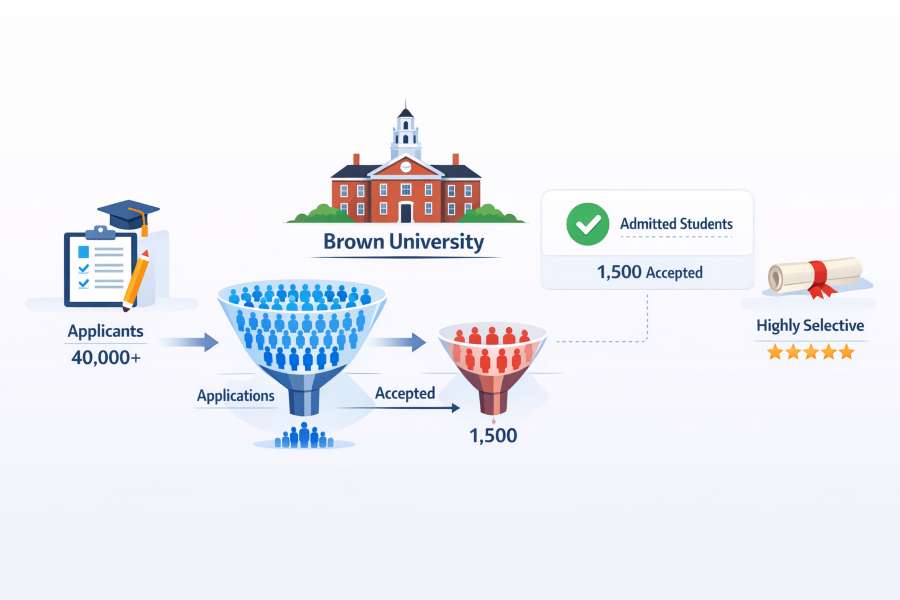
Brown University is one of the most selective colleges in the United States. As a member of the Ivy League, Brown attracts tens of thousands of high-achieving applicants each year, while offering admission to only a small fraction of them. Understanding Brown’s acceptance rate helps applicants realistically assess their chances and plan a competitive application strategy.
- Overview of Brown University
- Brown University Acceptance Rate
- Early Decision vs Regular Decision Acceptance Rates
- Why Brown’s Acceptance Rate Is So Low
- Trends in Brown University Admissions
- Academic Profile of Admitted Students
- Test Scores and Test-Optional Policy
- Role of Essays in Brown Admissions
- Extracurricular Activities and Impact
- How Brown’s Acceptance Rate Compares to Other Ivy League Schools
- What Brown Looks for Beyond Numbers
- The One Section Where Bullet Points Are Used
- Does a Low Acceptance Rate Mean You Should Not Apply?
- How Applicants Can Strengthen Their Chances
- Final Thoughts on Brown University Acceptance Rate
This guide explains Brown University’s acceptance rate, how it has changed over time, what factors influence admissions decisions, and what strong applicants typically have in common.
Overview of Brown University
Brown University is a private Ivy League institution located in Providence, Rhode Island. Known for its Open Curriculum, Brown emphasizes academic freedom, interdisciplinary study, and student-driven learning.
This distinctive academic philosophy attracts applicants who value flexibility, creativity, and intellectual independence.
Brown University Acceptance Rate
Brown University’s acceptance rate has become increasingly competitive over the past decade.
In recent admission cycles, Brown’s overall acceptance rate has been around 5 to 6 percent, placing it among the most selective universities in the country. This means that out of every 100 applicants, roughly five or six are offered admission.
The rate can vary slightly from year to year depending on application volume and institutional priorities.
Early Decision vs Regular Decision Acceptance Rates
Brown offers both Early Decision (ED) and Regular Decision (RD) application options.
Early Decision
Applicants who apply Early Decision commit to attending Brown if admitted. Historically, the acceptance rate for Early Decision applicants is higher than Regular Decision, though it remains extremely selective.
The higher ED rate reflects a smaller applicant pool and Brown’s preference for students who clearly demonstrate commitment to the university.
Regular Decision
Regular Decision acceptance rates are typically lower, as this pool includes a much larger number of applicants competing for fewer remaining spots.
Why Brown’s Acceptance Rate Is So Low
Several factors contribute to Brown’s low acceptance rate.
High application volume
Brown receives tens of thousands of applications each year, driven by its Ivy League status and reputation for academic innovation.
Limited class size
Brown intentionally keeps its undergraduate enrollment relatively small, limiting the number of seats available.
Self-selection of applicants
Many applicants are already top performers academically, making competition especially intense.
Trends in Brown University Admissions
Brown’s acceptance rate has steadily declined over time.
A decade ago, acceptance rates were noticeably higher. The rise of the Common Application, increased global interest, and test-optional policies have significantly expanded the applicant pool.
As a result, admission has become more competitive even for highly qualified students.
Academic Profile of Admitted Students
While Brown does not publish rigid cutoffs, admitted students typically demonstrate exceptional academic strength.
This often includes:
-
Top grades in rigorous coursework
-
Strong performance in honors, AP, IB, or equivalent programs
-
Intellectual curiosity reflected in academic choices
Brown places emphasis on depth of learning rather than simply accumulating credentials.
Test Scores and Test-Optional Policy
Brown has adopted a test-optional admissions policy.
Students may submit SAT or ACT scores, but doing so is not required. Admitted students who submit scores generally fall in the top national percentiles.
Applicants who choose not to submit test scores are evaluated holistically, with greater emphasis on coursework, writing, and recommendations.
Role of Essays in Brown Admissions
Essays play a critical role in Brown’s holistic review process.
Brown looks for:
-
Authentic voice
-
Intellectual curiosity
-
Alignment with the Open Curriculum
-
Thoughtful reflection and self-awareness
Strong essays often distinguish admitted students from equally qualified applicants.
Extracurricular Activities and Impact
Brown values meaningful engagement over long activity lists.
Successful applicants often show:
-
Leadership in a few areas
-
Depth of commitment
-
Creative or independent projects
-
Community involvement
Impact matters more than prestige or quantity.
How Brown’s Acceptance Rate Compares to Other Ivy League Schools
Brown’s acceptance rate is comparable to other Ivy League institutions.
While slight differences exist year to year, Brown consistently ranks among the most selective universities alongside schools like Harvard, Yale, and Princeton.
Acceptance rates alone do not determine fit, but they highlight the level of competition.
What Brown Looks for Beyond Numbers
Brown’s admissions process is holistic.
The university considers:
-
Academic achievement
-
Personal character
-
Intellectual independence
-
Contribution to campus community
Applicants are evaluated in context, including school environment and available opportunities.
The One Section Where Bullet Points Are Used
-
Brown’s acceptance rate is around 5–6 percent
-
Early Decision applicants have a slightly higher admit rate
-
Application volume has increased significantly
-
Essays and fit with the Open Curriculum matter greatly
-
Admissions decisions are holistic, not formula-based
These points summarize what applicants should understand about Brown admissions.
Does a Low Acceptance Rate Mean You Should Not Apply?
Not necessarily.
A low acceptance rate reflects competitiveness, not impossibility. Brown seeks students who align with its academic philosophy and campus culture, not just perfect résumés.
Applicants who clearly demonstrate fit and intellectual engagement may still stand out.
How Applicants Can Strengthen Their Chances
Students applying to Brown should focus on:
-
Challenging themselves academically
-
Writing thoughtful, personal essays
-
Pursuing interests deeply rather than broadly
-
Seeking strong teacher recommendations
-
Clearly explaining why Brown’s Open Curriculum fits their goals
Authenticity and clarity matter more than perfection.
Final Thoughts on Brown University Acceptance Rate
Brown University’s acceptance rate reflects its status as one of the most selective institutions in the world. With only a small percentage of applicants admitted each year, competition is intense.
However, Brown’s holistic admissions process means that strong academic performance combined with genuine intellectual curiosity and personal insight can still lead to success. Understanding the acceptance rate is important, but understanding fit is essential