



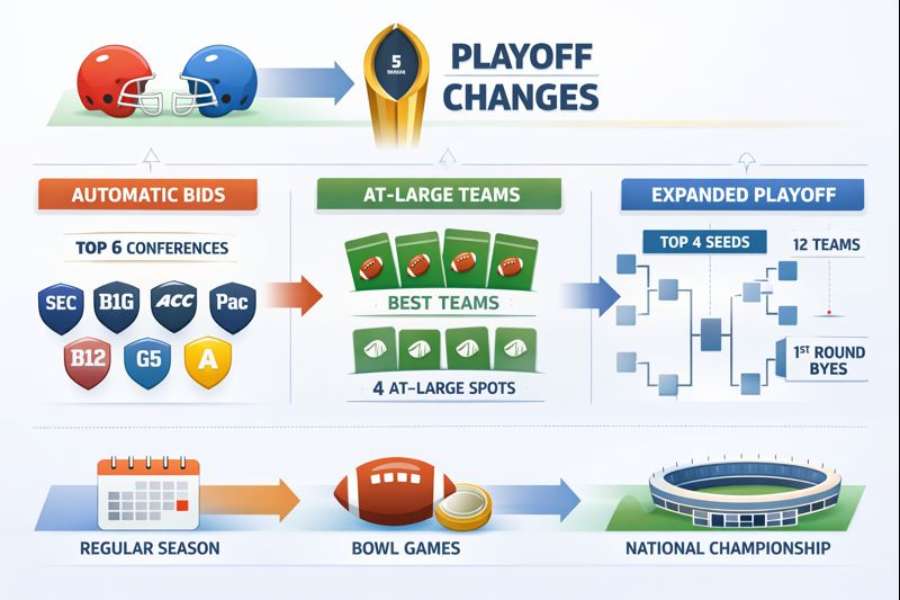
The College Football Playoff has undergone its most significant transformation since its creation. What began as a four-team system has now expanded, reshaping how teams qualify, how champions are crowned, and how the college football postseason operates. These changes are designed to increase access, fairness, and excitement while preserving the importance of the regular season.
- What Is the College Football Playoff?
- Why the College Football Playoff Was Changed
- The New Expanded College Football Playoff Format
- How Teams Qualify Under the New System
- Seeding and First-Round Byes
- Where Playoff Games Are Played
- Impact on the Regular Season
- How Conference Championships Are Affected
- Effects on Smaller Conferences
- Television and Revenue Implications
- Player Experience and Workload Concerns
- Criticism and Ongoing Debate
- How the Changes Affect National Championship Odds
- The One Section Where Bullet Points Are Used
- How the College Football Landscape Is Changing
- What Fans Can Expect Going Forward
- Final Thoughts on College Football Playoff Changes
This guide explains the College Football Playoff changes, why they happened, how the new format works, and what it means for teams, conferences, and fans.
What Is the College Football Playoff?
The College Football Playoff determines the national champion of major college football. It replaced the Bowl Championship Series to create a clearer path to a title game.
The system is overseen by the College Football Playoff, which sets the structure, selection process, and bowl partnerships.
For nearly a decade, the playoff featured only four teams. That model is now history.
Why the College Football Playoff Was Changed
The four-team playoff faced growing criticism.
Many argued it:
-
Excluded deserving teams
-
Overvalued subjective rankings
-
Favored a small group of power programs
-
Reduced national interest late in the season
As conferences expanded and schedules grew more complex, pressure mounted for a more inclusive postseason.
The New Expanded College Football Playoff Format
The most dramatic change is expansion from four teams to twelve.
The new playoff format includes:
-
Twelve total teams
-
Automatic bids for top conference champions
-
At-large selections for remaining spots
-
A multi-round elimination structure
This expansion significantly increases access while preserving elite competition.
How Teams Qualify Under the New System
Qualification now balances performance and opportunity.
Automatic qualifiers
The highest-ranked conference champions receive automatic bids. This ensures that winning a conference title carries real postseason value.
At-large selections
Additional teams are chosen based on rankings, allowing strong teams that do not win their conference to still compete.
This approach blends objective achievement with comparative evaluation.
Seeding and First-Round Byes
Seeding is another major change.
The highest-ranked teams receive first-round byes, rewarding regular-season excellence. Lower-seeded teams must compete in the opening round, adding pressure and excitement.
This structure creates meaningful differences between finishing first and finishing lower in the rankings.
Where Playoff Games Are Played
The new format changes where games occur.
Early-round games are hosted on campus by higher-seeded teams, giving home-field advantage to top performers. Later rounds rotate through traditional bowl sites.
This blend preserves bowl traditions while adding intensity to early playoff rounds.
Impact on the Regular Season
One concern with expansion was that it might reduce regular-season importance. Instead, the changes have arguably increased it.
Teams now compete not just for playoff inclusion, but for:
-
Higher seeding
-
Home-field advantage
-
First-round byes
Losses still matter, but one setback no longer ends championship hopes.
How Conference Championships Are Affected
Conference title games now carry greater significance.
Winning a conference can guarantee playoff entry, while losing may push a team into at-large uncertainty. This reinforces the importance of conference competition even in an expanded field.
Effects on Smaller Conferences
One of the most notable benefits of the changes is increased access for smaller conferences.
Under the new system:
-
More conferences can realistically reach the playoff
-
Undefeated or dominant seasons are rewarded
-
National exposure increases
This improves competitive balance and broadens the playoff narrative.
Television and Revenue Implications
Expansion dramatically increases the number of high-stakes games, which boosts television value.
More games mean:
-
Increased broadcast revenue
-
Wider fan engagement
-
Greater postseason exposure for programs
These financial incentives were a major driver behind the changes.
Player Experience and Workload Concerns
With more games come concerns about player health.
Teams reaching the championship may now play additional postseason games, raising questions about:
-
Injury risk
-
Recovery time
-
Academic schedules
Governing bodies continue to evaluate how to manage player welfare within the expanded structure.
Criticism and Ongoing Debate
Despite widespread support, the new format is not without critics.
Some argue:
-
The playoff could resemble professional leagues too closely
-
Traditional bowl games lose significance
-
Elite programs still dominate
These debates will continue as the system evolves.
How the Changes Affect National Championship Odds
The expanded playoff makes Cinderella runs more possible.
Upsets are more likely in a larger field, and depth becomes crucial over multiple rounds. This shifts how teams build rosters and manage seasons.
Championship paths are now longer but more accessible.
The One Section Where Bullet Points Are Used
-
The playoff expanded from four teams to twelve
-
Conference champions receive automatic bids
-
Higher seeds earn home games and byes
-
More teams have a path to a title
-
The regular season still strongly affects seeding
These points summarize the core College Football Playoff changes.
How the College Football Landscape Is Changing
The playoff expansion reflects broader shifts in college football, including conference realignment, media influence, and national branding.
As conferences grow larger and schedules change, a more flexible postseason structure helps accommodate the sport’s new realities.
What Fans Can Expect Going Forward
Fans should expect:
-
More playoff games
-
Greater late-season drama
-
Increased national representation
-
Higher stakes across the rankings
The postseason now resembles a true tournament rather than a short invitational.
Final Thoughts on College Football Playoff Changes
The College Football Playoff changes mark a turning point for the sport. Expansion opens the door to more teams, more games, and more meaningful competition, while still rewarding excellence.
While debate remains, the new format creates a clearer, fairer path to a national championship and reshapes the future of college football in a lasting way.