



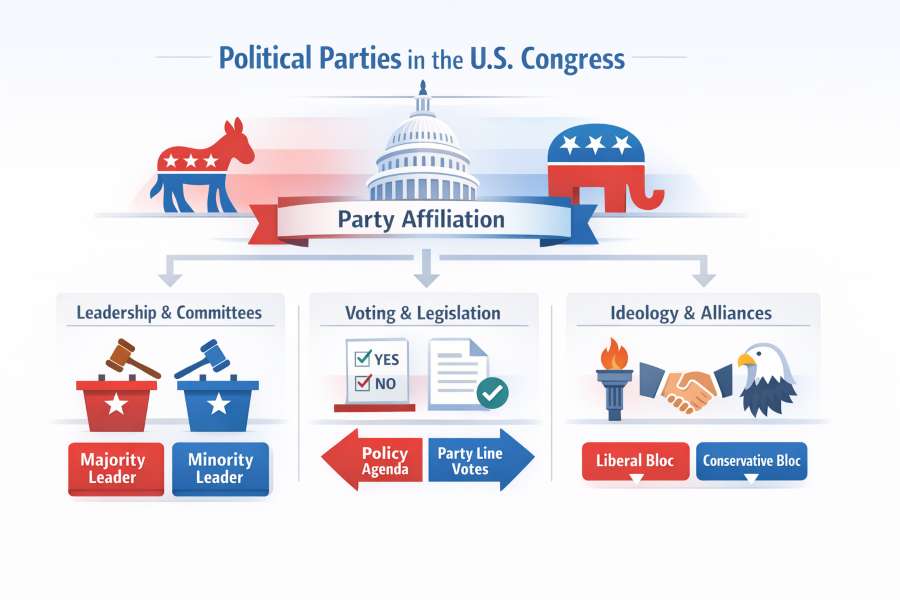
Political parties play a central role in how the U.S. Congress operates. While the Constitution does not mention political parties, party affiliation has become one of the most influential forces in lawmaking, leadership selection, committee control, and legislative outcomes. Understanding why parties matter helps explain how Congress functions day to day and why political debates often follow party lines.
- The Structure of Congress and Party Organization
- Party Affiliation Determines Leadership Positions
- Control of Committees Depends on Party Majority
- Party Affiliation Shapes Legislative Priorities
- Voting Patterns and Party Discipline
- Party Affiliation and Agenda Control
- Minority Parties Still Matter
- Party Affiliation and Coalition Building
- The Role of Party Caucuses
- Why Parties Matter More Today Than in the Past
- The One Section Where Bullet Points Are Used
- Are Political Parties Required by the Constitution?
- Can Members Act Independently of Their Party?
- How Party Affiliation Affects Lawmaking Outcomes
- Final Thoughts on Political Parties in the U.S. Congress
This article explains why political parties are important in the U.S. Congress, how party affiliation affects power, and what that means for legislation and governance.
The Structure of Congress and Party Organization
The United States Congress is divided into two chambers: the House of Representatives and the Senate. Members are elected individually, but once in office, they organize themselves largely by political party.
Party affiliation determines how members coordinate, form voting blocs, and pursue shared policy goals. Without parties, Congress would function as a collection of hundreds of independent actors with no consistent structure.
Party Affiliation Determines Leadership Positions
One of the most important reasons political parties matter is leadership selection.
The majority party in each chamber chooses key leaders who control the legislative agenda. These leaders include:
-
The Speaker of the House
-
The House Majority and Minority Leaders
-
The Senate Majority and Minority Leaders
Leadership roles come with authority over scheduling votes, recognizing speakers, and guiding legislation. Party affiliation determines who holds these positions and how power is distributed.
Control of Committees Depends on Party Majority
Committees are where most congressional work happens. Bills are debated, amended, and sometimes blocked entirely at the committee level.
Party affiliation determines:
-
Which party controls each committee
-
Who serves as committee chair
-
How many seats each party holds on a committee
Committee chairs, chosen from the majority party, set hearing agendas, decide which bills advance, and oversee investigations. This gives the majority party substantial influence over policy outcomes.
Party Affiliation Shapes Legislative Priorities
Political parties represent shared ideological platforms. Members of Congress generally align their votes with party priorities, especially on major issues.
Party affiliation influences:
-
Which bills are introduced
-
Which policies receive funding
-
How legislation is framed and debated
While members can vote independently, party unity increases the likelihood that shared goals become law.
Voting Patterns and Party Discipline
Although members of Congress are not legally bound to vote with their party, party affiliation strongly influences voting behavior.
Party leaders use persuasion, negotiation, and political incentives to encourage unity. Members often vote with their party because:
-
They share ideological beliefs
-
Party support helps with reelection
-
Committee assignments depend on leadership approval
As a result, many votes split along party lines, especially on high-profile legislation.
Party Affiliation and Agenda Control
Agenda control is one of the most powerful tools in Congress.
The majority party determines:
-
Which bills reach the floor
-
When votes occur
-
Whether legislation is delayed or accelerated
If a party does not control the agenda, it has limited ability to enact its policy priorities, even if individual members propose popular ideas.
Minority Parties Still Matter
Even when a party does not hold the majority, it remains influential.
Minority parties can:
-
Offer alternative policy proposals
-
Use procedural tools to delay legislation
-
Shape public debate
-
Influence closely divided votes
In the Senate, minority parties have additional leverage due to rules that allow extended debate and negotiation.
Party Affiliation and Coalition Building
Political parties simplify coalition building.
Rather than negotiating with every individual member, leaders can work through party structures to secure support. This efficiency makes large-scale legislation possible in a complex legislative body.
Coalitions still form across party lines on certain issues, but party affiliation remains the primary organizing force.
The Role of Party Caucuses
Each party forms internal caucuses or conferences where members discuss strategy, policy positions, and leadership decisions.
These caucuses:
-
Coordinate messaging
-
Develop legislative priorities
-
Resolve internal disagreements
Caucus decisions often shape how members vote on the floor.
Why Parties Matter More Today Than in the Past
Political parties have grown more important as Congress has become more polarized.
Ideological differences between parties are sharper, making party affiliation a stronger predictor of voting behavior. Close margins in both chambers also increase the value of party unity and discipline.
In tightly divided Congresses, even a single defection can alter outcomes.
The One Section Where Bullet Points Are Used
-
Party affiliation determines congressional leadership
-
Majority parties control committees and agendas
-
Parties coordinate legislative priorities
-
Voting patterns often follow party lines
-
Party organization makes large-scale lawmaking possible
These points explain why parties are central to congressional power.
Are Political Parties Required by the Constitution?
No. The Constitution does not establish political parties or require members to affiliate with one.
However, parties emerged naturally as lawmakers organized around shared beliefs. Over time, these informal groups became formal political institutions that now structure nearly every aspect of congressional work.
Can Members Act Independently of Their Party?
Yes, members of Congress can vote against their party. Some do so regularly, especially on local or constituent-focused issues.
However, consistent opposition to party positions may reduce influence, limit leadership opportunities, or affect committee assignments. Party affiliation creates incentives for cooperation, even when disagreements exist.
How Party Affiliation Affects Lawmaking Outcomes
Because parties organize votes, control leadership, and set priorities, party affiliation often determines whether legislation succeeds or fails.
When one party controls both chambers and the presidency, passing legislation becomes easier. Divided government increases negotiation and compromise but can also lead to gridlock.
Final Thoughts on Political Parties in the U.S. Congress
Political parties are important in the U.S. Congress because party affiliation structures power, organizes decision-making, and shapes legislative outcomes. While individual members retain independence, parties provide the framework that allows Congress to function efficiently and predictably.
Without political parties, Congress would struggle to coordinate action, resolve conflicts, or pass complex legislation. Party affiliation remains one of the most influential forces in American lawmaking.