



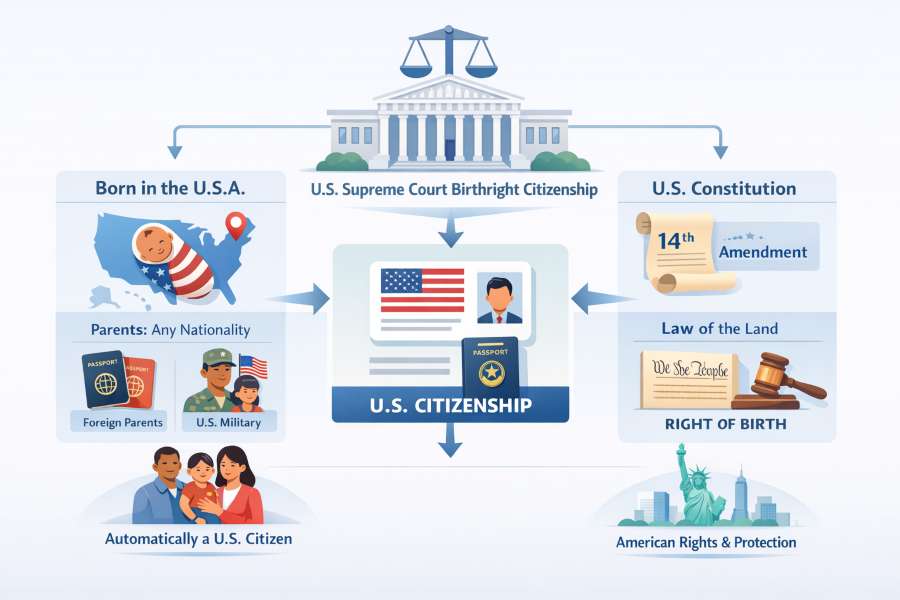
Birthright citizenship in the United States is one of the most debated constitutional principles in modern immigration law. Questions about who qualifies for U.S. citizenship at birth, whether the rule can be changed, and what role the Supreme Court plays come up frequently during political and legal debates. At the center of this issue is how the Constitution has been interpreted by the nation’s highest court.
- What Is Birthright Citizenship in the United States?
- The Supreme Court’s Role in Birthright Citizenship
- The Landmark Supreme Court Case on Birthright Citizenship
- What “Subject to the Jurisdiction” Means
- Does Birthright Citizenship Apply to Undocumented Immigrants’ Children?
- Can the Supreme Court Change Birthright Citizenship?
- Can Congress End Birthright Citizenship?
- Executive Orders and Birthright Citizenship
- Why Birthright Citizenship Remains Controversial
- How the Supreme Court Approaches Citizenship Cases
- The One Section Where Bullet Points Are Used
- Could a Future Supreme Court Narrow Birthright Citizenship?
- Why the Wong Kim Ark Decision Still Matters Today
- Common Myths About Supreme Court and Birthright Citizenship
- Final Thoughts on the U.S. Supreme Court and Birthright Citizenship
This article explains how the U.S. Supreme Court has shaped birthright citizenship, what the Constitution actually says, how court rulings apply today, and whether the law could realistically change.
What Is Birthright Citizenship in the United States?
Birthright citizenship means that a person automatically becomes a U.S. citizen by being born on U.S. soil. This principle comes from the 14th Amendment, adopted after the Civil War to guarantee citizenship and equal protection under the law.
The amendment states that all persons born in the United States and subject to its jurisdiction are citizens. That language has been central to nearly every legal debate surrounding birthright citizenship.
The Supreme Court’s Role in Birthright Citizenship
The Supreme Court of the United States serves as the final authority on how the Constitution is interpreted. While Congress can pass immigration laws, it is the Supreme Court that determines whether those laws comply with constitutional citizenship protections.
Importantly, the Supreme Court has never issued a ruling that eliminates birthright citizenship for children born in the United States to non-citizen parents.
The Landmark Supreme Court Case on Birthright Citizenship
The most important Supreme Court decision on birthright citizenship is United States v. Wong Kim Ark.
In this case, the Court ruled that a child born in the United States to non-citizen parents was a U.S. citizen under the 14th Amendment. The parents were Chinese nationals who were not eligible for U.S. citizenship at the time, yet the Court still affirmed the child’s citizenship.
This ruling firmly established that birthright citizenship applies broadly to nearly all children born on U.S. soil.
What “Subject to the Jurisdiction” Means
One of the most debated phrases in the 14th Amendment is “subject to the jurisdiction.”
The Supreme Court has interpreted this phrase to mean that almost everyone born in the United States falls under U.S. laws and authority. There are only a few narrow exceptions, such as:
-
Children of foreign diplomats
-
Children born to enemy forces occupying U.S. territory
Outside these rare cases, birthright citizenship applies regardless of the parents’ immigration status.
Does Birthright Citizenship Apply to Undocumented Immigrants’ Children?
Yes. Under current Supreme Court interpretation, children born in the U.S. to undocumented immigrants are U.S. citizens.
The Court has never ruled otherwise, and existing precedent treats immigration status as irrelevant to the child’s citizenship at birth.
This legal interpretation has been consistently applied for more than a century.
Can the Supreme Court Change Birthright Citizenship?
The Supreme Court could theoretically reinterpret the 14th Amendment, but doing so would require overturning long-standing precedent.
Courts are generally cautious about reversing decisions that have been relied upon for generations. Overturning birthright citizenship would affect millions of people and disrupt settled constitutional understanding.
Because of this, any change through the Supreme Court would be extraordinary and legally complex.
Can Congress End Birthright Citizenship?
Congress cannot end birthright citizenship by passing a regular law.
Because birthright citizenship is rooted in the Constitution, Congress would need to pass a constitutional amendment to change it. That process requires approval by two-thirds of both houses of Congress and ratification by three-quarters of the states.
This makes legislative elimination of birthright citizenship extremely unlikely.
Executive Orders and Birthright Citizenship
Presidents do not have the authority to eliminate birthright citizenship through executive orders.
Any attempt to do so would almost certainly be challenged in court and blocked as unconstitutional. The Constitution and Supreme Court precedent outweigh executive action in this area.
Why Birthright Citizenship Remains Controversial
Despite clear Supreme Court precedent, birthright citizenship remains politically controversial.
Critics argue it encourages illegal immigration, while supporters say it upholds equality, prevents statelessness, and reflects core American values. These debates often resurface during election cycles and immigration reform discussions.
However, political disagreement does not change constitutional law.
How the Supreme Court Approaches Citizenship Cases
When addressing citizenship issues, the Supreme Court focuses on:
-
Constitutional text
-
Historical intent
-
Long-standing legal precedent
-
Practical consequences
This approach explains why the Court has consistently upheld broad birthright citizenship protections.
The One Section Where Bullet Points Are Used
-
Birthright citizenship comes from the 14th Amendment
-
The Supreme Court affirmed it in United States v. Wong Kim Ark
-
Immigration status of parents does not affect citizenship
-
Congress cannot end it without a constitutional amendment
-
Executive orders cannot override Supreme Court precedent
These principles define the current legal framework.
Could a Future Supreme Court Narrow Birthright Citizenship?
While legally possible, narrowing birthright citizenship would require the Court to reinterpret constitutional language that has been settled for over 120 years.
Any such move would likely trigger intense legal challenges, political backlash, and uncertainty for millions of people born in the United States.
For now, the Court continues to treat birthright citizenship as settled law.
Why the Wong Kim Ark Decision Still Matters Today
The Wong Kim Ark decision remains the cornerstone of modern citizenship law. Courts still rely on its reasoning when evaluating citizenship claims, immigration disputes, and constitutional challenges.
As long as this precedent stands, birthright citizenship remains secure.
Common Myths About Supreme Court and Birthright Citizenship
Many people believe:
-
The Supreme Court has weakened birthright citizenship
-
Birthright citizenship only applies to legal residents’ children
-
Congress can eliminate it by statute
None of these claims reflect current constitutional law or Supreme Court precedent.
Final Thoughts on the U.S. Supreme Court and Birthright Citizenship
The U.S. Supreme Court has played a decisive role in protecting birthright citizenship. Through its interpretation of the 14th Amendment, the Court has consistently affirmed that nearly all children born on U.S. soil are citizens, regardless of their parents’ immigration status.
Unless the Constitution itself is amended or the Court dramatically reverses over a century of precedent, birthright citizenship remains a foundational and enduring part of American law.