



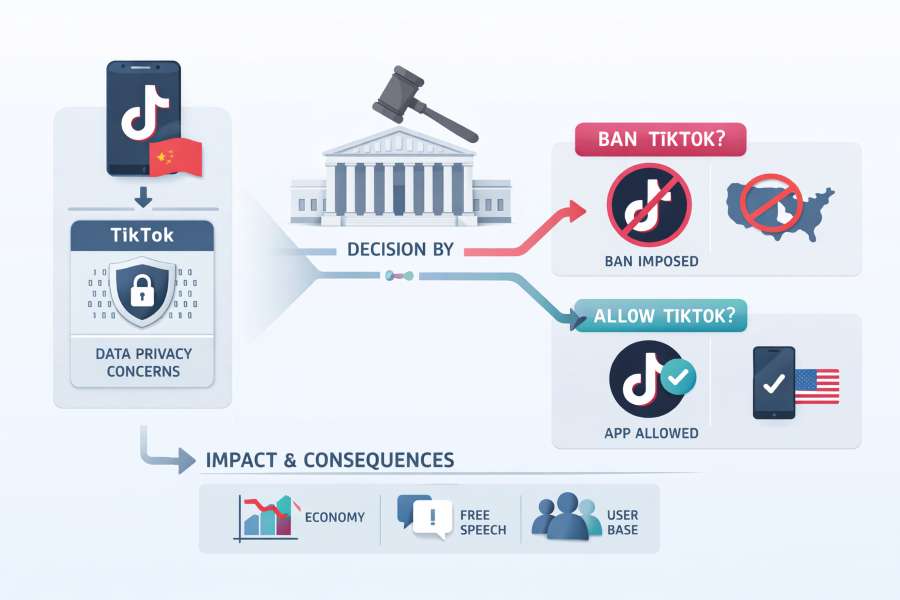
Debates over a possible TikTok ban in the United States have raised major legal questions about national security, free speech, and government authority. Because of those stakes, many people ask whether the Supreme Court has already ruled on a TikTok ban. As of now, there is no final Supreme Court decision banning TikTok nationwide, but legal and political developments have made the issue one of the most closely watched constitutional questions in recent years.
- Has the Supreme Court Issued a TikTok Ban Decision?
- Why TikTok Has Become a Supreme Court Issue
- The Role of Congress in the TikTok Ban Debate
- How TikTok Cases Could Reach the Supreme Court
- Constitutional Issues at the Center of the Case
- What the Supreme Court Would Have to Decide
- Could the Supreme Court Uphold a TikTok Ban?
- Could the Supreme Court Strike Down a TikTok Ban?
- What Happens While the Case Is Pending
- Why There Is So Much Confusion About a “Decision”
- The One Section Where Bullet Points Are Used
- What a Supreme Court Decision Would Mean for Users
- Could a TikTok Decision Affect Other Apps?
- Timeline for a Possible Decision
- Final Thoughts on the TikTok Ban Supreme Court Decision
This article explains the current status of the TikTok ban issue, how the Supreme Court could become involved, what legal arguments are central to the case, and what a future decision could mean.
Has the Supreme Court Issued a TikTok Ban Decision?
No. The Supreme Court of the United States has not issued a ruling that bans TikTok nationwide.
While TikTok has been restricted on government devices and targeted by federal legislation, no Supreme Court opinion has ordered a nationwide shutdown of the app for the general public. Any such ban would require either:
-
Enforcement of a federal statute challenged in court, or
-
A final judicial ruling after full constitutional review
At present, the issue remains in the legislative and lower-court phase rather than resolved by the Supreme Court.
Why TikTok Has Become a Supreme Court Issue
TikTok’s legal controversy centers on ownership, data access, and foreign influence concerns. Lawmakers have argued that TikTok’s parent company, ByteDance, poses a national security risk due to its ties to China.
Supporters of restrictions argue that the U.S. government must act to prevent potential misuse of American user data. Opponents argue that banning the app raises serious constitutional problems.
Because these disputes involve constitutional rights, the Supreme Court is the only court with authority to issue a final nationwide interpretation.
The Role of Congress in the TikTok Ban Debate
Congress has taken the lead so far by proposing and passing legislation aimed at TikTok.
These laws typically:
-
Require divestment of TikTok’s U.S. operations
-
Authorize bans if ownership conditions are not met
-
Restrict TikTok use on federal and state government devices
When Congress acts in this way, affected companies often challenge the law in federal court, arguing that it violates constitutional protections.
How TikTok Cases Could Reach the Supreme Court
A TikTok ban reaches the Supreme Court only through the normal judicial process.
First, TikTok or affected users file lawsuits in federal district courts. Those cases are appealed to federal circuit courts. Only after conflicting rulings or major constitutional questions arise does the Supreme Court decide whether to hear the case.
The Court is not required to take the case. If it does, its ruling becomes binding nationwide.
Constitutional Issues at the Center of the Case
First Amendment concerns
TikTok users and civil liberties groups argue that banning the app restricts freedom of speech. Millions of Americans use TikTok to communicate, express opinions, and earn income.
The key question is whether banning a platform amounts to restricting speech itself, or merely regulating a foreign-owned business.
National security authority
The federal government argues that national security concerns justify regulation, even when speech is affected. Courts must balance these concerns against constitutional protections.
Due process and equal protection
Some legal challenges argue that TikTok is being unfairly singled out without sufficient evidence or procedural protections.
What the Supreme Court Would Have to Decide
If the Supreme Court hears a TikTok ban case, it would not decide whether TikTok is good or bad. It would decide whether the government acted within constitutional limits.
The Court would likely examine:
-
Whether Congress has authority to restrict or ban a platform
-
Whether such restrictions violate the First Amendment
-
Whether national security claims are sufficient to justify the action
-
Whether less restrictive alternatives exist
The ruling would shape future regulation of digital platforms.
Could the Supreme Court Uphold a TikTok Ban?
Yes, it is legally possible.
If the Court determines that the ban targets foreign ownership and national security rather than speech itself, it could uphold restrictions. The government would need to show that its actions are narrowly tailored and supported by legitimate security concerns.
Such a decision would likely emphasize regulation of corporate structure rather than content.
Could the Supreme Court Strike Down a TikTok Ban?
Also yes.
If the Court finds that a ban disproportionately restricts speech or lacks sufficient justification, it could rule the law unconstitutional. That would prevent enforcement of a nationwide ban and set limits on how far the government can go in regulating digital platforms.
This outcome would have broad implications beyond TikTok.
What Happens While the Case Is Pending
While litigation continues, TikTok remains operational for most users in the United States. Restrictions remain limited to government devices and specific regulatory contexts.
Lower courts may issue temporary injunctions, but only a Supreme Court ruling would definitively resolve the issue nationwide.
Why There Is So Much Confusion About a “Decision”
Confusion often arises because:
-
Congressional actions are mistaken for court rulings
-
Lower-court decisions are reported as final outcomes
-
Political statements are interpreted as legal decisions
Until the Supreme Court issues an opinion, no final constitutional answer exists.
The One Section Where Bullet Points Are Used
-
The Supreme Court has not banned TikTok
-
Congress has passed laws targeting TikTok ownership and access
-
Constitutional challenges are ongoing in lower courts
-
The Supreme Court may review the issue in the future
-
Any final nationwide ban would require judicial resolution
These points clarify the current legal reality.
What a Supreme Court Decision Would Mean for Users
A Supreme Court ruling would set a precedent affecting:
-
Social media regulation
-
National security powers
-
Digital free speech rights
-
Foreign-owned technology companies
The impact would extend far beyond TikTok.
Could a TikTok Decision Affect Other Apps?
Yes. A ruling involving TikTok could influence how the government treats other foreign-owned apps and platforms. It could also shape future laws aimed at regulating social media more broadly.
This is one reason courts approach the issue cautiously.
Timeline for a Possible Decision
There is no fixed timeline. Supreme Court cases can take months or years to reach final resolution.
Until then, TikTok’s legal status depends on ongoing litigation, legislative developments, and executive enforcement decisions.
Final Thoughts on the TikTok Ban Supreme Court Decision
As of now, there is no Supreme Court decision banning TikTok in the United States. The issue remains unresolved at the highest judicial level, with constitutional questions still working their way through the courts.
If and when the Supreme Court takes up a TikTok ban case, the decision will shape the future of digital speech, national security law, and technology regulation for years to come.