



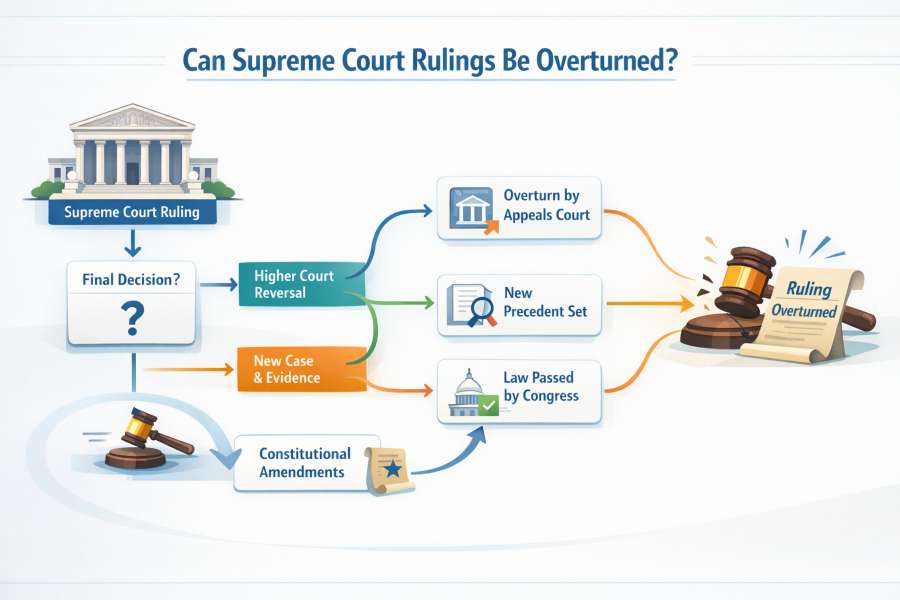
The Supreme Court sits at the top of the U.S. judicial system, and its decisions shape law, policy, and daily life. Because of that authority, many people wonder whether its rulings are permanent. The short answer is yes, Supreme Court rulings can be overturned, but it happens only in specific ways and usually over long periods of time.
- Understanding the Supreme Court’s Authority
- What “Overturning” a Supreme Court Ruling Means
- The Most Common Way Supreme Court Rulings Are Overturned
- Constitutional Amendments Can Overturn Supreme Court Rulings
- Can Congress Overturn Supreme Court Decisions?
- The Role of Judicial Precedent
- How Often Does the Supreme Court Overturn Itself?
- Why Supreme Court Rulings Change Over Time
- Does Overturning a Ruling Apply Retroactively?
- The One Section Where Bullet Points Are Used
- What Overturned Rulings Mean for the Public
- Are Supreme Court Decisions Final?
- Common Misconceptions About Supreme Court Authority
- Final Thoughts on Overturning Supreme Court Rulings
This guide explains how Supreme Court rulings are overturned, how often it happens, who has the power to do it, and what it means for future cases.
Understanding the Supreme Court’s Authority
The Supreme Court of the United States is the final interpreter of federal law and the U.S. Constitution. Once the Court issues a ruling, lower courts must follow it.
However, the Supreme Court is not above the Constitution itself. Its authority exists within a legal framework that allows change when interpretations evolve.
This balance is intentional. The legal system values stability, but it also allows correction when past decisions are widely seen as flawed or outdated.
What “Overturning” a Supreme Court Ruling Means
Overturning a ruling does not mean ignoring it. It means replacing an existing legal precedent with a new interpretation that directly contradicts the earlier decision.
When this happens:
-
The old ruling is no longer binding
-
Lower courts must follow the new standard
-
Laws previously blocked may become enforceable again
-
Rights previously recognized may change or disappear
Overturning precedent is serious and rare, which is why it draws public attention when it occurs.
The Most Common Way Supreme Court Rulings Are Overturned
The Supreme Court overturns itself
The Supreme Court can overturn its own prior decisions when a new case presents the same legal question and a majority of justices decide the earlier ruling was incorrect.
This is the most common method of overturning Supreme Court precedent.
Justices often consider:
-
Whether the earlier decision was poorly reasoned
-
Whether it has proven unworkable
-
Whether social, legal, or factual conditions have changed
-
Whether later rulings undermined the original logic
This process can take decades and often reflects shifts in judicial philosophy.
Constitutional Amendments Can Overturn Supreme Court Rulings
Another powerful method is through a constitutional amendment.
Congress and the states can amend the Constitution to override the Court’s interpretation of constitutional law. When this happens, the amendment becomes supreme over prior rulings.
Famous examples include:
-
The 14th Amendment overturning parts of Dred Scott
-
The 16th Amendment reversing limits on federal income tax
-
The 26th Amendment lowering the voting age after Court rulings upheld higher limits
Because amendments are difficult to pass, this method is rare but permanent.
Can Congress Overturn Supreme Court Decisions?
Congress cannot directly overturn Supreme Court rulings that interpret the Constitution. However, it can respond in limited ways.
When Congress can act
If a Supreme Court decision interprets a federal statute, Congress can amend or rewrite that law to change the outcome for future cases.
This does not override the Court’s constitutional authority, but it reshapes the legal framework the Court applied.
When Congress cannot act
If the ruling is based on constitutional interpretation, Congress alone cannot override it without a constitutional amendment.
The Role of Judicial Precedent
The legal doctrine of stare decisis encourages courts to follow established precedent. This principle promotes consistency and predictability in the law.
However, stare decisis is not absolute. The Supreme Court has repeatedly stated that it will depart from precedent when a decision is clearly wrong or harmful.
This tension explains why some rulings stand for generations while others are eventually overturned.
How Often Does the Supreme Court Overturn Itself?
Overturning precedent is uncommon but not extraordinary.
Throughout U.S. history, the Supreme Court has overturned dozens of its own decisions. Some occurred quietly, while others reshaped American law.
Notable overturned rulings often involve:
-
Civil rights
-
Economic regulation
-
Criminal procedure
-
Privacy and personal liberty
The Court tends to be cautious, but it does not treat past decisions as untouchable.
Why Supreme Court Rulings Change Over Time
Several factors contribute to reversals.
Changes in Court membership
New justices bring different legal philosophies. Over time, shifts in the Court’s composition can alter how constitutional questions are viewed.
Evolving social standards
While the Court does not follow public opinion directly, changing societal norms can influence how laws are interpreted.
Legal inconsistencies
Some rulings create confusion or conflict with other precedents, prompting reconsideration.
Practical consequences
If a decision proves unworkable in real-world application, the Court may revisit it.
Does Overturning a Ruling Apply Retroactively?
In most cases, new rulings apply moving forward rather than undoing all past actions.
However, retroactivity depends on:
-
The type of case
-
The nature of the right involved
-
Whether criminal or civil law is affected
Courts often limit retroactive impact to avoid legal chaos.
The One Section Where Bullet Points Are Used
-
Supreme Court rulings can be overturned
-
The Court most often overturns its own precedents
-
Constitutional amendments can permanently override rulings
-
Congress can change statutory rulings but not constitutional ones
-
Overturning precedent is rare but legally accepted
This framework explains how change happens without dismantling the judicial system.
What Overturned Rulings Mean for the Public
When a Supreme Court ruling is overturned, the effects ripple outward.
States may regain authority to regulate certain areas. Congress may pass new legislation. Individuals may see rights expand, contract, or shift depending on the issue.
Importantly, overturning a ruling does not erase history. It changes how the law is applied going forward.
Are Supreme Court Decisions Final?
Supreme Court decisions are final in the sense that no higher court exists. However, they are not permanent in all circumstances.
The legal system allows reinterpretation because constitutional law must function across generations with changing realities.
This flexibility is a core feature of the U.S. system, not a flaw.
Common Misconceptions About Supreme Court Authority
Many people believe Supreme Court decisions can never be changed. Others assume Congress can simply override rulings by passing laws.
Both views are incorrect. The truth lies between permanence and flexibility, with strict processes governing change.
Understanding these limits helps explain why legal battles often take decades to resolve.
Final Thoughts on Overturning Supreme Court Rulings
Yes, Supreme Court rulings can be overturned, but only through deliberate and legally structured processes. Most often, the Court revisits its own decisions. In rare cases, constitutional amendments permanently reverse them.
These mechanisms ensure that the law remains stable yet adaptable, protecting both legal continuity and the ability to correct past errors.