



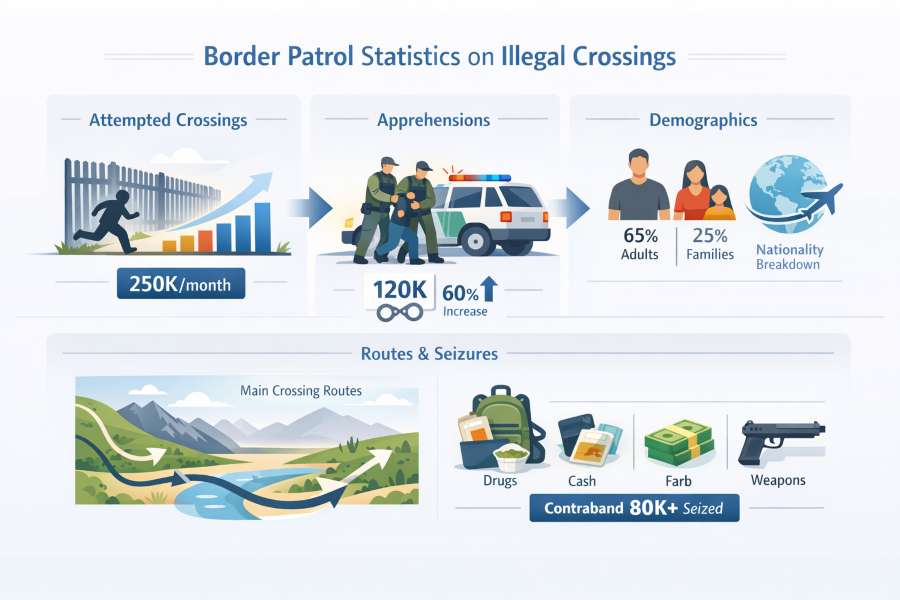
Border security remains one of the most discussed topics in U.S. immigration policy. Central to that conversation are statistics on illegal border crossings, which are collected and published by the U.S. Customs and Border Protection (CBP) and its Border Patrol division. These statistics help policymakers, researchers, and the public understand trends in migration, enforcement activity, and regional patterns along the nation’s borders.
- What Border Patrol Counts as an Illegal Crossing
- How Border Patrol Collects and Reports Data
- Key Border Patrol Statistics: Latest National Trends
- Yearly Encounter Totals at the Southwest Border
- Seasonal Patterns in Illegal Crossings
- Regional Breakdown: Where Illegal Crossings Occur
- Nationalities and Demographics of Encounters
- Family Units and Unaccompanied Minors
- Enforcement Outcomes: What Happens After an Encounter
- How Policies Influence Border Patrol Statistics
- Misconceptions About Border Patrol Statistics
- Border Patrol vs CBP Data: What’s the Difference?
- International Migration Drivers and Border Statistics
- How Researchers Use Border Patrol Statistics
- Future Outlook for Illegal Crossing Trends
- The Best Sources for Current Border Patrol Statistics
- Single Most Important Points About Border Patrol Statistics
- Final Thoughts on Border Patrol Illegal Crossing Data
This article provides a detailed, data-driven overview of Border Patrol statistics on illegal crossings, including how the data is collected, recent trends, regional breakdowns, enforcement outcomes, and context for interpreting the numbers.
What Border Patrol Counts as an Illegal Crossing
Illegal crossings generally refer to encounters where individuals are apprehended or deemed inadmissible between official ports of entry along the U.S. border. These encounters can take several forms:
-
Apprehensions: Individuals physically taken into custody after crossing unlawfully.
-
Turnbacks: Individuals encountered and returned across the border without formal processing.
-
Expulsions: Removals under specific public health or emergency authorities.
It is important to understand that “illegal crossing” refers to encountered attempts, not necessarily successful entries into the interior of the United States.
How Border Patrol Collects and Reports Data
Border Patrol collects data through a combination of:
Field Encounters
Agents patrolling between ports of entry document apprehensions and expulsions.
Technology
Sensors, cameras, aircraft, and drones help detect movement along remote border areas.
Reporting Protocols
Encounters are logged into national databases and published periodically by CBP.
The statistics include multiple contact types, and multiple encounters may involve the same individual in a short period.
Key Border Patrol Statistics: Latest National Trends
The most recent Border Patrol statistics show that encounters at the U.S. southwest border have remained high compared to historical norms, although patterns fluctuate monthly and annually.
According to CBP data:
-
FY 2024 and FY 2025 saw historically elevated encounter counts.
-
Encounters peaked in certain months with sharp seasonal variation.
-
Enforcement activity is concentrated at the southwestern border.
These trends represent multi-year patterns shaped by global migration pressures, enforcement policies, and regional conditions.
To interpret these numbers properly, it’s important to look at longer-term trends rather than single months.
Yearly Encounter Totals at the Southwest Border
Border Patrol publicly releases monthly and fiscal year encounter totals. The data reflect both lawful entries and enforcement encounters.
Recent official figures include:
-
Fiscal Year 2023: Approximately 2.5 million total southwest border encounters.
-
Fiscal Year 2024: Encounters remained elevated, with more than 2.4 million reported.
-
Fiscal Year 2025: Overall southwest border encounters continued at high levels but with volatility month-to-month.
These annual totals show how enforcement activity and encounters have shifted relative to policy changes, economic conditions, and global migration trends.
Seasonal Patterns in Illegal Crossings
Border encounters fluctuate throughout the year based on weather, migration routes, and enforcement focus.
Spring and Early Summer
Typically see rising encounters as conditions improve for travel.
Mid-Summer
Often highest contact counts occur around this period.
Fall
Encounters decline but may spike due to seasonal migration patterns.
Winter
Encounters usually decrease due to harsher travel conditions and lower migrant flows.
Seasonality affects data interpretation and requires comparing similar periods across multiple years rather than relying on single months.
Regional Breakdown: Where Illegal Crossings Occur
Illegal border crossings are not uniformly distributed. CBP breaks down data by specific border sectors:
Rio Grande Valley Sector
Historically the busiest corridor for encounters, accounting for a significant portion of total counts.
Del Rio Sector
Sees large numbers of crossings, especially in remote regions with brush and ranch land.
Tucson Sector
Encompasses wide desert regions with high historic encounter levels.
Other Sectors
Lesser but still significant encounter counts occur in sectors such as El Paso, Laredo, and San Diego.
Understanding sector-level data helps illustrate where resource deployment and enforcement pressures are most intense.
Nationalities and Demographics of Encounters
Border Patrol statistics often include demographic breakdowns of encountered individuals. These include:
-
Country of origin
-
Age groups
-
Family units versus single adults
-
Unaccompanied minors
Recent data show increasing diversity in national origins, including migrants from:
-
Central America
-
South America
-
Caribbean nations
-
Other global regions
The mix of encounters varies over time based on regional conditions and migration drivers.
Family Units and Unaccompanied Minors
A major shift in border statistics over recent years has been the increase in family units and unaccompanied children.
Family Units
Encounters involving parents with children have comprised a substantial share of total counts in recent fiscal years. These groups often present complex humanitarian and legal challenges.
Unaccompanied Minors
Encounters with children traveling alone have also made up a notable portion of contacts. These cases require specialized processing and protections under U.S. law.
Enforcement Outcomes: What Happens After an Encounter
Encounters with Border Patrol can lead to different outcomes depending on circumstances and policies:
Expedited Removal
Certain individuals may be removed immediately under statutory provisions or emergency authorities.
Parole and Release
Some migrants are released with a notice to appear in immigration proceedings due to capacity constraints or legal obligations.
Detention
Individuals may be detained pending removal proceedings based on risk and priority.
Continued Presence
In humanitarian cases, individuals may receive specific status designations allowing legal presence during court processes.
These outcomes reflect enforcement priorities, legal frameworks, and administrative discretion.
How Policies Influence Border Patrol Statistics
Border Patrol encounter figures are heavily influenced by U.S. immigration policies and operational strategies.
Examples include:
-
Changes to asylum eligibility
-
Public health authorities affecting expulsions
-
Agreements with neighboring countries
-
Border security funding and staffing
-
Technology deployments
Policy shifts often result in short-term fluctuations in encounter counts.
Misconceptions About Border Patrol Statistics
Statistics on illegal border crossings are sometimes misunderstood or oversimplified. Key clarifications include:
-
Encounter totals do not equal successful entries into the U.S. interior.
-
Multiple encounters of the same individual may be counted more than once.
-
High encounter numbers reflect detection and enforcement levels, not solely migration pressure.
-
Not all encounters involve unlawful entry; some involve individuals turned back.
Accurate interpretation requires context and nuance.
Border Patrol vs CBP Data: What’s the Difference?
Border Patrol operates between ports of entry and records encounters. Meanwhile, the larger CBP agency includes multiple components that also record data, including:
-
U.S. Border Patrol (field enforcement)
-
Office of Field Operations (ports of entry)
-
Air and Marine Operations
CBP publishes combined data, but southwest border encounter totals typically refer specifically to Border Patrol statistics.
International Migration Drivers and Border Statistics
Border Patrol encounter trends are connected to broader global migration dynamics:
-
Economic instability in home countries
-
Violence and insecurity
-
Natural disasters and climate impacts
-
Family reunification motivations
-
Network effects of migration routes
These drivers affect the number of people attempting to cross and the methods they choose.
How Researchers Use Border Patrol Statistics
Academic and policy researchers analyze encounter data alongside other sources to understand:
-
Migration patterns over time
-
Policy impacts on movement
-
Demographic shifts
-
Regional pressures and resource allocation
These analyses help inform public debate and legislative proposals.
Future Outlook for Illegal Crossing Trends
Predicting future border encounter trends involves uncertainty. Factors that could influence patterns include:
-
Changes in U.S. immigration policy
-
Economic conditions in origin countries
-
Enforcement resource adjustments
-
Seasonal migration cycles
-
External events such as natural disasters or geopolitical shifts
Long-term trends often depend as much on international conditions as domestic policy.
The Best Sources for Current Border Patrol Statistics
Official and regularly updated sources include:
-
CBP Southwest Border Migration FY Statistics
-
Border Patrol weekly operational updates
-
CBP enforcement and removal data
These sources provide monthly breakdowns, national summaries, and sector-level detail.
Single Most Important Points About Border Patrol Statistics
This is the only section where bullet points are used.
-
Border Patrol counts encounters, not confirmed unlawful entries
-
Multiple encounters of the same person may be reported
-
Southwestern border sectors dominate total counts
-
Enforcement outcomes vary by policy and resources
-
Family units and unaccompanied minors make up a significant share
Understanding these helps make sense of the data beyond raw numbers.
Final Thoughts on Border Patrol Illegal Crossing Data
Border Patrol statistics on illegal crossings are a key tool for understanding migration and enforcement activity at the U.S. border. While numbers can be high and fluctuate year-to-year, they must be interpreted within context—considering policy changes, migration drivers, seasonal cycles, and enforcement practices.