



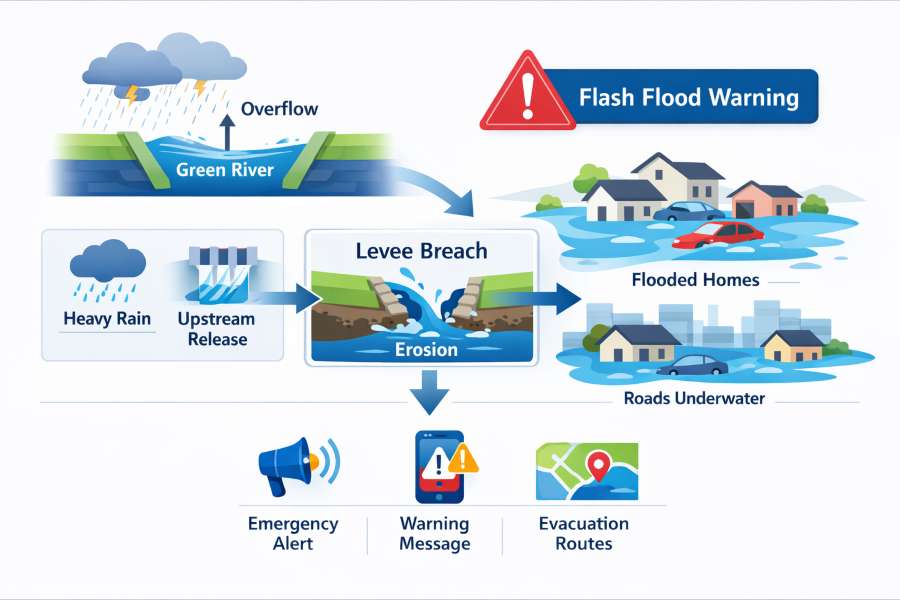
Flash flood warnings involving levees are among the most serious weather alerts issued by emergency authorities. When a Green River levee flash flood warning is declared, it signals an immediate threat to life, property, and infrastructure. Water levels can rise rapidly, levees can overtop or fail, and communities downstream may have only minutes or hours to react.
- Understanding the Green River and Its Levee System
- What a Levee Flash Flood Warning Really Means
- How Levee Failures Happen During Flash Floods
- Overtopping from rapid water rise
- Internal erosion and seepage
- Saturation and slope instability
- Debris impact and surface damage
- Why Flash Flood Warnings Are Issued So Quickly
- Areas Most Vulnerable During a Green River Levee Emergency
- Low-lying residential neighborhoods
- Agricultural and rural lands
- Transportation corridors
- Industrial and utility zones
- How Emergency Authorities Monitor Levee Conditions
- What Residents Should Do When a Flash Flood Warning Is Issued
- Why Evacuation Orders May Seem Sudden or Aggressive
- How Floodwaters Behave After a Levee Breach
- The Role of Weather Patterns in Green River Flood Events
- Historical Context of Flooding Along the Green River
- Impact on Communities and Local Economies
- Recovery and Cleanup After Levee Flooding
- How Emergency Alerts Are Communicated
- Long-Term Flood Mitigation Efforts
- Climate Change and Increasing Flood Risk
- Preparing Before a Flash Flood Warning Is Issued
- Common Misconceptions About Levees and Flood Safety
- Coordination Between Agencies During Flood Emergencies
- Final Thoughts on Green River Levee Flash Flood Warnings
This guide explains what a Green River levee flash flood warning means, why it is issued, how levee systems fail, which areas face the greatest risk, and what residents should do before, during, and after such an event.
Understanding the Green River and Its Levee System
The Green River flows through multiple regions in the United States, supporting communities, agriculture, industry, and ecosystems. Over decades, levee systems were constructed along portions of the river to protect towns and farmland from seasonal flooding.
Levees are engineered earthen or concrete barriers designed to contain rising river water. While effective under normal conditions, levees are not floodproof. They rely on careful maintenance, stable soil conditions, and water levels remaining within design limits.
When extreme rainfall, snowmelt, or upstream dam releases occur, pressure on the levee system can exceed its capacity, prompting emergency warnings.
What a Levee Flash Flood Warning Really Means
A flash flood warning related to a levee is different from a routine flood watch. It indicates an urgent and developing situation.
Authorities issue this warning when there is credible evidence of one or more of the following conditions:
-
Water overtopping the levee
-
Structural weakening such as seepage or cracking
-
Rapid river level rise approaching failure thresholds
-
Partial or imminent levee breach
Once issued, flooding can occur quickly and unpredictably, especially in low-lying downstream areas.
How Levee Failures Happen During Flash Floods
Levees rarely fail without warning signs. Understanding how failures occur helps explain why evacuation orders can be sudden and non-negotiable.
Overtopping from rapid water rise
When river levels exceed the height of a levee, water flows over the top. Even shallow overtopping can erode the landward side, weakening the structure until collapse occurs.
Internal erosion and seepage
High water pressure forces water through the levee body or foundation. This internal erosion, often invisible at first, can hollow out the structure and lead to sudden failure.
Saturation and slope instability
Extended rainfall saturates the soil, reducing its strength. Once saturated, the levee may slump or slide, opening pathways for uncontrolled flooding.
Debris impact and surface damage
Floating debris, trees, or ice can strike levees during floods, damaging protective surfaces and accelerating erosion.
Why Flash Flood Warnings Are Issued So Quickly
Flash floods behave differently from slow-rising river floods. They develop rapidly, often with little visible warning.
Meteorological conditions such as stalled storms, atmospheric rivers, or rapid snowmelt can dump large volumes of water into the Green River basin within hours. When this happens, levee systems may move from stable to critical conditions in a short time.
Emergency managers issue flash flood warnings early to give residents the maximum possible time to evacuate, even if exact outcomes are uncertain.
Areas Most Vulnerable During a Green River Levee Emergency
Risk levels vary depending on geography, elevation, and distance from the river.
Low-lying residential neighborhoods
Homes built below or near river level face the greatest danger. Floodwaters can reach these areas first and rise fastest.
Agricultural and rural lands
Farmland near levees often lacks secondary flood protection. Water can spread quickly across open fields, isolating homes and roads.
Transportation corridors
Highways, bridges, and rail lines near levees may become impassable early in a flood event, cutting off evacuation routes.
Industrial and utility zones
Facilities near the river may contain hazardous materials or critical infrastructure, increasing risk during inundation.
How Emergency Authorities Monitor Levee Conditions
Levee systems along the Green River are monitored using multiple methods to detect early signs of failure.
River gauge measurements
Automated gauges track water levels continuously. Sharp rises or readings above warning thresholds trigger alerts.
Visual inspections
Trained personnel inspect levees for seepage, cracks, sloughing, and erosion during high-water events.
Remote sensing and aerial surveys
Drones and aircraft provide real-time imagery of levee conditions, especially in hard-to-reach areas.
Community reporting
Residents are encouraged to report unusual water flow, muddy seepage, or sudden changes near levees, which can signal developing failure.
What Residents Should Do When a Flash Flood Warning Is Issued
When a Green River levee flash flood warning is announced, immediate action is critical. Delay can be deadly.
This is the only section where bullet points are used.
-
Move to higher ground immediately without waiting for official evacuation orders
-
Avoid driving through flooded roads or near levees
-
Follow instructions from emergency management and law enforcement
-
Take essential items only if time allows
-
Stay informed through official weather and emergency alerts
Flood conditions can change faster than forecasts. Trust the warning and act quickly.
Why Evacuation Orders May Seem Sudden or Aggressive
Evacuation orders during levee emergencies are issued with a safety-first mindset.
Levee failures can escalate from minor seepage to full breach in minutes. Authorities cannot guarantee how long a levee will hold once warning signs appear. As a result, evacuation decisions err on the side of caution.
Ignoring or delaying evacuation increases the risk of being trapped by rapidly moving water.
How Floodwaters Behave After a Levee Breach
Floodwaters released by a levee breach move differently than ordinary flooding.
Water surges outward with force, often carrying debris, sediment, and contaminants. Depths can increase rapidly, and currents may be strong enough to sweep away vehicles and structures.
Unlike coastal storm surge, levee breach flooding may not recede quickly. Water can remain pooled behind the failed levee for days or weeks, delaying recovery.
The Role of Weather Patterns in Green River Flood Events
Certain weather conditions increase the likelihood of levee-related flash flood warnings.
Prolonged heavy rainfall
Repeated storms saturate soil and fill river channels, reducing the levee’s margin for error.
Rapid snowmelt events
Warm temperatures combined with rain can release large volumes of snowmelt into the river system.
Atmospheric river systems
These moisture-rich weather patterns deliver intense rainfall over short periods, overwhelming river basins.
Understanding these patterns helps communities prepare before emergencies develop.
Historical Context of Flooding Along the Green River
Flooding along the Green River is not new. Historical records show repeated high-water events that shaped levee construction and floodplain management.
Past floods revealed vulnerabilities in older levee systems, leading to reinforcement projects and updated emergency plans. Despite improvements, extreme weather events continue to test infrastructure limits.
History underscores the importance of taking warnings seriously, even in areas that have not flooded recently.
Impact on Communities and Local Economies
A levee-related flash flood affects more than individual homes.
Residential displacement
Families may be displaced for extended periods due to water damage, mold, and infrastructure repairs.
Agricultural losses
Flooded fields can destroy crops, erode soil, and delay planting seasons, impacting food supply chains.
Business disruption
Local businesses may face closures, inventory loss, and workforce displacement.
Public health concerns
Floodwaters often contain sewage, chemicals, and debris, increasing health risks during cleanup.
Recovery and Cleanup After Levee Flooding
Once floodwaters recede, recovery begins, but it is often slow and complex.
Residents returning to affected areas should be cautious. Structural damage may not be immediately visible, and contaminated water can linger in basements and soil.
Authorities typically assess levee damage, restore utilities, and determine whether rebuilding or relocation is necessary for high-risk zones.
How Emergency Alerts Are Communicated
During a Green River levee flash flood warning, information is distributed through multiple channels.
Local emergency management agencies coordinate with weather services to issue alerts via mobile notifications, radio broadcasts, and television warnings. Social media platforms and community alert systems also play a role.
Residents should rely on official sources rather than rumors or unverified online posts.
Long-Term Flood Mitigation Efforts
Following major flood events, communities often reevaluate flood protection strategies.
Levee reinforcement and redesign
Engineers may strengthen existing levees or redesign them to handle higher water levels.
Floodplain zoning changes
Some areas may be rezoned to limit development in high-risk zones.
Early warning system upgrades
Improved sensors and forecasting models enhance detection and response times.
Mitigation efforts aim to reduce future risk, but no system can eliminate flooding entirely.
Climate Change and Increasing Flood Risk
Changing climate patterns are influencing river behavior nationwide.
Heavier rainfall events, warmer winters, and altered snowmelt cycles contribute to more frequent and intense flooding. Levee systems designed decades ago may face conditions beyond their original specifications.
This reality increases the importance of preparedness and adaptive infrastructure planning.
Preparing Before a Flash Flood Warning Is Issued
Preparation reduces panic and saves lives when emergencies occur.
Residents near the Green River should know their flood risk, evacuation routes, and local emergency contacts. Keeping emergency supplies ready and having a family communication plan can make a critical difference.
Preparedness turns minutes into survivable outcomes.
Common Misconceptions About Levees and Flood Safety
Many people assume levees guarantee protection. This misconception can be dangerous.
Levees reduce risk but do not eliminate it. They are designed for specific flood levels and can fail under extreme conditions. Trusting warnings rather than infrastructure alone is essential.
Coordination Between Agencies During Flood Emergencies
Flood response involves coordination between weather services, emergency management, law enforcement, public works, and community organizations.
Clear communication and rapid decision-making are vital when levee integrity is threatened. These coordinated efforts aim to protect lives first, then property.
Final Thoughts on Green River Levee Flash Flood Warnings
A Green River levee flash flood warning is one of the most serious alerts a community can receive. It signals immediate danger, rapid change, and the need for decisive action.
Understanding what the warning means, why it is issued, and how to respond can save lives. When warnings are issued, act quickly, trust official guidance, and prioritize safety over property.
Preparation, awareness, and timely response remain the strongest defenses against flood disasters