



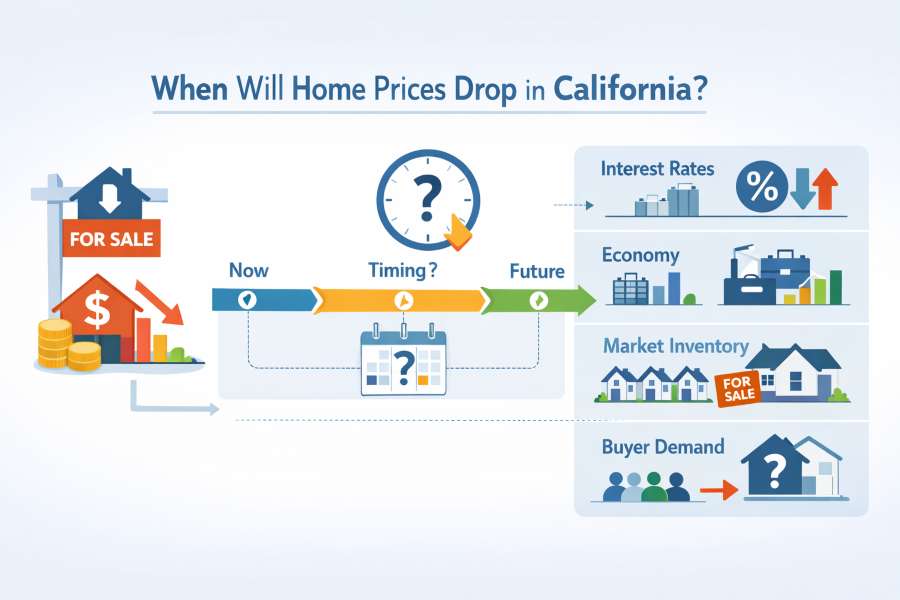
California’s housing market is no longer racing upward, but it has not given buyers the reset many expected. As 2026 begins, prices remain historically high, sales activity is muted, and uncertainty defines nearly every transaction. Buyers are hesitating, sellers are recalibrating, and investors are becoming selective. At the center of it all sits a simple but loaded question: when will home prices drop in California, and where will that drop actually happen?
- California Housing Market Conditions at the Start of 2026
- Why California Home Prices Rarely Fall All at Once
- Mortgage Rates and Their Influence on 2026 Pricing
- Affordability as the Natural Limit on Price Growth
- Inventory Growth and the Quiet Shift in Market Balance
- Employment Trends and Economic Stability in California
- Migration Patterns Reshaping Demand
- Insurance Costs and Climate Risk as Pricing Factors
- What Experts Expect for California Home Prices in 2026
- Regional Outlook: Where Prices Are Most Likely to Decline
- Bay Area
- Los Angeles Metro
- San Diego and Coastal Southern California
- Sacramento and Central Valley
- Inland Empire and Northern Interior
- The Single Most Important Factors Driving 2026 Price Pressure
- What 2026 Means for Home Buyers
- What 2026 Means for Home Sellers
- Investor Outlook and Long-Term Perspective
- Will California Experience a Housing Crash After 2026?
- Final Thoughts on California Home Prices in 2026
This analysis takes a grounded approach. Instead of chasing dramatic predictions, it examines real market constraints, regional behavior, affordability limits, and economic signals shaping California housing in 2026.
California Housing Market Conditions at the Start of 2026
Entering 2026, California’s housing market is best described as restrained rather than weak. Prices remain elevated compared to historical norms, but momentum has clearly slowed.
Sales activity declined sharply throughout late 2025, reaching levels not seen in decades outside of crisis periods. Mortgage rates above six percent have significantly reduced buying power, especially for first-time buyers. Inventory has increased compared to earlier years, yet supply remains tight in many regions due to zoning restrictions and homeowner rate lock-in.
The market is no longer defined by bidding wars or panic buying. Instead, it is shaped by caution, negotiation, and selective demand. This shift explains why prices are softening in some areas without triggering a statewide decline.
Why California Home Prices Rarely Fall All at Once
California does not experience housing downturns the same way other states do. Broad price drops have historically required severe economic stress rather than simple demand slowdowns.
Limited housing supply plays a central role. Coastal cities, job hubs, and established suburbs face physical and regulatory barriers to new development. Even when demand weakens, supply does not surge fast enough to overwhelm prices.
Another stabilizing factor is homeowner equity. Most Californians who purchased before 2022 locked in low fixed mortgage rates and built substantial equity. Selling often means giving up a manageable payment for a significantly higher one, discouraging voluntary listings.
Historically, meaningful statewide price declines occurred only during deep recessions when unemployment surged and forced selling became widespread. In 2026, those conditions are absent.
Mortgage Rates and Their Influence on 2026 Pricing
Mortgage rates remain the single most powerful force shaping buyer behavior. Even modest increases in rates have had an outsized effect on affordability.
In 2026, rates remain well above the levels that fueled the pandemic-era boom. Monthly payments, not home prices alone, are the primary barrier preventing demand from rebounding. While forecasts suggest slight easing later in the year, rates are expected to remain high enough to cap purchasing power.
Lower rates could stabilize prices, but they are unlikely to spark another surge unless they fall dramatically. Until then, affordability acts as a ceiling rather than a springboard.
Affordability as the Natural Limit on Price Growth
California home prices are constrained less by supply today than by affordability.
Even as wages rise, housing costs remain far ahead of income growth in most metropolitan areas. Property taxes, insurance premiums, and maintenance expenses further strain budgets.
Buyers in 2026 are more deliberate. Many are choosing smaller homes, moving farther inland, or remaining renters longer. This behavior slows appreciation and increases price sensitivity, particularly in markets that experienced rapid growth over the past few years.
Inventory Growth and the Quiet Shift in Market Balance
Inventory trends are uneven but important.
Resale inventory has increased slowly as some sellers test the market. Homes are staying listed longer, and price adjustments are more common than in recent years. However, many potential sellers remain on the sidelines, unwilling to trade low-rate mortgages for higher payments.
New construction tells a different story. Builders in suburban and inland areas expanded aggressively during the boom years. As demand cooled, incentives replaced price hikes. In some markets, base prices have started to fall, signaling pressure that could extend to resale homes.
This builder-led softening is one of the earliest signs of where price declines are most likely to persist.
Employment Trends and Economic Stability in California
Employment stability is a major reason prices have not fallen statewide.
California’s economy slowed in 2025, but job losses have been concentrated rather than widespread. Technology hiring cooled, entertainment production fluctuated, and logistics demand softened, yet overall employment remains relatively strong.
Without mass layoffs, homeowners are not being forced to sell. Mortgage delinquencies remain low, and distressed inventory is scarce. As long as this remains true, price declines will stay localized.
Migration Patterns Reshaping Demand
Population movement continues to reshape California housing.
Out-migration has reduced demand in certain regions, particularly inland commuter cities and pandemic-era boom markets. At the same time, international migration and high-income domestic inflows continue to support demand in coastal job centers.
Younger buyers are delaying ownership due to debt and affordability constraints, while older homeowners are downsizing or relocating. These shifts increase inventory in some areas while leaving others largely untouched.
Insurance Costs and Climate Risk as Pricing Factors
Insurance availability has become a growing concern in parts of California.
Wildfire risk, flood exposure, and climate-related losses have led insurers to raise premiums or withdraw from certain regions. In affected areas, buyers face higher ownership costs and limited coverage options.
Homes that are difficult or expensive to insure take longer to sell and often require price concessions. While this factor has not yet impacted statewide pricing, it is increasingly relevant in rural and high-risk zones.
What Experts Expect for California Home Prices in 2026
Most professional forecasts align on one key conclusion: a statewide price drop is unlikely in 2026.
Projections generally point to flat or modest price growth, with slight improvements in sales volume as buyers adjust to new conditions. Affordability is expected to improve gradually through slower price increases rather than falling prices.
What these forecasts often miss is the variation beneath the surface. ZIP-code-level data shows declines already forming in certain markets, particularly where supply has grown faster than demand.
Regional Outlook: Where Prices Are Most Likely to Decline
Bay Area
The Bay Area is showing selective softening rather than broad decline. Slower tech hiring and continued out-migration have reduced demand in some neighborhoods, particularly for condos and entry-level homes.
Prime single-family areas remain resilient, supported by limited supply and high-income buyers. Any declines are likely to remain modest and localized.
Los Angeles Metro
Los Angeles has shifted into a balanced market. Inventory has increased, buyer urgency has faded, and price growth has stalled.
Some submarkets may see small declines, particularly where affordability is stretched and supply has risen. Well-located homes continue to attract interest, but sellers must price carefully.
San Diego and Coastal Southern California
Coastal Southern California remains relatively stable. Strong lifestyle appeal, limited land, and long-term demand continue to support prices.
Builder incentives have softened the entry-level segment, but broad declines remain unlikely unless economic conditions worsen.
Sacramento and Central Valley
This region faces the most visible downside risk. Rapid growth during the pandemic, combined with increased construction and slowing migration, has created supply pressure.
Price declines are already appearing in parts of Sacramento and nearby metros, and further softening is possible through 2026.
Inland Empire and Northern Interior
Markets farther from major job centers are more sensitive to economic shifts. Reduced remote work flexibility, higher insurance exposure, and slower population growth have weakened demand.
These areas are among the most likely to experience continued price corrections.
The Single Most Important Factors Driving 2026 Price Pressure
The forces shaping California housing in 2026 are interconnected, but a few stand above the rest.
This is the only section where bullet points are used.
-
Mortgage rates remaining high enough to cap affordability
-
Inventory growth concentrated in inland and overbuilt regions
-
Migration away from pandemic boom markets
-
Rising insurance and ownership costs in risk-prone areas
-
Limited forced selling due to homeowner equity and job stability
Together, these forces explain why prices soften in some areas without collapsing statewide.
What 2026 Means for Home Buyers
Buyers have more leverage in 2026 than at any point since before the pandemic. Homes sit longer, negotiations are common, and concessions are increasingly available.
The best opportunities lie in markets where inventory has grown faster than demand. Buyers who focus on long-term affordability rather than short-term price movements are best positioned for success.
Waiting for a dramatic statewide drop may mean missing realistic opportunities already forming.
What 2026 Means for Home Sellers
Sellers face a more disciplined market. Overpricing leads to stagnation, while accurately priced homes still attract interest.
In stable regions, patience can pay off. In softening markets, speed and flexibility matter more. Sellers who adapt quickly fare better than those anchored to peak-era expectations.
Investor Outlook and Long-Term Perspective
For investors, the California housing market requires a shift in strategy.
Appreciation alone is no longer reliable. Cash flow, location quality, and long-term demand drivers matter more than short-term price movements.
Beyond 2026, interest rates, housing policy, climate adaptation, and population trends will shape outcomes. Markets with constrained supply and stable employment remain the safest long-term plays.
Will California Experience a Housing Crash After 2026?
A crash remains unlikely without major economic disruption.
Widespread job losses, credit tightening, and forced selling are the conditions that trigger deep declines. None are currently present at scale.
More likely scenarios include prolonged stagnation, selective regional corrections, and gradual improvements in affordability over time.
Final Thoughts on California Home Prices in 2026
California home prices are not set for a statewide drop in 2026. Instead, the market is fragmenting.
Some regions will experience real declines. Others will remain stable or grow slowly. Buyers gain leverage, but outcomes depend heavily on location and timing.
The real question is no longer when prices will drop, but where pressure is already building and how long it will last.