



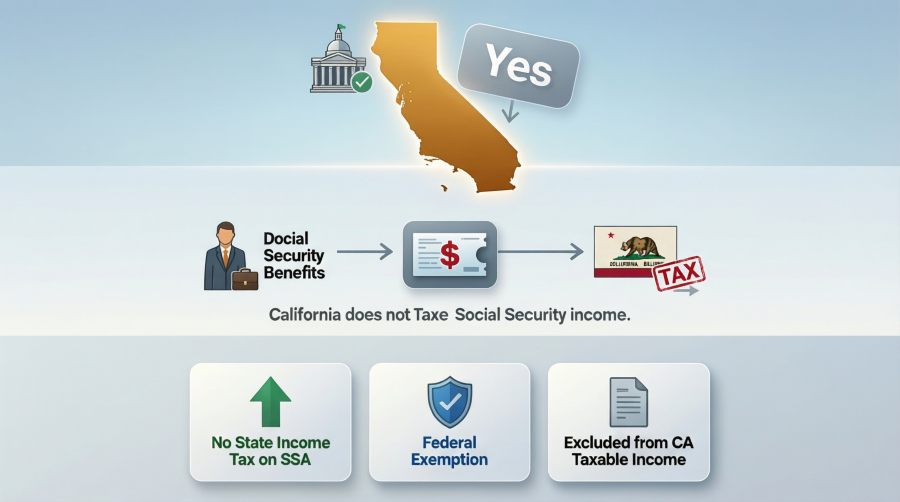
If you are searching this question, you probably want a yes-or-no answer. You might be retired, planning retirement, helping a parent, or simply trying to understand whether California will take a cut of your Social Security income. So let’s start exactly where you want. No, California does not tax Social Security benefits. That answer is correct, complete, and accurate in 2026.
- Why this “simple” question deserves a full explanation
- The short answer, clearly stated
- Why do people still get surprised by taxes in California
- How California legally treats Social Security income
- Retirement benefits, disability benefits, and survivor benefits all count
- The federal tax twist that changes everything
- Why California refuses to follow federal rules here
- California does tax income in retirement
- A story that explains the difference better than numbers
- Does California ever tax Social Security indirectly?
- Why does this matter more as you age?
- How California compares to other states on Social Security
- Cost of living changes the real answer
- Planning around California’s Social Security exemption
- Disability and survivor benefits deserve special mention
- Filing taxes without mistakes
- Could California ever tax Social Security?
- What this really means for you
But if you stop reading here, you will miss something important. Because while California does not tax Social Security, that fact alone does not tell you whether your retirement income will be tax-friendly, expensive, or unexpectedly complicated. And this is where most people get caught off guard.
Why this “simple” question deserves a full explanation
Social Security taxation is one of the most misunderstood topics in retirement planning. Many people assume that if a state does not tax Social Security, it must be a tax-friendly place for retirees. Others hear that Social Security can be taxed and assume California must do it too.
Both assumptions are wrong in different ways.
California’s treatment of Social Security is extremely clear, but its overall retirement tax picture is far more nuanced. Understanding the difference can mean thousands of dollars per year in avoided surprises.
To understand why, we need to look at how California treats Social Security, how federal taxes interact with it, and how your other income quietly changes the outcome.
The short answer, clearly stated
California does not tax Social Security benefits. This includes retirement, disability, and survivor benefits paid by the Social Security Administration.
There are no income limits.
There are no partial exclusions.
There is no phase-out at higher income levels.
If the money comes from Social Security, California does not tax it. Now, let’s talk about why that answer alone isn’t enough.
Why do people still get surprised by taxes in California
Many retirees move to or stay in California, believing their retirement income will be mostly tax-free because Social Security benefits are exempt. Then they file their first return and feel blindsided.
The shock does not come from Social Security.
It comes from everything else.
California draws a very sharp line between Social Security and other retirement income. On one side of the line, Social Security is completely protected. On the other side, almost everything else is taxable. Understanding that line is the key to understanding California retirement taxes.
How California legally treats Social Security income
California tax law excludes Social Security benefits entirely from state taxable income. This is not a credit, deduction, or temporary exemption. Social Security is not counted at all.
When you file a California return, Social Security is not used to calculate taxable income, tax brackets, credits, or thresholds. It does not matter whether you receive a small benefit or a very large one. The amount is irrelevant.
This rule applies regardless of:
- Your age
- Your filing status
- Your total household income
If it is a Social Security benefit, California ignores it.
This makes California one of the clearest states in the country regarding Social Security taxation.
Retirement benefits, disability benefits, and survivor benefits all count
Another common misunderstanding is that only retirement benefits are exempt.
That is not true.
California treats all Social Security benefits the same way, including:
- Benefits paid to retirees
- Social Security Disability Insurance payments
- Survivor benefits are paid to spouses or children
The reason for the benefit does not matter. The source does.
If the payment comes from Social Security, it is not subject to California tax.
The federal tax twist that changes everything
Here is where confusion usually starts. People hear that Social Security can be taxed and assume California must be doing it. In reality, the taxation they are hearing about almost always comes from federal, not state, law.
At the federal level, Social Security can become taxable depending on your total income. The federal government uses a formula called combined income, which includes your adjusted gross income, certain nontaxable interest, and half of your Social Security benefits.
Once your combined income exceeds specific thresholds, a portion of your Social Security benefits becomes federally taxable. In some cases, up to 85 percent of the benefit can be taxed.
California does not use this formula. It does not care whether the federal government taxes your Social Security or not.
This is why someone can owe federal tax on Social Security while still owing zero California tax on the same income.
Why California refuses to follow federal rules here
California’s decision not to tax Social Security is intentional and deeply rooted.
Social Security is funded through payroll taxes paid over decades. California lawmakers have historically viewed taxing those benefits as a double burden on retirees and disabled individuals who rely on fixed incomes.
Even as California has adjusted other tax rules, raised rates, and expanded taxable income categories, Social Security has remained untouched.
This consistency is rare in tax law and is one reason the rule is considered reliable rather than temporary.
California does tax income in retirement
Here is the part that many people do not fully understand until it is too late. California taxes most retirement income that is not Social Security.
That includes income from traditional retirement accounts, private pensions, and investments. Withdrawals from traditional 401(k) plans and traditional IRAs are taxed as ordinary income. Pension payments are taxable. Capital gains are taxable. Interest and dividends are taxable.
California does not offer a general retirement income exclusion. It does not offer a broad pension deduction. It does not exempt retirement account withdrawals.
So while Social Security is safe, many retirees still pay significant California income taxes.
A story that explains the difference better than numbers
Imagine two retirees living in the same California city.
They receive the same Social Security benefit each month. Their housing costs are similar. Their lifestyles look similar from the outside.
But one pays almost no state income tax, while the other pays thousands. The difference is not age. It is not the location. It is not Social Security. The difference is where the rest of the income comes from.
One relies mostly on Social Security. The other relies heavily on withdrawals from retirement accounts. California treats those two income streams very differently. This is why understanding the full system matters more than knowing a single rule.
Does California ever tax Social Security indirectly?
Some states claim to exempt Social Security but still include it when calculating tax brackets or income limits for credits. That creates an indirect tax effect.
California does not do this.
Social Security is excluded cleanly and completely. It does not push you into higher brackets. It does not affect eligibility for state tax credits. It does not trigger alternative minimum tax calculations.
From California’s perspective, Social Security does not exist.
This is one of the strongest exemptions in the country.
Why does this matter more as you age?
As retirees get older, their income mix often changes. Required minimum distributions increase. Investment income becomes more significant. Healthcare expenses rise.
Social Security becomes the most stable and predictable source of income.
Knowing that California will never tax that income provides certainty. It allows retirees to plan around other income sources rather than worry about Social Security changing unexpectedly.
How California compares to other states on Social Security
Some states fully tax Social Security. Some partially tax it. Some exempt it only below certain income levels. California belongs to the group that does not tax it at all.
However, California is not always the most tax-friendly state for retirees overall. Some states that tax Social Security offer generous pension exclusions or do not tax withdrawals from retirement accounts. Others have no state income tax at all.
California’s approach is simple but not necessarily cheap. It protects Social Security but taxes much of everything else.
Cost of living changes the real answer
Taxes alone do not determine retirement affordability.
California’s housing costs, healthcare expenses, and general cost of living can reduce the practical value of the Social Security exemption for some retirees.
For others, especially those who already own homes or value California’s lifestyle, the exemption provides a stable, untaxed income base that helps offset higher costs elsewhere.
This is why retirement decisions cannot be based on a single tax rule.
Planning around California’s Social Security exemption
The exemption creates planning opportunities. Because Social Security is not taxed by California, retirees can focus tax planning on other income sources. Managing the timing of retirement account withdrawals, using Roth strategies, and controlling capital gains can significantly reduce state taxes.
Social Security becomes the anchor, not the problem.
The people who benefit most are those who understand this before retirement, not after.
Disability and survivor benefits deserve special mention
Many people receiving Social Security are not retirees. They may be disabled or receiving survivor benefits after the loss of a spouse or parent.
California treats these benefits exactly the same way. Age does not matter. Circumstances do not matter. The exemption applies equally.
This consistency is especially important for families relying on Social Security during already difficult periods.
Filing taxes without mistakes
On your federal return, Social Security may appear as taxable depending on your income. On your California return, it should not be included as taxable income at all.
Most tax software handles this correctly. Still, errors happen, especially when returns are prepared manually or transferred incorrectly.
If Social Security appears in your California taxable income, it should be corrected. That mistake alone can cost you money unnecessarily.
Could California ever tax Social Security?
Tax laws can change, but as of 2026, there is no serious proposal to tax Social Security in California.
Such a move would be politically explosive and would represent a dramatic departure from long-standing policy. If it ever happened, it would almost certainly involve extensive debate and advance notice.
For planning purposes, Social Security’s exemption in California is considered stable.
What this really means for you
If you searched for this question, you wanted certainty.
Here it is. California does not tax Social Security benefits. It does not matter how much you receive, what type of benefit it is, or how much other income you have.
But knowing that fact alone is not enough. The real financial outcome depends on how the rest of your income is structured. That is why people who understand this early feel confident, while those who do not often feel surprised later.